
This Belongs Here Too
By Katie Manning
Summary: The 100 Cleft Portraits project uses art to affirm the humanity, individuality, and beauty of people born with cleft lip and palate. Inspired by the author’s daughter Ella, the project grew from a desire to offer families something beyond medical terminology and treatment plans.
As the portraits traveled across the U.S., children and adults saw faces like their own, families connected, and clinicians engaged with cleft experiences outside traditional medical settings. The project highlights the importance of representation, emotional wellbeing, and whole-person care alongside excellent medical treatment.
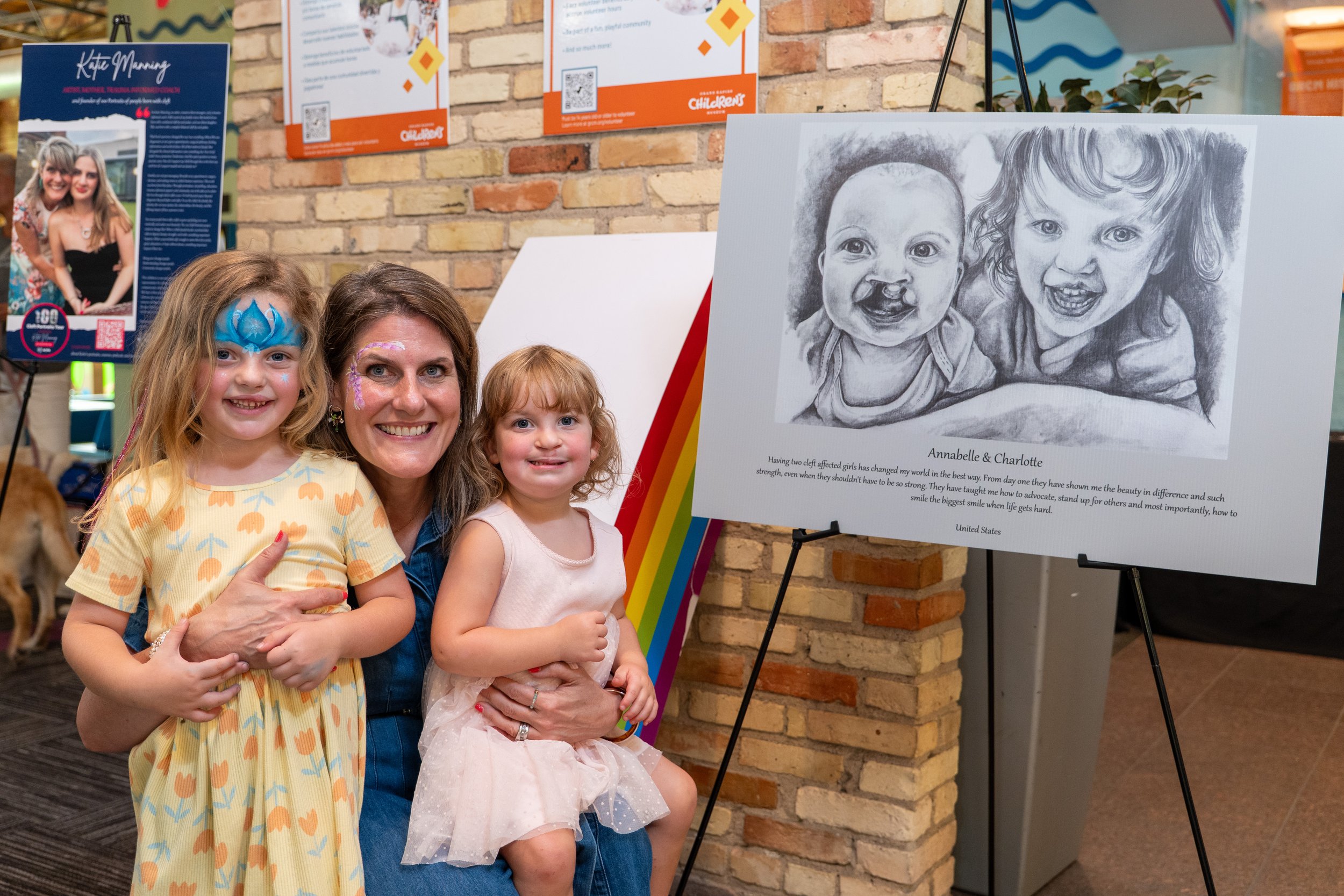
Katie Manning with Annabelle and Charlotte, two subjects in her portrait project.
“I feel seen.” Three small words, spoken without hesitation by a little girl called Mila as she stood among the portraits at Nemours Children’s Hospital in Orlando. I had asked her how she found the exhibition. Around us were portraits of children and adults who had been born with a cleft. Faces drawn and painted at different ages, from different countries, each carrying a completely different story. Mila didn’t need time to think about her answer. She spoke these words without hesitation. I have heard these words throughout this project, including from my own daughter, and they stop me every time. There is something incredibly powerful about taking something that may first enter a family’s life through diagnosis, uncertainty, surgery, fear and medical language, and placing it somewhere entirely different. On the wall of an art gallery, in a museum, across a hospital atrium. Not asking people to assess it, measure it, compare it or ‘fix’ it. Simply inviting them to look. To see the face, person, and their story. Standing there in Florida, thousands of miles from home and surrounded by families at every stage of the cleft journey, Mila’s words contained the whole reason I had started painting these portraits in the first place. But to explain why those words mattered so much, I need to go back almost twenty years.
A Diagnosis, and a World I Knew Nothing About
My daughter, Ella, was diagnosed with a bilateral cleft lip and palate during my 20-week pregnancy scan. At the time we were living in Singapore, and that diagnosis opened the door into a world I knew absolutely nothing about. Like many parents receiving a prenatal diagnosis, we were suddenly introduced to cleft through medicine. Appointments. Terminology. Surgery. Feeding. Outcomes. What would happen next and what the coming months and years could involve. And of course, that information matters enormously. Skilled surgeons, nurses, speech and language therapists, orthodontists and multidisciplinary cleft teams do need and extraordinary work. But cleft also lives outside the hospital. It exists in homes and classrooms, on playgrounds and family holidays. It sits inside identity, confidence, relationships, and photographs. It can influence how a parent sees their baby before they are even born and how a young person comes to understand their own face. And somewhere along the way, while navigating raising our daughter, I began to realize that there was an enormous part of the story we were not seeing enough of. The human part.
What Portraiture Taught Me
I had been an art teacher for many years before eventually leaving education during the COVID-19 pandemic. I had three small children and needed to focus closer to home. I began working on commission drawing dogs, houses and eventually children. Initially I had been apprehensive about drawing portraits; a portrait either represents someone, or it does not. One commission comes to mind as the turning point and my realization that I loved working with faces. I was asked to draw a friend’s child. I realized that portraiture taught me to slow down, to not assume I knew what I was looking at. To study the nuance of light, shape and texture in a face is to spend time with that person, their energy, their being. The tiny things that make their face unmistakably theirs. In 2021, two parts of my life, art and my lived experience as Ella’s mum came together. I retrained as a trauma coach, and I began creating what I had needed the day I received Ella’s diagnosis. A beautifully human representation of a baby drawn with a cleft. One which inspired hope, optimism, love, and strength. What if children born with a cleft could walk into a room and see faces like theirs displayed as art? What if parents receiving a diagnosis could see not only surgical diagrams and before-and-after photographs, but children, teenagers, and adults simply existing, smiling, serious, funny, beautiful, thoughtful, ordinary, and completely individual? What if representation could become part of the emotional landscape of cleft care? One portrait became another. Families began sharing photographs and stories with me. Some were people I already knew through the cleft community. Others lived thousands of miles away. Last year, all 100 portraits were exhibited together in London for the first time. This summer the 100 Cleft Portraits US Tour, presented by ACPA, has taken the collection into hospitals, museums, art spaces, and community venues across America. Every city has been completely different. And yet I keep witnessing the same thing.
People Recognize Themselves
At Nemours in Orlando, I met Avery, the recipient of a portrait we had chosen to gift during the event. She looked at it initially and then came the wonderful moment when she realized the girl in the picture was her. Her excitement was palpable. Her whole face changed. It was a moment of pure joy. In Winston-Salem, North Carolina, I met a little girl called Olivia. She spent a long time walking among the portraits, carefully studying the faces which looked like hers. Eventually she chose Abril’s portrait as her favorite. Abril lives in Spain. I know her mum and their family story has been part of this project for years. Olivia sat down and began drawing Abril. Two little girls living thousands of miles apart, connected for a moment through a piece of art. As I sent a photograph of Olivia in front of Abril’s portrait, her mum sent straight back a video of Abril saying hi to Olivia. Then there was Allie and Lizzie in Atlanta. I have known both of their mums online for several years, and both girls feature in the 100 Cleft Portraits collection. At the Atlanta event, they finally met. They hung out, made art, chatted. They were simply two girls spending time together. Without this exhibition, these two children may never have been in the same room. That is something I have begun to understand more deeply as the tour has unfolded. The portraits may bring people into the room. But what happens around them is connection. Families meet, children meet other children, parents exchange stories. Clinicians see families in a different environment and people create art together. Conversations happen that wouldn’t happen in a consulting room, and stories cross over. In Atlanta I was also able to present Diana with a pencil portrait of her two sons, now grown men, who were both there beside her. These moments are poignant. Cleft care tends, understandably, to focus heavily on childhood, yet children grow up and families grow around their experiences. Years pass. A portrait can hold all that time in one image.
Widening the Lens
Throughout the tour, I have also had the privilege of speaking with clinical teams and delivering trauma-informed workshops for parents. That part of my work has grown directly from my experience as a mother. Over the years I have trained as a trauma-informed coach and become increasingly interested in what happens emotionally and physiologically around a cleft diagnosis and throughout repeated medical procedures. It is all about widening the lens. A cleft diagnosis doesn’t happen only in a baby’s anatomy. It happens inside a family. Parents can experience fear, grief, guilt, uncertainty, and a profound loss of the future they had imagined. Babies and children experience repeated examinations, procedures, anesthetics, and interventions long before they have language with which to explain what is happening. Families are extraordinarily resilient. But resilience isn’t the same as being unaffected. In Orlando, the morning after the exhibition, I spoke at Grand Rounds to around 60 clinicians. Standing there as the mother of a young woman born with a bilateral cleft lip and palate, an artist, and a trauma-informed coach, I was very aware of the journey that had brought me into that room. A few years ago, I would never have imagined doing it and now I find myself increasingly interested in what becomes possible when we bring these worlds together. Medicine, art, lived experience, emotional wellbeing. They do not need to sit in separate boxes. In fact, some of the most powerful moments happen when they don’t.
This Belongs Here Too
One of the biggest lessons this project has taught me is that representation is not superficial. Seeing yourself matters. Social safety is health. Seeing people who resemble you living full, varied, ordinary lives matter. And perhaps particularly for children, seeing cleft as art carries a very different message from seeing cleft only within medical environments. One says: this needs treatment. The other can say: this belongs here too. Both truths can exist at once. A child can need surgery and still be whole. A family can be grateful for medical care and still need space to process fear or grief. Someone can feel proud of their face while also having difficult days. Cleft can be significant without becoming the entirety of someone’s identity. Human beings are allowed to be complicated. Perhaps that is what I hope these portraits make visible most. Our humanity. The tour has also changed me personally. When I began this work, I wanted my daughter to see herself as I saw her, simply beautiful. The work has shown me it is here to do more. I now understand that I was creating doorways into conversations I could not yet imagine. I have watched parents become emotional in front of faces. I have seen children hunt through the collection looking for someone who resembles them. I have watched adults born with a cleft stand quietly in front of portraits and tell me that they never had anything like this growing up. I have seen clinicians, artists, families, and children gather around the same images and each see something different. Art will always meet you wherever you are. I have become increasingly convinced that changing the story around facial difference does not always require enormous campaigns or complicated language. Sometimes change happens one person at a time. I don’t want children born with a cleft simply to become good at overcoming the idea that there is something wrong with them. I am interested in what might happen if fewer of them absorb that idea in the first place. What happens if, alongside excellent medical care, families encounter representation, connection and whole-person stories from the beginning? What happens if children grow up seeing faces like theirs in art? What happens if we become as curious about the person living the story as we are about the treatment of the cleft? I don’t think 100 portraits can answer all those questions. But they can begin a conversation. And, perhaps most importantly, they can remind us that every face we are looking at belongs to a whole human being. It was true when Ella entered our lives almost twenty years ago and changed my understanding of cleft completely. And it was true in Orlando when Mila looked around a room filled with faces that somehow reflected something of her own experience and gave me the simplest explanation of why this work matters.
“I feel seen.” My hope is that, wherever these portraits travel next, more people will too.
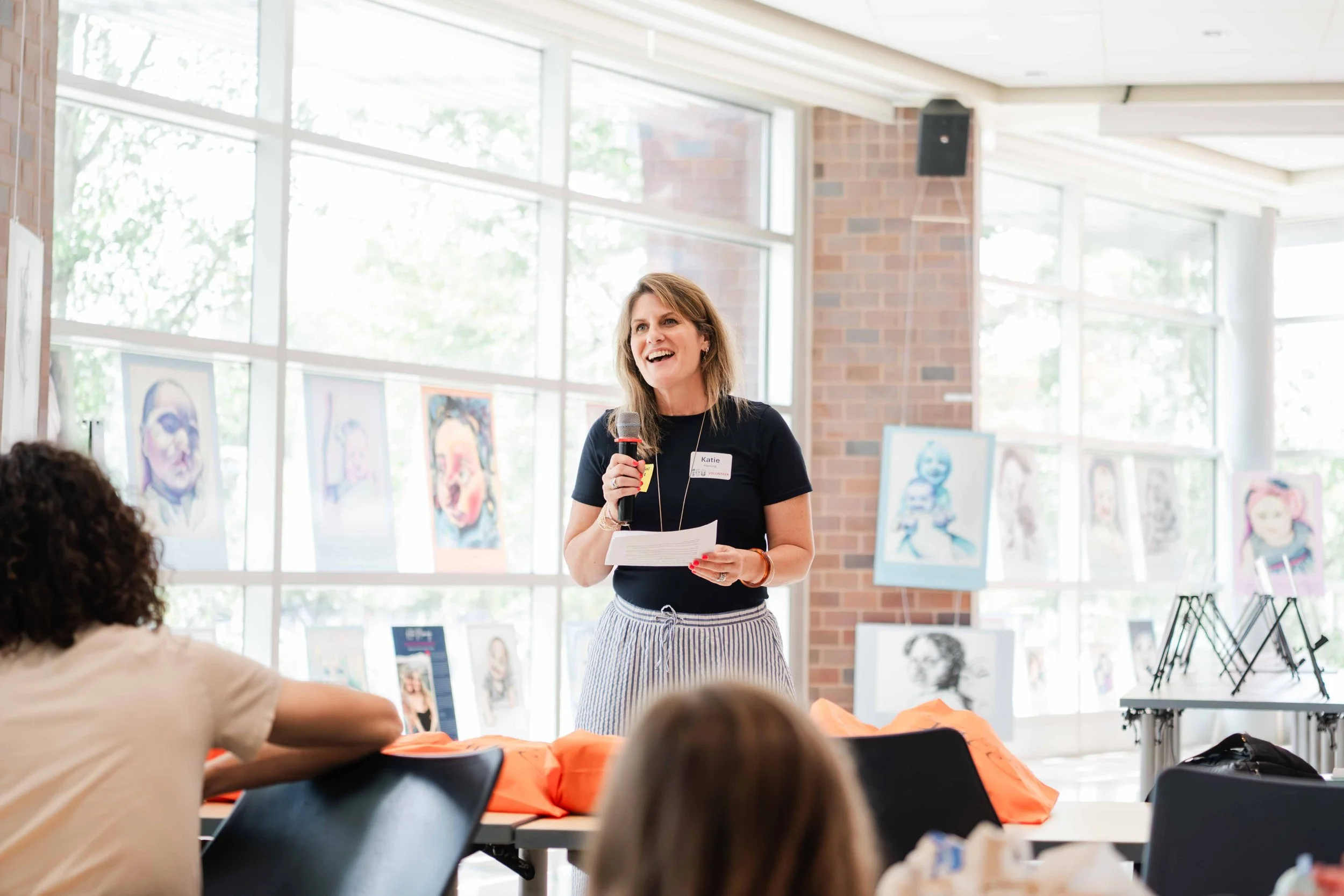
Katie Manning gives a presentation about her portrait project.
About the Author
Katie Manning is an artist and trauma-informed coach, and the creator of 100 Cleft Portraits — a collection of drawn and painted portraits of children and adults born with a cleft, which traveled twelve US cities this summer, presented by the American Cleft Palate Craniofacial Association. She is the mother of a young woman born with a bilateral cleft lip and palate. Here, she writes about what changes when a face leaves the clinic and enters the gallery.