
Not the Inspiration, the Architect
Bridge Between Two Worlds
By Rasheera Dopson, MPH, PhD(c)
Summary: Living with Goldenhar syndrome taught Dopson that acceptance often begins with finding people who truly understand your experience. After 105 surgeries, she found that community offered a kind of healing medical care alone could not. That sense of belonging grew into advocacy, leadership, and a commitment to ensuring people with facial differences are not merely represented, but included as decision-makers shaping the systems that affect their lives.
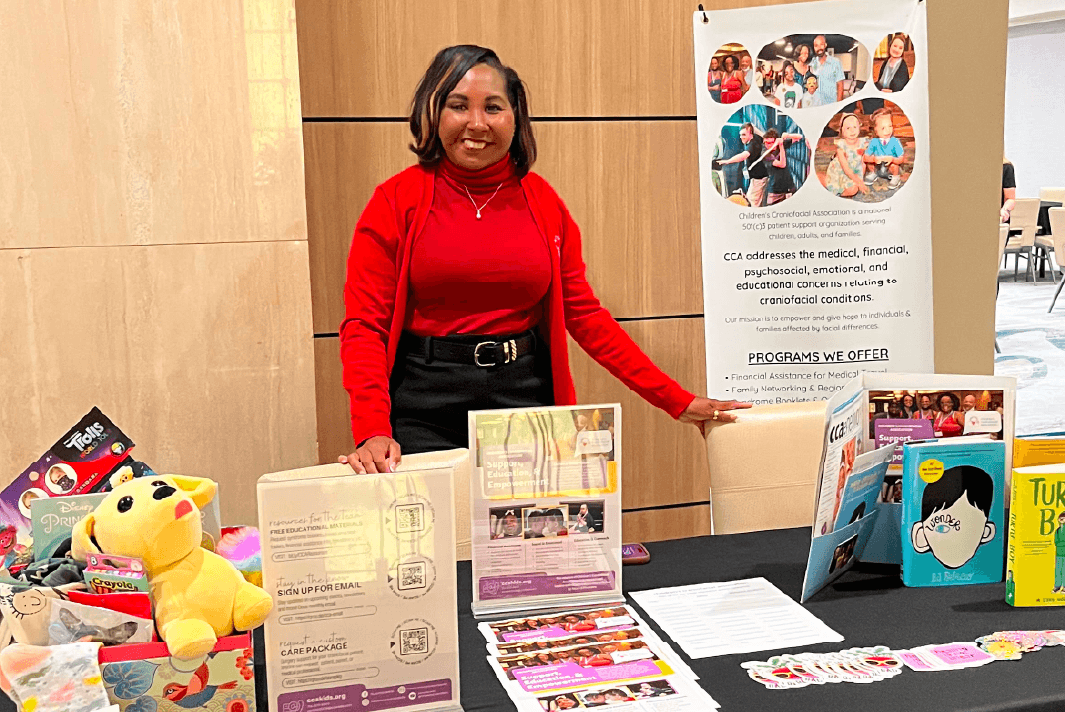
Rasheera Dopson mans an informational table at a conference.
In the month of September, here at the Children’s Craniofacial Association (CCA), we take the time to celebrate what it means to live in acceptance in a world that too often meets embodied differences and disabilities with indifference. I intentionally set out to stake my path of acceptance at the gateway of community, because I believe we come to accept who we are in the safety of community, or at least that’s how I found acceptance of myself, my disabilities, and my facial differences. It wasn’t until that ah-ha moment of first meeting someone else with Goldenhar syndrome or seeing a little toddler waddling around with no ears like mine, that quietly sent me a message that I wasn’t alone in this world. For me, these pivotal moments happened during Retreat. If I could take that feeling of belongingness, bottle it up and give it to my surgeon, show them this is what I needed more of: less surgeries, more connection, maybe my path wouldn’t have seemed so lonesome most days. The beautiful thing about community is that being among others like yourself, whether in spirit or appearance, has a way of healing the part of us that has felt at odds with the world. Before I ever knew organizations like this existed, where families meet at the intersection of mutual aid, education, and psychosocial support, I was just a little Black girl that people came to know with one ear and a crooked face. Most people didn’t care to hear my complete medical pathology. No, that was for doctors to unpack, deliver, and strategize. My role as the patient evolved into leader, and now, just a girl who uses her story to help others carry the burden and blessing of living with a craniofacial condition. My family stood by my side, my mom, my older sister, and brother, through all 105 surgeries, the doctors’ appointments, hospitalizations, cycles of sickness, long recovery, and the day-to-day upkeep of managing a chronic illness and disability. But they did not have to embody the weight of my scars, the psychological and physical pain, and the angst surgery brings, the wear and tear of it all on the body.
I did. I embodied it all for decades, and that alone is distinctive.
So, if you could imagine, the sigh of relief when sitting in a room of people who got it without question. People who understood my mother’s fears, exhaustion, and pride without question. Adults who could relate to my hidden traumas without question. To me, the arch of community rested in the heart of CCA and the broader craniofacial communities that continue to stride toward a more accepting future for those of us who fall at the margins of the world of disability and culture.
Where I Thought the Journey Would End
However, to my surprise, I thought my journey would end there. That all I needed was acceptance, community, and belonging. And for some, that is all they need, just a chance to feel and be seen, and to have that inner knowing that they belong. But as my mom poignantly points out, I was also destined for change, and to be honest, I’ve positioned my life not only to experience change but to be a change agent. So alongside integrating into an already existing community, I’ve spent the most recent years expanding into other facets of both the craniofacial and disability communities, searching for ways to build the bridge between the two. Most would assume that one necessitates the other, but as I discovered, micro-condition-specific communities are not always integrated into broader movements, because they develop their own momentum. And larger movements can unfortunately overlook the smaller conditions in exchange for bigger systemic impact. Both are necessary and equally valid. But both need to be touching each other, running alongside one another, creating a symbiosis of reciprocal exchange. This is an art that must be delicately crafted and prioritized. One of the ways I’ve been operationalizing this simultaneous movement is by introducing one to the other and embodying representation, whether through positionality or through translating expertise.
The Work Didn’t Start with a Title
This work of bridging didn’t start with a title. Before my role in joining the CCA staff as Program Director, I was already a partner across craniofacial and disability spaces, entrenched in grassroots disability advocacy, working alongside adults across the span of intellectual and developmental disability, and came to understand what disability rights were and where disability justice lay. I spent years working alongside disability rights initiatives, building representation at the community level, educating stakeholders, and empowering individuals to find their voice on the local and state level, having the boldness to share my testimony with state legislators and policymakers. I worked and volunteered countless hours, writing stories, reporting, and documenting, so when I stood in front of people who had decision-making power, I didn’t just have my own story to offer, but the community as evidence. That grassroots foundation is what carried me into academia. I triangulated that community-based knowledge into institutional knowledge, positioning myself to make the claim that people with disabilities are not separate from our healthcare system. Championing health equity became less about the numbers that show disparities and more about the people the disparities were reflecting. In my iteration of using community as evidence, I’ve employed a specific methodology of real-time experience, partnership, and collaboration to demonstrate nuance, complexity, and applied expertise, one that positions community and health populations right in the middle of organizational structure, all the way through programming and outreach. This is also the way I like to orient toward multi-level systems change. I live with both lived and professional expertise, a duality I use as leverage, and one that is not only unique but revolutionary in bringing about lasting change.
Not the Inspiration
Which is why, in closing this Craniofacial Acceptance Month, I don’t want to focus on the personal efficacy of living with a facial difference, because that is an individual experience everyone has to walk out themselves. I want to look at broader systemic change, the kind that takes us out of individual narratives of inspiration and into a network, an ecosystem run by and for people with facial differences. I’ve learned it’s not my job to be an inspiration. I challenge that narrative, and I believe the community needs to expand beyond it. But it is my job to lead, to help frame a more inclusive and accessible future. I think about the next generation of kids with facial differences, and the world they will come into and occupy. I don’t want them working alongside the system. I want them inside it, shaping it, building it, deciding what it becomes.
Not represented. Not accommodated.
In the room, at the table, on the org chart, in the room where the room gets decided.
Inclusion isn’t a seat we save for later. It’s a door we build now and hold open behind us.
About the Author
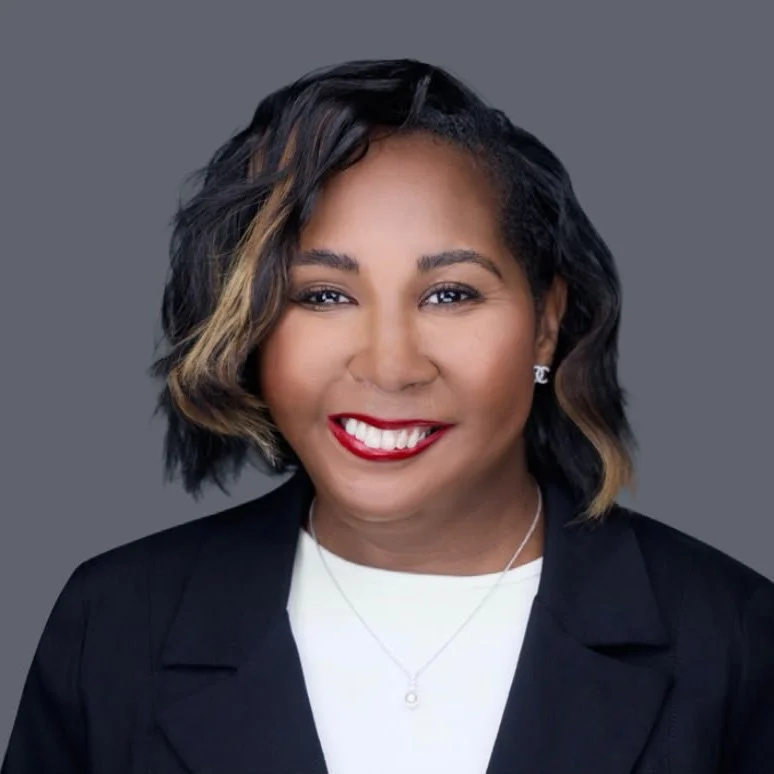
Rasheera Dopson is Program Director at the Children’s Craniofacial Association and lives with Goldenhar and VACTERL syndromes. In this piece, written for Craniofacial Acceptance Month, she traces the path from finding community to building the systems that hold it — and asks what happens when the next generation stops waiting for a seat at the table.