
When Flying Isn’t Enough
By Sora Kasuga
Summary: The author reflects on living with facial difference, the pressure to “fix” themselves, and the belief that achievement was necessary to belong. Through Disability Justice and connection with the Facial Difference community, they came to see lookism and ableism as systemic forces rather than personal failures. That shift led to greater self-acceptance, a return to performing, and the founding of The FaceOut Project, a grassroots collective focused on advocacy, community, and systemic change.
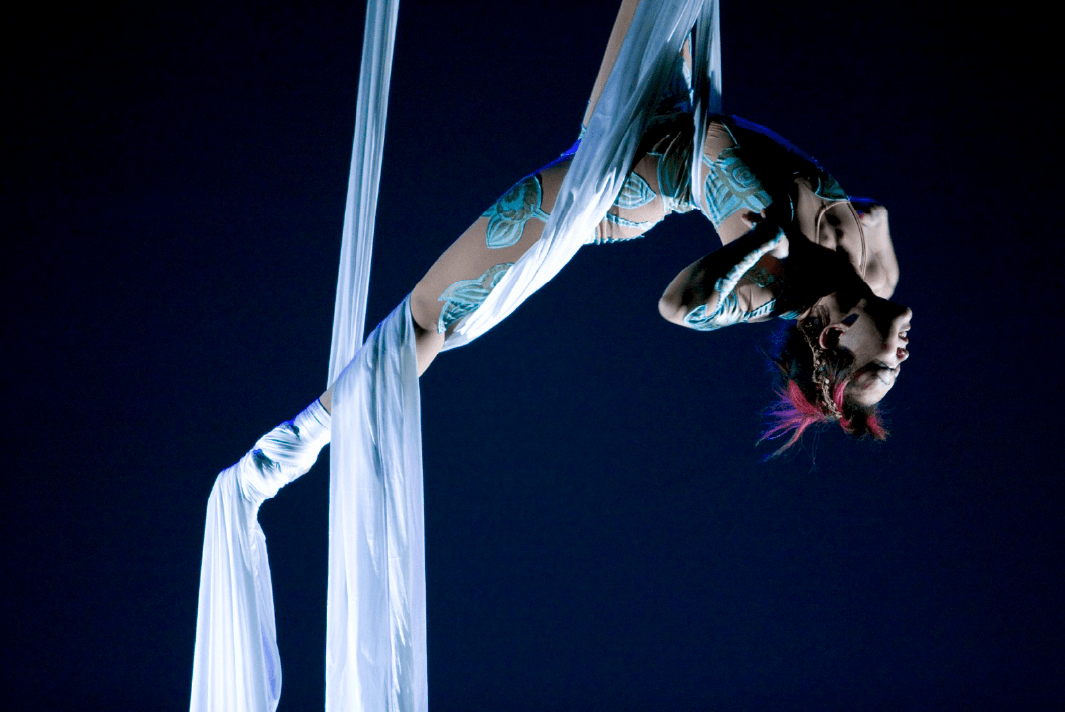
Sora Kasuga flying above her circus audience. Photo by Rose Marincil.
I walked into the packed hotel ballroom.
Chin up. Deep breath.
Today, I was at a networking event in my home city. If you’ve ever attended one of these functions, you might know that for most people, it’s a game of handshakes, name-dropping, and talking about one’s business with epic speed and without ever taking a breath. This was my living hell, but it seemed like a necessary evil if I wanted to get more local gigs. The night was a blur of person after person asking, “What do you do?” … to which I would answer with pride, “I’m a circus artist. I fly for a living.” To a typical person, I can see how it might be weird to take pride in being a circus performer. My Japanese American (JA) family expected me to be a doctor. My mom smiled supportively through her tears when I broke the news to her that I was changing my life path. She would often try to sneak money to me because she worried I was starving. But for me, becoming a professional entertainer meant I had made it. I was born with a facial difference (FD) on the left side of my face due to lymphatic malformations. I wasn’t meant to be on stage, on camera, or anywhere else that was highly visible. At least, that’s what society told me. But I loved performing so much. It became a game to get hired where I “didn’t belong”: in a circus as a showgirl…in a large casino nightclub as a go-go dancer…as a model for a renowned fine-arts photographer. Every time I landed a job, I felt like I had pulled off a heist. It was the greatest high. And then, to perform in front of hundreds or thousands of people and to believe they saw me as beautiful… and whole… and powerful… That brought me life. And yet every time, when the audience cleared, when I packed up my equipment, when the dazzling costume and carefully crafted makeup came off… deep down in unreachable places, I felt like a fake. A failure. Like I was going to be found out and exposed as the fraudster I was. There were two narratives, voiced loudly in my head, guiding my every move:
If you want to fit in, fix yourself.
Your value hinges on achieving greatness. You must overcome.
I had surgery after surgery as a child to make my face more symmetrical. To make me “normal.” I never knew there was another choice. Outside of the hospital, I harbored extreme mental health challenges due to never feeling like I was enough, though, by societal standards, I was actually seen as a “high achiever.”
Fix yourself. Achieve greatness.
These directives were with me at birth and powered me through my career before I decided I couldn’t do it anymore. All the years of trying to hide …or on the contrary, using my facial difference as “inspiration porn” to get accolades …or just feeling like I was cheating the system every time I walked onstage, instead of believing that I belonged there. ALL this culminated in a decision: I would end my career as a performer.
What I Found When I Went Looking
Years prior to quitting, I started getting curious about my Japanese American heritage, and I started connecting with the wider JA community online. Of course, this led me to discussions and research on the racist systems in our country that led to the unjust incarceration of my family in WWII, but also how those systems still, to this day, disproportionately oppress and dehumanize Black people. Every community of color is, in one way or another, connected by this same thread. We are all told to assimilate. To work harder, do better. To rise from the ashes. But what do you do when government, institutions, and the mass media are responsible for creating those ashes in the first place? My curiosity about my heritage led me to research other aspects of my identity: being pansexual, gender neutral, ASD and ADHD…and finally…having a facial difference, being Disabled. What I found was that having a facial difference had so many historical similarities not only to my personal history as a Japanese American, but to all other marginalized groups. People of color are instructed to approximate themselves as closely to whiteness as possible. As a facially different person, I’m told to fix myself, to overcome, to make myself simultaneously (and ironically) as non-disabled and remarkable as possible. When we comply, we’re rewarded. This narrative of personal achievement is used as a tool of oppression. It diverts attention away from the fact that systemic oppression, not personal competence, is to blame for the lack of integration and upward mobility of different groups. Across disability, race, gender, sexual orientation, socioeconomic and immigration status, the question is always the same:
If that person can do it, why can’t you?
The Voice I Couldn’t Hear
For most of my life, I listened to the undetectable, yet powerfully influential voice of Lookism: discrimination based on a person’s appearance. Lookism is baked into our society, and while its impacts have an outsized effect on members of the FD community, every person on the planet experiences its negative effects, even those who are considered traditionally “beautiful.” Lookism will always tell us to achieve more, to fix ourselves, that we are not enough. Lookism can determine everything from whether someone gets the job or not to whether a child is raised and nurtured or put up into foster care. Lookism creates the false narrative that physical appearance determines competence or morality. Lookism determines our value, our “social capital,” by how close we come to the Eurocentric ideal of beauty. Lookism creates an environment where violence and abuse are the norm, not the exception, in the FD experience. Lookism is deeply intertwined in every system on the planet…racism, ableism, sexism, anti-gay and anti-trans bigotry, povertyism, xenophobia. For most of my life, lookism and internalized ableism subconsciously made me believe my power lay in forcefully pushing away every non-conforming identity that made me a unique human. Before I knew what I know now, I grieved and raged, not understanding why I could never truly find belonging in the places I so wanted to be.
A New Gentleness
Over the years, I have been practicing a new gentleness that gives myself permission to understand my personal power in fresh ways, away from capitalist values and traditional tropes. This new approach was informed by the wisdom of the Disability Justice movement—created by disabled queer and trans people of color. I finally realized that I was never meant to be fixed. I shouldn’t have to mold my bodymind to conform to a capitalist ideal of what a “perfect” human should be. My bodymind is complicated on so many levels, and yet, that is the definition of what it means to be fully human. With this new perspective, I recently started working onstage again. I feel like an entirely new person. As Patty Berne, one of the founders of the Disability Justice movement and a beloved Disabled ancestor, said, “A Disability Justice framework understands that all bodies are unique and essential, that all bodies have strengths and needs that must be met. We know that we are powerful not despite the complexities of our bodies, but because of them.”
Finding Home
My journey led me to the wider Facial Difference community, and, just like finding other JA’s online, I felt like I had found a vibrant home I never knew existed. In 2024, I hosted the first meeting of The FaceOut Project. My vision was to gather a grassroots collective of FD activists dedicated to advancing equity for our community by empowering individuals and building community so that we can create meaningful, lasting, systemic change for people with FD. In doing this work, we would unite with all other marginalized movements in solidarity because as Maya Angelou wrote, “The truth is, no one of us can be free until everybody is free.” Yes. We are all in this together. Over the past two years, we have become quite the spirited community, indeed! We are creating a powerful movement of love and softening toward ourselves, where we are guided by our wisdom and the wisdom of our tenacious facially different ancestors, like Sandy Goodwick and David Roche, to reimagine the systems that continue to shut us out. We have regular monthly programming, including two Activism Hubs and a night dedicated to a Virtual Coffee House where we can get to know each other in a relaxed, informal environment. We know from our siblings in other movements before us: community is key to building momentum. In the movement toward equity for the Facial Difference community, we believe in creating strong relationships with others who are aligned in the work they are doing. We are grateful to be in community with fabulous organizations like Face Equality International and the Children’s Craniofacial Association, and we hope to create new relationships along the way.
You. Are. Enough.
Throughout history, we were taught to be ashamed, but now, we are learning to brandish hard-earned wisdom from the differences we bear with pride. We were taught to change ourselves to fit in. Now, we are learning how to transform exclusionary systems into a more inclusive and powerful humanity. We were taught “Achieve greatness!!” Now, we are learning to whisper to ourselves, “You. Are. Enough.”—and know with certainty that we are beautiful… and whole… and powerful… …not despite our differences, but because of them. We use this knowledge to fuel our fight to change the world. Not just for us, but alongside and for all movements.
About the Author
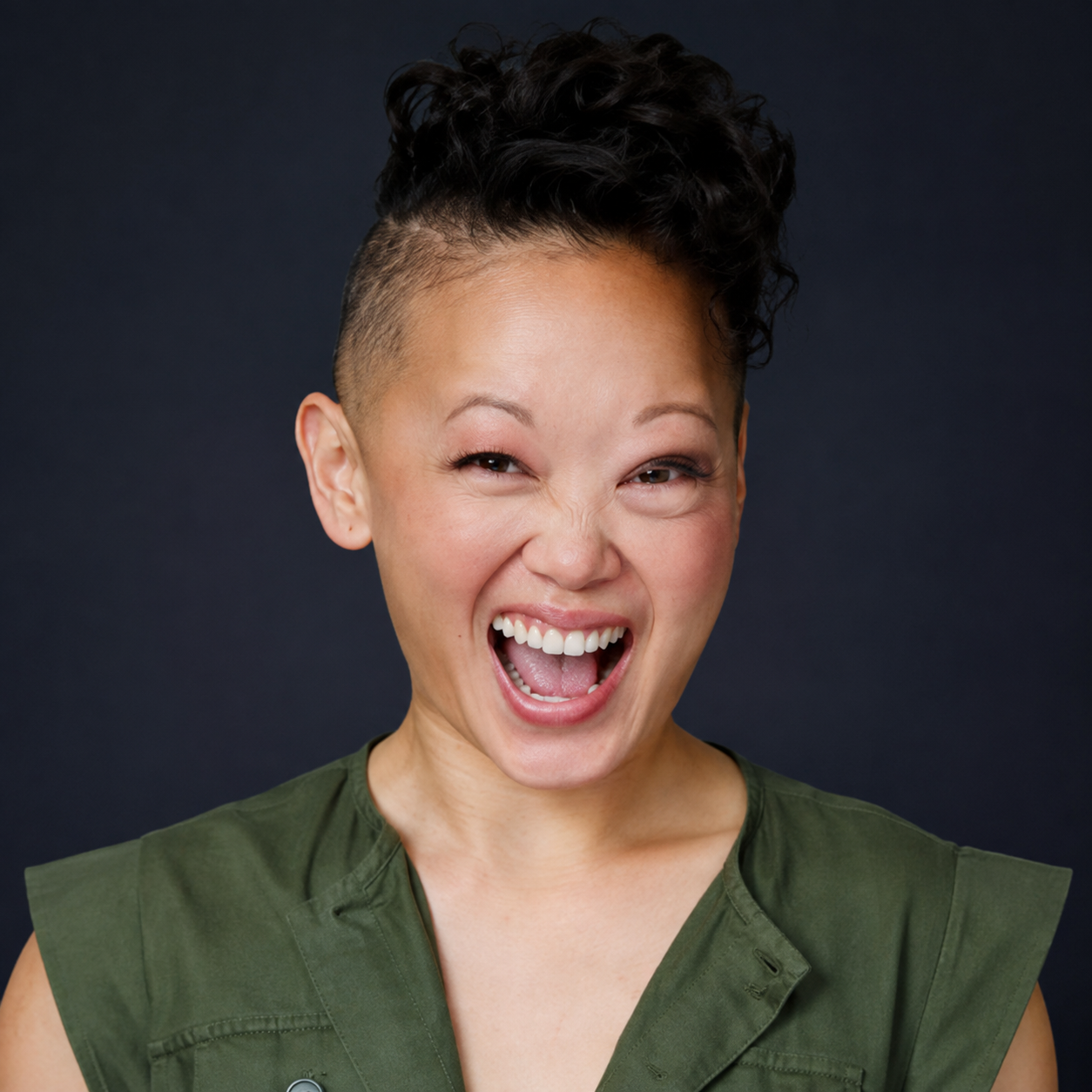
Sora Kasuga is a circus artist and the founder of The FaceOut Project, a grassroots collective of facial difference activists. Born with a facial difference caused by lymphatic malformations, they built a career being hired into rooms where, according to society, they did not belong – and then had to work out why that never once felt like belonging. Here: lookism, Disability Justice, and the long road from “fix yourself” to “you are enough.”