
Training for Inclusive Care
UCEDDs and LEND Programs Educate Students at Their Universities’ Health Schools About Disabilities
Miriam Edelman
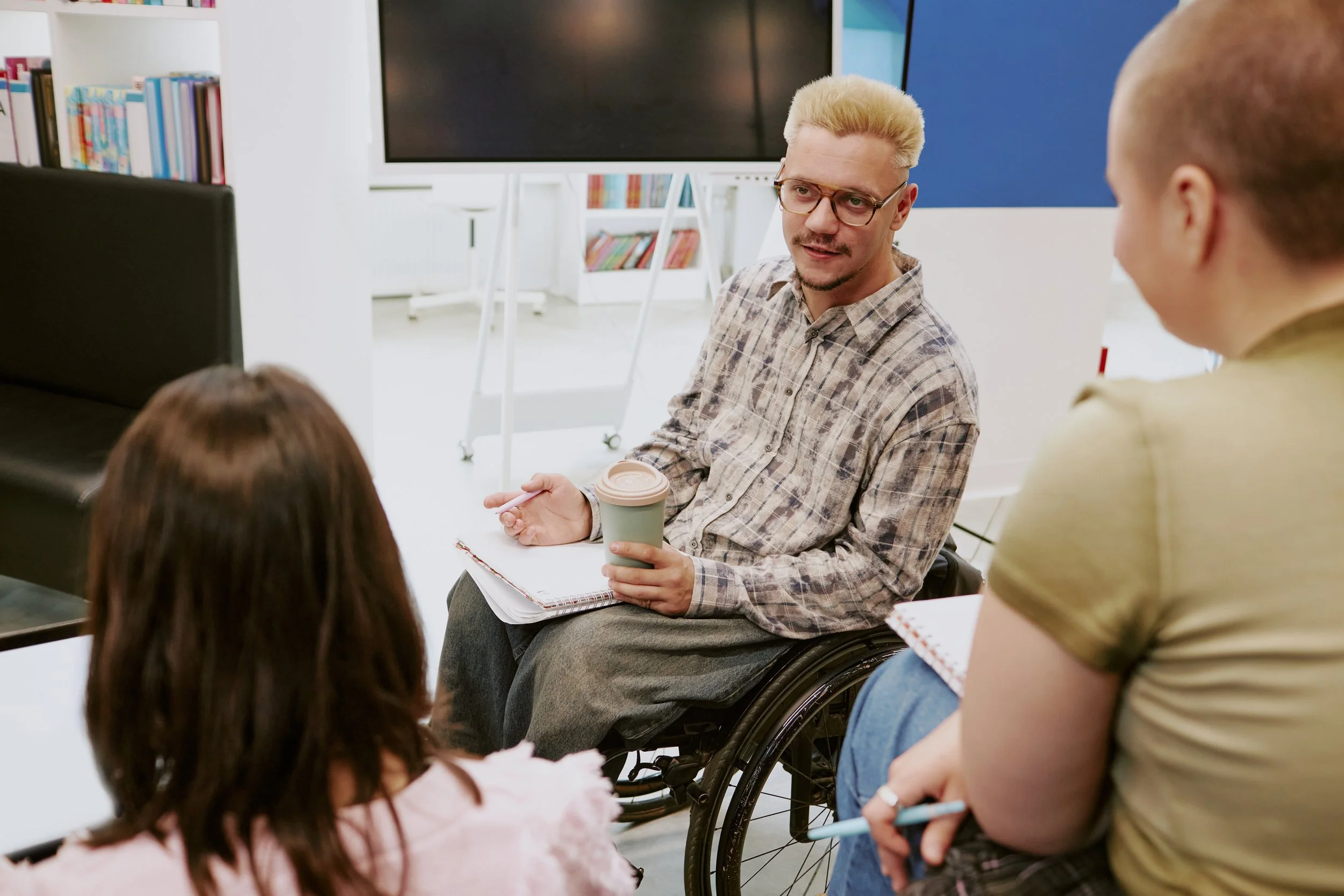
Some University Centers for Excellence in Developmental Disabilities (UCEDD) and Leadership Education in Neurodevelopmental and Related Disabilities (LEND) programs make meaningful contributions to curricula about disabilities. They use their expertise in disabilities, connections to people with disabilities, or both, to educate students at their universities’ health-related schools, such as medical schools.
UCEDDs collaborate with individuals with disabilities, their relatives, state and local government, and service providers on “projects that provide training, technical assistance, service, research, and information sharing, with a focus on building the capacity of communities to sustain all their residents.” There are sixty-eight UCEDDs nationwide, located in each state, the District of Columbia, and territories.
LEND programs, some of which are located in UCEDDs, train people from different professions, students, people with disabilities, and family members. Some individuals may fall under multiple categories. These programs seek to “improve the health of infants, children, and adolescents with disabilities.” There are 60 LEND programs nationwide, located in every state, the District of Columbia, and other jurisdictions.
At least some of the UCEDDs and LEND programs include people with disabilities in their curriculum/educational initiatives. It is critical that individuals with disabilities help train future clinicians. Children’s author and teacher MaryBeth Gahan, MS, said:
“It’s such a valuable undertaking to help medical professionals see disability from the perspective of individuals with disabilities ourselves. It’s helpful and crucial, I believe, for physicians and others to see that those with functional limitations are not perennial patients. Yes, from time to time we have needs and health concerns that require the expertise of those in the healthcare field. We also have dreams and heartaches and responsibilities and joys that may have very little to do with a diagnosis, functional limitation or impairment.”
Dr. Megan Morris, Project Lead for Patient Instructor Simulated Cases and Founder and Director of the Disability Equity Collaborative, said:
“For too long, people with disabilities have been excluded from shaping the healthcare they receive. Their engagement in training helps future clinicians see people with disabilities as people, rather than a diagnosis.”
Contributions of UCEDDs and LEND programs to health education are extremely important. A major cause of the heath disparities experienced by people with disabilities is the dearth of disability-related curriculum and training of health care students and professionals. For example, lack of training is a major cause of challenges that autistic people have with therapy.
Ohio State University
At the Ohio State University, the Nisonger Center, a UCEDD, trains Ohio State dental and dental hygiene students and postgraduate residents “through service” to people with intellectual and developmental disabilities. The Nisonger Center prides itself as “one of the only programs in the country to provide such exposure for all university dental health students as part of their training.”
Rutgers University
At Rutgers University, the Boggs Center on Disability and Human Development (Boggs Center), which is New Jersey’s UCEDD and part of the Department of Pediatrics at the Robert Wood Johnson Medical School, helps educate Rutgers medical students on disabilities. The Boggs Center co-coordinates the Seminar on Family Centered Care and Developmental Disabilities, a required part of third year medical students’ pediatric rotation. The course occurs eight times a year. Students visit the homes of families who have a child with a developmental disability. Visits are usually between two and three hours. Families typically host students two to four times a year and are compensated. Rutgers describes benefits of the visits:
“Students gain invaluable insight into aspects of health care that are challenging or complex and those that are remarkably family-centered; access to school and community-based supports; family dynamics; finances and so much more.”
The Boggs Center also coordinates the two-week elective for third- and fourth- year medical students, Healthcare for Children and Adults with Developmental Disabilities. The Boggs Center describes the course:
“Designed to increase students’ sensitivity to the complex and mult[i]-faceted nature of providing health care to [individuals] with developmental disabilities and their families, the course combine[s] experiential and didactic learning opportunities to expose students to a range of settings, contexts and providers. The elective is individually designed with each student to best align with their interests and meet their needs.”
University of Illinois-Chicago
At the University of Illinois-Chicago (UIC), the University Center for Excellence in Developmental Disabilities Education, Research and Service, Illinois’ UCEDD, partners on Advancing Disability-Inclusive Healthcare (ADIH). The university’s College of Medicine administers ADIH, which empowers “health professionals to provide exceptional care for individuals with disabilities through a curriculum for lifelong learning.” ADIH’s curriculum focuses on “Grounding disability in a holistic biopsychosocial model,” “Centering the perspectives of people with disabilities as the experts in their conditions,” “Adopting inclusive and universal learning strategies,” and “Integrating high-quality materials that have been developed by others.”
ADIH’s curriculum includes the Disability Medicine elective that can be taken by fourth-year UIC College of Medicine students. The elective fills in gaps by discussing important concepts, such as implicit bias and Americans with Disabilities Act (ADA) and Rehabilitation Act requirements. Reducing implicit and explicit bias in physicians regarding disabilities could improve healthcare for people with disabilities.
Content about the ADA is especially important. According to the article, entitled “US Physicians’ Knowledge About The Americans With Disabilities Act And Accommodation Of Patients With Disability” (2022),
“35.8 percent [of 714 practicing U.S. clinicians) reported knowing little or nothing about their legal responsibilities under the ADA, 71.2 percent answered incorrectly about who determines reasonable accommodations, 20.5 percent did not correctly identify who pays for these accommodations, and 68.4 felt that they were at risk for ADA lawsuits.”
Knowing ADA requirements may yield better heath care for individuals with disabilities.
University of Miami
At the University of Miami’s Miller School of Medicine, the LEND program and the Mailman Center, a UCEDD, collaborated to create a longitudinal four-year medical school curriculum regarding disabilities. People with disabilities co-created the curriculum, which consisted of required content, “elective modules, and extracurricular activities.” Required sessions focused on “interdisciplinary healthcare teams, implicit bias, health disparities, disability culture, shared decision-making, communication, and self-determination.” One elective is the LEND program. Through the Disability Awareness and Sensitivity in Healthcare, an extracurricular activity, students have helped create a “health passport” and a video on “healthcare provider best practices” regarding disability. Three of the authors of the journal article discussed their curriculum on a podcast episode, the transcript of which is on https://idrpp.usu.edu/research/episode-17-english.pdf. Students have described the impact of the disability curriculum.
Hannah Ship, et al described their work with LEND in their journal article, entitled “Disability Education in Medical Schools: A Paradigm Shift for Inclusive Care:”
“Furthermore, our institution is fortunate to have cultivated strong relationships with the local disability community through the LEND program at our institution’s child development center. Collaborating with LEND faculty not only enriches the curriculum with real-world insights and opportunities, but also establishes a foundation for ongoing engagement, bridging the gap between academics and the experiences of PWD. This is also important for the guardianship and updates of the curriculum as time progresses and language or insights may change. For institutions that may struggle with formally integrating a mandatory curriculum, partnerships through LEND and other university and community organizations are an essential starting point to formally connect with PWD and enrich the development and allyship of trainees. As one of 60 LEND programs in the nation, these elements can be duplicated at other medical schools (LEND, 2023).”
University of Michigan
At the University of Michigan, the Michigan Leadership Education in Neurodevelopmental and Related Disabilities program produced videos that are used in a two-week Disability Health Elective course. Third- and fourth-year medical students can take the class, which prepares them to “provide patient-centered care for patients who have disabilities.” The course also includes didactic sessions and non-health experiences in the community. Through community experiences, students can be more connected and understanding, traits that can enable them to provide the best care in the future. Students who complete the class earn a Michigan LEND Intermediate Trainee certificate.
University of Oklahoma
The Center for Learning and Leadership (CLL), Oklahoma’s UCEDD at the University of Oklahoma Health Sciences Center (OKHS), operates the Self-Advocates/Family Advocates as Medical Educators (SAME-FAME) program. This virtual simulation training educates OKHS and Oklahoma University health profession students about patients with intellectual and developmental disabilities, family caregivers, and relevant systems. The training is available to students in medicine, nursing, physician associate, social work, and other programs. As the CLL wrote, “[s]elf-advocates and family advocates are key in planning, presenting, and evaluating the program.”
Recommendations/Conclusions
Some UCEDDs and LEND programs are teaching students in health care fields about disabilities. Funding should be continued for this important and creative work, which will enable future clinicians to provide better care for their patients with disabilities. Other programs can be inspired to create and implement similar initiatives at their universities.
About the Author
Miriam Edelman, MPA, MSSW, is a Washington, D.C.–based policy professional and writer focused on disability issues, including autism. She holds degrees from Barnard College, Cornell University, and Columbia University, and serves on the DC Commission on Persons with Disabilities. Miriam is also a trainee in Georgetown University’s Leadership Education in Neurodevelopmental and Related Disabilities program and participates in a national initiative to strengthen disability-related healthcare education. She plans to continue her career in public service, with interests including disability, employment, health, and civic education.
References
Association of University Centers on Disabilities. (n.d.). “Directory Center List.”
https://www.aucd.org/directory-center-list?type=UCEDD
Association of University Centers on Disabilities. (n.d.). “Leadership Education in
Neurodevelopmental and Related Disabilities (LEND)” https://www.aucd.org/about-lends
Association of University Centers on Disabilities. (n.d.). “University Centers for Excellence in
Developmental Disabilities (UCEDD)”. https://www.aucd.org/about-ucedds
Bannister, E. (2025). “SAME/FAME: Highlighting Voices of Lived Experience in Healthcare
Education.” Helen The Journal of Human Exceptionality. https://helenjournal.org/september-
2025/samefame-highlighting-voices-of-lived-experience-in-healthcare-education
Center for Learning and Leadership. (n.d.). “About the Center for Learning for Leadership (CLL
| UCEDD).” https://ouhsc.edu/thecenter/About-Us
Center for Learning and Leadership. (n.d.). “Self-Advocates/Family Advocates as Medical
Educators (SAME-FAME).” https://ouhsc.edu/thecenter/Projects/Training-and-
Collaboration/SAME-FAME
Ddnj. (2025). “Ep. 17 Disability Education in Medical Schools.”
https://ddnjauthorinsights.podbean.com/e/ep-17-disability-education-in-medical-schools/
Disability Equity Collaborative. (n.d.). “Disability Equity Collaborative.”
https://www.disabilityequitycollaborative.org/
Edelman M. (2026). “Why Therapy May Not Always Help Autistic People: Part 1.” Social Work
Today. https://www.socialworktoday.com/archive/exc_040726.shtml
5
Iezzoni, L, Rao S R, Ressalam S, Bolcic-Jankovic D, Agaronnik N D, Lagu T, Pendo E,
Campbell E G. (2022). “US Physicians’ Knowledge About The Americans With Disabilities Act
And Accommodation Of Patients With Disability.” Health Affairs. 41(1). Doi:
https://doi.org/10.1377/hlthaff.2021.011
Jefferson Health. (n.d.). “Lack of Provider Training Creates Healthcare Barriers for Individuals
with Intellectual or Developmental Disabilities.” https://www.jeffersonhealth.org/about-
us/news/2023/04/lack-of-provider-training-creates-healthcare-barriers
Krahn G L, Walker D K, Correa-De-Araujo R. (2015). “Persons With Disabilities as an
Unrecognized Health Disparity Population.” Am J Public Health. 105(Suppl 2). Doi:
10.2105/AJPH.2014.302182
LinkedIn. (n.d.). “Megan Morris.” https://www.linkedin.com/in/megan-morris-43303315/
The Ohio State University Nisonger Center. (n.d.). “Dental Services.”
https://nisonger.osu.edu/adolescent/adolescent-clinics-services/dental-program/
Rutgers Health The Boggs Center on Disability and Human Development Robert Wood Johnson
Medical School. (n.d.). “About The Center.” https://boggscenter.rwjms.rutgers.edu/about-the-
center/overview
Rutgers Health The Boggs Center on Disability and Human Development Robert Wood Johnson
Medical School. (n.d.). “Academic Experiences.”
https://boggscenter.rwjms.rutgers.edu/academic-experiences/medical-student-education
Rutgers Health The Boggs Center on Disability and Human Development Robert Wood Johnson
Medical School. (n.d.). “ Do you have a child with a developmental disability and an interest in
providing a unique educational experience for medical students?.”
https://boggscenter.rwjms.rutgers.edu/documents/BOGGS/StudentExperiences/HostFamilyFlyer
_FCCDDSeminar.pdf
Rutgers Health The Boggs Center on Disability and Human Development Robert Wood Johnson
Medical School. (2025). “The Boggs Center Seeks Host Families to Share Experiences with
Medical Students.” https://boggscenter.rwjms.rutgers.edu/news/the-boggs-center-seeks-host-
families-to-share-experiences-with-medical-students-2025
Ship H, Shankar S, Baer R, Brosco J, Arana A. (2024). “Disability Education in Medical
Schools: A Paradigm Shift for Inclusive Care.” Developmental Disabilities Network Journal.
4(2). https://digitalcommons.usu.edu/cgi/viewcontent.cgi?article=1104&context=ddnj
University of Illinois Chicago. (n.d.). “Advancing Disability-Inclusive Healthcare (ADIH).”
https://adih.uic.edu/
6
University of Illinois Chicago. (n.d.). “Institute on Disability and Human Development.”
https://idhd.ahs.uic.edu/
University of Michigan Medical School. (n.d.). “MD Program Years 3 & 4.”
https://medschool.umich.edu/programs-admissions/md-program/md-curriculum/md-program-
years-3-4
University of Michigan Medical School. (n.d.). “We’re Changing the Future of Medicine. Join
Us.” https://medschool.umich.edu/
VanPumbrouck L, Friedman C, Feldner H. (2020). “Explicit and Implicit Disability Attitudes of
Healthcare Providers.” Rehabilitation Psychology. 65(2). Doi:
http://dx.doi.org/10.1037/rep0000317
Zondlak, A. (2021). “The Disability Health Elective: Equipping Med Students for Patient-
Centered Care.” University of Michigan Medical School. https://medschool.umich.edu/dose-
reality/disability-health-elective-equipping-med-students-patient-centered-care