
Navigating the Journey
Activating Collaborative Mindsets as a Beginning Special Education Teacher
Angela Shaw

Across the country, new special education teachers are embarking upon an exciting new adventure in support of students with special needs. With the promise of their newly acquired education set in motion, they are in for an exciting and life-changing journey. The collaborative teaching experiences of today and tomorrow hold the power to inspire and build resilience within themselves and others. In the dawn of their career, as they discover their strengths and successfully adapt to challenges, their wisdom will grow and their effectiveness will widen across generations of students, families, and colleagues.
Three overlapping mindsets, supported by research, are key to achieving greater results for students and the teams that support them. Cultivation of these viewpoints lays a solid foundation as a teacher and a lifelong learner. Moving synergistically, by exchanging knowledge, sharing skills, and combining strengths, builds a team dynamic equipped to ensure beneficial access to learning for all. Read on to discover how boosting mindsets that favor collaborative perspectives, solution-focus and proactive thinking benefit students and the educational caregivers who support them.
“Alone we can do so little: together we can do so much.”
Collaborative Perspective:
The educational landscape is more collaborative than ever. Sparked initially by 20th century special education legislation, known today as Individuals with Disabilities Education Act (IDEA), the collaborative spirit of today offers a highly invigorating climate for inclusive success socially and academically for our students. The outcome of 1975 regulations that were initially intended to provide students identified with special needs access to free appropriate public education (FAPE) in the least restrictive environment (LRE) opens the classroom door and beyond. With advances in research and much more inclusive practices, brought forth through these principles, the outcome of cooperative work has become the norm across university and public-school campuses.
With the true compass of least restrictive environment (LRE) bound with free appropriate public education (FAPE), special education principles, central to IDEA, coexist within the realm of today’s general education classrooms in methodology, practice, and mindfulness. The expertise and specialized knowledge provided by general educators, special educators, school counselors, administrators, and related service providers generates a snowball effect of consultation and collaboration. This benefits all settings and students. With the proverbial welcome mat into the general education class rolled out, possibilities for students with special needs abound. Special education teams are gaining a first-hand perspective relative to the realistic expectation of the general education classroom experience. IEP teams are better able to customize inclusive plans with balance, alignment and scaffolding appropriate to the needs of students identified with special needs. Inclusive thinking, sharing strengths and learning together to navigate areas of challenge builds a bridge to campus-wide and home partnership.
With special education and general education settings intersecting through collaborative and consultative processes, all team members share their voice, ideas, and expertise. Low-tech and no-tech tools, traditional to special education settings, are an effective and research-based approach for scaffolding students with unique needs within the most appropriate LRE. Tailoring these collaborative tools to student needs offers a wide range of actionable strategies for everyone. As a proactive team member when introducing a new scaffolding tool or approach to collaborative partners, providing a quick over-view, digitally or in real-time, serves to strengthen understanding for solid implementation and builds the skills associated with solution-focus. The time investment is a vital component for all collaborative partners. Opportunities abound for all educational caregivers, as they gain insight into the strategies and situation through discussion and feedback. These invaluable conversations allow for a deeper focus and appropriate implementation based upon student need. Providing beneficial access for students, by meeting them where they are at with an eye toward moving them forward and guiding them toward participation, learning, and growing is an essential inclusive practice. Check out the launchpad of ideas below to begin delivering universal scaffolds that are proven to seamlessly fit into general and special education classrooms:
Collaboration Tool # 1

Visual timer: Monitoring and understanding time becomes a breeze when students can see it pass on a countdown timer. No need to know how to read a clock, this low-tech assistive technology (AT) tool is a great visual to support students with managing the abstract notion of time. It is a way to ease their anxiety, as they triumphantly overcome the challenges of executive function. The timer even has a gentle auditory cue available when the visual sequence is over. Using a visual provides boundless opportunities for success individually, with small groups or entire classrooms. Teachers within the general education settings will gain a proactive classroom management tool, as students with and without special needs learn to navigate tasks and time. Implementation of this powerful visual scaffold within the classroom creates a potential for:
Calmer transitions.
Greater focus and engagement.
Improving time management.
Building internalization of time.
Increasing task completion.
Gaining understanding of procedural steps.
Celebrating success.
After introducing the visual timer to student(s) as a tool to keep track of how much time they have left for a few activities, just find a space to set it where a student or students can see it at a glance. As the timer is set throughout the day for various tasks and transitions, some students may find it so helpful that they request it for a widening variety of tasks. Others may find they need it less and less.
Collaboration Tool #2

Auditory Button: Oftentimes, teachers may place small labels or visual schedules around the classroom to spark and support learning. Visual supports are an effective and research-based tool. In addition to scaffolding access and skill-building, visual supports assist with internalizing new procedures and increasing memory. For a student who is not yet reading, has low vision or does not yet comprehend symbols, visual scaffolds of this sort may need an extra layer of support. By adding an auditory button, as an option for accessing the posted sign, students with and without special needs
have a better foothold on the path of learning. With an additional modality to support understanding and memory, at the push of a button, access to learning is within their reach. Beneficial modalities that this auditory scaffold offers include:
Chunking strategies
Auditory supports
Visual supports
Kinesthetic supports
Tactile supports
Collaboration Tool #3
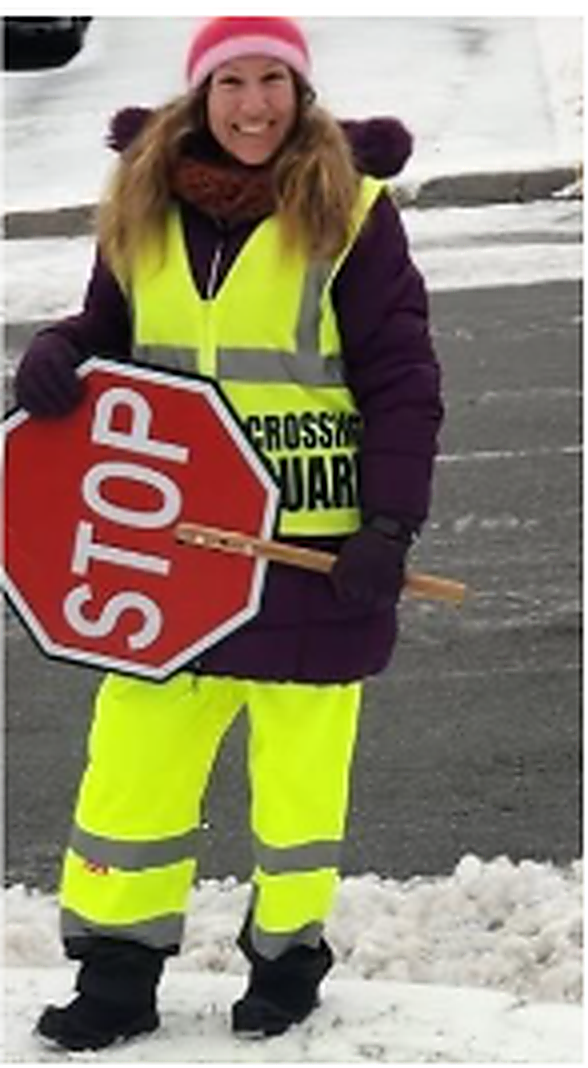
Two-pocket Data Collection: Research supports data collection and analysis as a beneficial collaborative tool. Data sharing can answer so many questions about how a student responds to their environment and, perhaps, even why they respond in such a manner. One of the biggest hurdles to collecting data in the natural setting, unfortunately, is because the process can be cumbersome. For general education teachers, librarians, or other school personnel, it can be an overwhelming task. Removing the hurdles to data collection can create meaningful collaborative conversations and solution-based answers. Benefits are far-reaching and can support students with and without special needs. Below is a streamlined approach to data collection for you or your collaborative partners.
READY:
Jot it down on your chart:
Name of student.
Date of collection.
Time and setting of collection.
Targeted behavior for observation.
SET:
Gear up:
Strap on a two-pocket sweater or apron.
Fill the pocket of your dominant hand with counters, such as a handful of small stones, buttons, or paperclips.
Set your visual timer, so that you can see it, for the time frame you will be collecting data.
GO!
Collect your data:
Move one counter to your other pocket, each time targeted behavior occurs.
Discontinue counting, once the visual timer stops.
List number of times behavior occurred, once the teaching segment is over.
Review or provide data with collaborative partners, in an agreed upon manner (i.e.: email, text, meeting, etc.).

A tie-on restaurant-style waist apron offers a versatile no-tech tool for collaborative partners. I like to call them teacher toolbelts. They offer busy school staff:
A sturdy design.
Two good-sized pockets.
Hands-free and one-handed convenience.
Long apron strings to adjust to various waist sizes.
Keeping a few of these “teacher toolbelts” on-hand for quick accessibility makes data-collection a convenient task for you and your collaborative partners. You can even add a dash of fun by embellishing it with customized iron-on patches.
“Don’t find fault, find a remedy.”
Solution Focus
Propelling the team beyond the problem and into the solution puts the focus upon actionable steps and builds upon strengths to enhance an engaging and effective collaborative process. Teams prioritize productive, creative, and positive plans in their quest to find a solution, seek answers to questions, and follow the path to remedies. Rather than getting stuck in the quagmire of dwelling on a problem and running the risk of spiraling into a complaint session, teams with a solution-focus approach utilize open communication, engagement, and positivity to discover strengths for scaffolding success. The very nature of staying on the course with a focal point of tracking progress over perfection, maintains the momentum of forward thinking. Additionally, chunking goals into small manageable tasks and celebrating small wins provides a momentum for cultivating effort and an enduring enthusiasm for learning.
Being mindful of a mindset moving you out of the problem and into a solution has far-reaching benefits in situations across the learning community. Support effective team motion by systemizing the process in actionable steps:
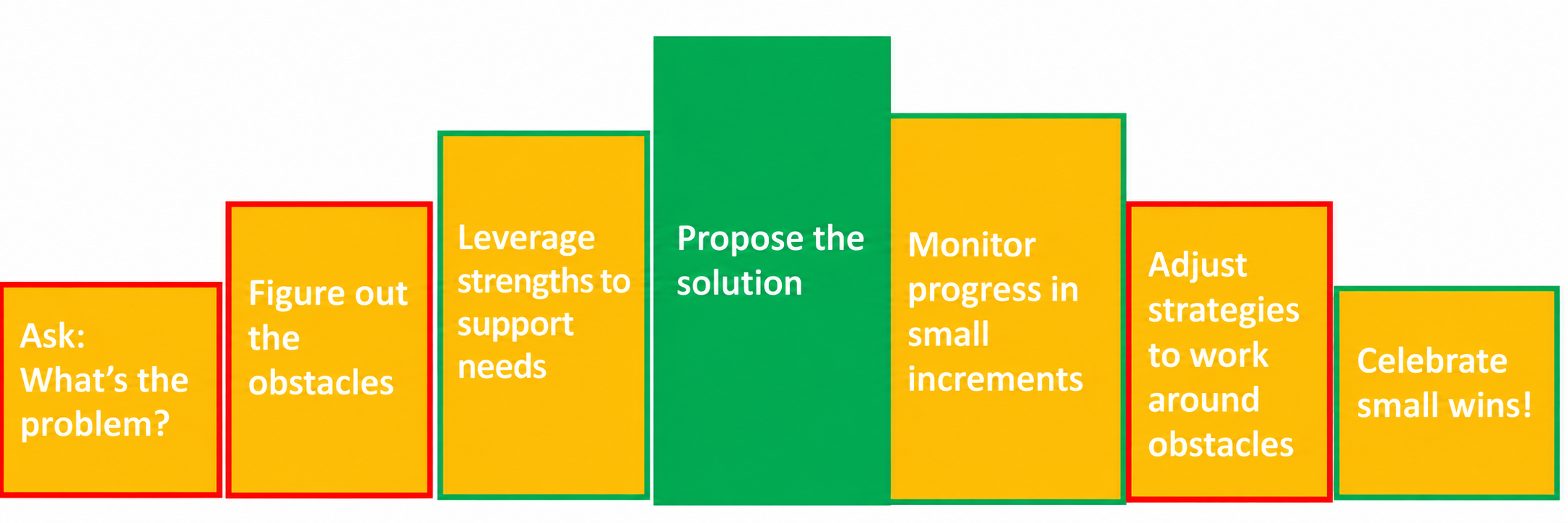
Using a dynamic discovery format, similar to the model above, is a great way for teams to
investigate and move toward solutions. Interacting beyond the proposed solution supports forward momentum and continuing next steps.
“You cannot escape the responsibility of tomorrow by evading it today.”
Proactive Thinking:
A shift to a proactive thinking style pairs well with a solution-focused approach. Although similar, with both approaches demonstrating positive and forward-thinking styles, solution-focused strategies creatively work toward a resolution for an existing hurdle compared to a proactive focus that has a preventative vibe. Rather than reacting as a problem arises, proactive thinkers take positive forward action. They anticipate possible challenges, planning adjustments and preparing contingency plans, if need arises. Proactive thinkers are ready, willing, and able to positively handle challenges when they arise.
Adopting a mindset, moving away from an impulsive reactive state or a passive procrastination state, toward calm strategic planning creates actionable possibilities in anticipation of challenges or obstacles. Teachers often report that planning and scheduling are one of the most difficult tasks relative to bringing an IEP team together. With timelines looming as a threat to compliance, Special Education teachers are ahead of the game with proactive strategies in place for this task. Try moving your plan book onto an interactive planning board. Synthesizing an overview of planning strategies and checklists, onto an auxiliary board, while moving closer to meeting date, ensures tasks follow a timely and compliant pathway. Meetings remain on calendars, but emerging plans and checklists are progressing in real time. Utilize previous and proactive contact with parents about best times/days for meeting. Set up a tentative time with a school-based team. Contact parents to confirm their availability once the school team confirms. In the case of parent non-availability, revisit scheduling. Taking this forward action will maintain compliance with timelines and keep your program running smoothly.
Tips for Building and Interacting with your Board:
Use a 4’x4’ erasable whiteboard.
Keep in a confidential space. If one is not available, use predetermined codes in lieu of student names (i.e., identifying #s you list in your grade book).
Premark it with a permanent marker. Create the grid in black. Write the headings and the words “Due by:” in permanent ink of an alternate color (see green and red notations on model).
For easy erasure and reuse, complete the remainder of your board with a dry-erase pen.
Circle confirmations.
Checkmark completion of testing.
After confirmation with the parent, follow up with other team members with confirmation and/or possible alternative date.
Conclusion:
Build access to learning in small individual steps. Just like the workers on Henry Ford’s assembly line, each education specialist has their own part of ensuring learning. Encountering the different perspectives and sharing your own part proactively reinforces collaborative strategies, as you update, modify and adjust with a solution-focus. Combining the mindset shifts within this article with a growing inventory of practical strategies, as you navigate the first years and beyond, provides an experience paved with resilience, purpose, and joy.
About the Author

Angela Shaw is a retired special educator with dual Master’s degrees in special education and school counseling. She writes about special education topics. With over 25 years in public education, Angela synthesizes her broad range of teaching experiences and educational background to support families and educators as they navigate the diverse learning needs of children in their care across a changing educational landscape.