
From Our Friends
We are happy to share news from our partner organizations because, as Helen Keller once said, “Alone we can do so little; Together we can do so much.”
A Message from Theo Braddy: Ordinary People!
Theo W. Braddy, Executive Director of the National Council on Independent Living
I have wanted to write something on this particular topic for a while now.
It is a point I have briefly talked about before, but I want to address it in more detail. It is about something society often does with movements.
We lift up a few well-known leaders and place them on the front pages of history. The Independent Living Movement is no different.
In my own writings, I often lift up the names some of these leaders. Names like Ed Roberts, Judy Heumann, Justin Dart Jr., Marca Bristo, and Wade Blank, to name just a few.
These well-known leaders helped shape and lead the IL movement. Their courage, leadership, and vision changed lives and opened doors for millions of people with disabilities.
Their stories deserve to be remembered.
But they were not alone.
Behind every well-known leader were thousands of people doing the hard work every single day. People whose names may never appear in books or documentaries, but who helped build this movement from the ground up.
They were the advocates and organizers. They were peer counselors. They were staff of Independent Living Centers. They ran Statewide Independent Living Councils. Many were parents and community leaders. Many were just everyday, ordinary people who refused to give up.
I remember these ordinary people. I remember some of their faces, though many of their names have faded away and I can no longer recall them.
I attended meetings with them, often after work, as we planned and organized late into the evening.
I remember!
We fought for ramps and curb cuts.
We challenged discrimination.
We pushed for transportation access.
We helped people move out of nursing homes and back into their communities.
We fought for the simple idea that people with disabilities deserve the same freedom, dignity, and choices as everyone else.
They were the army of soldiers behind the IL movement.
I remember seeing one of these soldiers, a quadriplegic, throw himself out of his motorized wheelchair onto the pavement to block the passing of an inaccessible Greyhound bus during a protest.
He was part of this army. I have forgotten his name, but I have never forgotten what he stood for.
An army of unsung heroes.
And the truth is, we need that army now more than ever.
We are living in a time when many of the gains our movement fought for are under pressure, are under attack.
We see threats to community living, Medicaid, accessibility, and disability rights protections.
We see efforts to roll back progress little by little.
We see ableism still deeply rooted in systems that too often underestimate the value and potential of disabled people.
This is not the time to sit on the sidelines.
This is the time for people to step up again.
Not just nationally known leaders.
Not just executive directors or policy experts.
But everyday ordinary people throughout the Independent Living Movement and disability community.
We need people willing to advocate, willing to organize, willing to mentor, willing to speak up, and willing to fight for the next generation.
Because movements are not sustained by a few famous names alone.
Movements survive because ordinary people decide they are not willing to quit.
Their names may never appear in the history books.
Many of their stories and even yours may never be told.
But they were and you still will be ordinary people doing extra-ordinary things.
Thank you for being ordinary.
This is Theo W. Braddy, executive director for the National Council on Independent Living. Until we meet again. Bye-bye now.
Theo Braddy
Executive Director
National Council on Independent Living
About NCIL
NCIL is the longest-running national cross-disability grassroots organization, driven by and dedicated to people with disabilities. Since its founding in 1982, NCIL has represented thousands of organizations and individuals, advocating tirelessly for the human and civil rights of people with disabilities across the United States.
Disability: Ten Tenets of a Disability-Affirming Practice
Mbita Mbao, PhD, LICSW, and Elspeth Slayter, MSW, MA, PhD
Moving From a Focus on Disability Access and Inclusion to a Disability-Affirming Practice Framework
Twenty-seven percent of adults in the United States are members of the disability communities,1 with 40% aged 65 and older2—a fact about which social workers are often unaware, despite their involvement in this service sector. Given the high prevalence of disability, the status of these communities remains an area of concern for social workers who want to engage with this stigmatized and oppressed population in a respectful and empowering manner.3
Although concerns about ableism and sanism in the social work realm have been well-documented for decades, social workers most often focus on disability access and inclusion in response to policy mandates. While disability access and inclusion are foundational requirements for social work practice with the disability communities, there’s a call for a move toward what’s known as disability-affirming practice.4,5
Comparing disability access and inclusion to disability-affirming practice is akin to moving from a focus on diversity to a focus on equity, knowing that we need both. When one thinks of disability access and inclusion, the focus is on what the legal requirements are for creating an accessible practice or workplace. Our focus is also on how to carefully and thoughtfully implement laws like the Americans with Disabilities Act of 1990.6 But taking an inclusion and access frame alone, we miss an opportunity to address the widespread ableism and sanism present in both social work and in the world‚ not to mention the ways that these “isms” can become internalized among members of the disability communities.
The disability communities are more likely to experience mental health challenges as a result of societal barriers, cultural stigmas, and internalized ableism or sanism. Therapist Cat Maness7 notes that these communities are likely to have experienced disability-related trauma or stress, including discrimination, access barriers, and either mental or physical pain. It’s essential for social workers to provide accessible disability-affirming therapy for these individuals by incorporating disability-affirming approaches into treatment that ideally can improve outcomes and promote overall wellbeing. Disabled social workers recommend incorporating intersectional, antioppressive, and “critically culturally competent” practices.8
What Is Disability-Affirming Practice?
This framework is focused on creating safe, healing, and validating environments in the context of social work practices that lift up the perspectives, wisdom, creativity, and experiences of various disability communities.
Building on existing commentaries about disability-affirming therapy, we propose the following tenets of an intersectional disability-affirming practice:
It’s vital to acknowledge as well as confront experiences of ableism and sanism in the lives of clients from the disability communities by listening to and validating those experiences. This may involve confronting attitudes that may reflect ableism or sanism, such as the idea that disability is a personal failing or that disabled individuals are “less than” people without disabilities.
Social workers can foster a positive disability identity.9 Research supports the notion that a positive disability identity fosters better long-term psychological outcomes. While not all clients may wish to identify as disabled (often due to fears of stigma or the idea that their disability is just a medical condition), social workers may be able to connect them with the strong online support available in the disability communities, where a positive and rich disability culture exists.
Social workers must learn about disability culture, acknowledging the diverse experiences within those communities. This is akin to the ongoing work of “critical cultural competence,” in which social workers continually seek knowledge about different cultures, knowing that there’s no end point to that work.10 Especially important is the need to lift up the perspectives, contributions, and experiences of the disability communities in discussions with clients.
Social workers must recognize that the ways members of the disability community experience the world are not only framed by disability but that other intersecting social identities (such as race, ethnicity, and gender identity) also inform their experiences in life.11 Social workers must know that disability is more prevalent among certain social identity groups, such as women, older adults, some racial and ethnic groups, and adults living below the federal poverty level.12 When social workers understand these complexities of the intersectionality of disability with social identity, they can appropriately advocate for equitable programs and resources to address the needs of specific populations.
Social workers can embrace central principles associated with disability practice, such as self-determination, community inclusion, the “dignity of risk,” and the principles of the disability justice movement.13,14
Social workers should be attentive to the power of language, acknowledging the endemic nature of ableist and sanist language in Western society. This also relates to being attentive to how members of the disability communities want to self-identify, whether it’s with identity-first or disability-first language or with person-first language, knowing that preferences will vary from person to person and there’s no one right way.3
Social workers must continually engage in reflective and reflexive practice15,16 to examine the ways in which they may hold ableist or sanist views or engage in unintentionally ableist or sanist behaviors.17
Social workers must have knowledge about chronic illness and the challenges of aging with a disability. Recent data shows that 41.6% of adults with a disability have at least one chronic illness. Training social workers in chronic illness, aging, and disability will help bridge the gap in knowledge and skills and lead to more equitable services and resources for both younger adults and those older than 65.18,19
Social workers must embrace working collaboratively to identify person-specific goals and objectives in their work while honoring the fact that members of the disability communities are experts on their own lives.
Social workers employed in research and policy must collaborate with and include people with disabilities at all research and program development levels to ensure inclusiveness and appropriate development of interventions that represent the population. Through this collaboration, social workers can produce more inclusive and appropriate evidence, interventions, and programming for this population.20
By drawing on these tenets of disability-affirming practice in addition to a focus on inclusion and access, social workers can build rich, supportive, and empowering relationships with members of the disability communities with which they work.
— Mbita Mbao, PhD, LICSW, is an assistant professor in the School of Social Work at Salem State University. Her scholarly agenda centers around behavioral health, aging, workforce development, and issues affecting immigrants.
— Elspeth Slayter, MSW, MA, PhD, is a disabled professor in the School of Social Work at Salem State University. Her scholarly agenda centers around disability, race, and ethnicity in the addiction and child protection service sectors.
Medical students' experiences in providing medical care to older patients: A rich picture study
Emma J. Draper, Anne de la Croix, Ariadne A. Meiboom, Nynke van Dijk, Rashmi A. Kusurkar, Martin Smalbrugge
Abstract
Introduction
With an ageing population, future doctors must be prepared to care for older patients facing complex and often chronic needs. Despite curricular efforts, medical students often report less positive attitudes towards providing this care—shaped not only by knowledge gaps but also by cultural norms and the hidden curriculum. Little is known about how students themselves reflect on their clinical encounters with older patients. This study explores medical students' experiences providing care to older patients, and which aspects they find rewarding or frustrating.
Methods
We conducted a qualitative study based on a constructivist paradigm, using semi-structured interviews supported by a visual narrative method (rich pictures). Sixteen final-year medical students who had completed their senior internship were purposively sampled. Participants drew two ‘rich pictures’ representing one positive and one negative clinical experience involving the care of older persons. These drawings were used as prompts for in-depth interviews. Data were analyzed using reflexive thematic analysis.
Results
We identified three themes that captured students' experiences: (1) feeling connected, (2) witnessing humane and compassionate care, and (3) making a difference. Rewarding experiences involved human connection, dignity and presence—particularly in end-of-life care or when guided by compassionate role models—leading to a sense of fulfilment. Frustrating experiences arose from poor communication, systemic barriers and unclear goals of care, leaving students feeling powerless, isolated and emotionally burdened.
Conclusion
Students experienced care for older patients as emotionally rich and qualitatively distinct from other clinical work. This practice demands patience, presence, and the ability to navigate complexity beyond mere clinical competence. Medical education should support students in valuing care beyond cure—through fostering reflective practice, peer support, and engaged supervision—helping them reframe what it means to make a difference for older patients and their families in complex, chronic and end-of-life care.
Where Does Dentistry Fit in the “Junk Food” Debate?
Rick Valachovic, DMD, MPH, Clinical Professor and Co-Executive Director of the NYU Dentistry Center for Oral Health Policy and Management
I’ve read a lot about ultraprocessed food (UPF) these past few years, but a recent publication combining scholarship on UPFs’ health effects with revelations about the forces that have made them ubiquitous in the American diet was well worth my time. Writing in a special issue of the American Journal of Public Health published this month, Associate Editor Nicholas Chartres, PhD, MHumNutr, describes how the corporations responsible for some of the nation’s most popular brands applied tactics borrowed from their parent companies to hook Americans on snack foods in much the same way they did with smoking.
As early as the 1960s, tobacco companies were buying up food and beverage companies. Over the ensuing decades, they applied flavoring and packaging technologies developed for the tobacco industry to make commercially processed foods more appealing. The increase in sugar, sodium, fat, and other additives to enhance the color, texture, and taste of these products made them hyperpalatable, a term best explained by the advertising slogan, “Betcha you can’t eat just one.” As a result, UPFs have been linked to cravings and overconsumption, excessive weight gain, and a host of chronic conditions.
Ultraprocessed Foods and Their Harms
Today, UPFs make up more than 50% of the food consumed in the United States, with lower-income, less educated, and younger people consuming a disproportionate share of these products. What exactly are UPFs? While “junk food” is in the eye of the beholder, a team at the University of São Paulo School of Public Health studying the rise in obesity rates among low-income populations developed a system to classify foods, not by their nutrient content, but by the extent and purpose of their processing. Introduced in 2009, the Nova (“new” in Portuguese) system divides food into four groups:
Unprocessed or minimally processed (e.g., fruits, vegetables, grains, meat, and milk) Processed culinary ingredients used to cook and season meals (e.g., oil, butter, and salt) Processed foods that combine the first two groups (e.g., cheese and freshly baked bread) Ultraprocessed foods — foods industrially formulated for convenience, shelf life, and hyperpalatability An AJPH article by the lead developer of the Nova system, Carlos A. Monteiro, MD, PhD, and colleagues describes how the addition of the UPF concept can inform dietary guidance and food regulation. “A growing body of evidence links the ultraprocessed dietary pattern to multiple chronic disease outcomes,” they write, and in a separate Lancet article, Monteiro lays out that evidence, noting that “the risk of multiple diet-related chronic diseases…is substantiated by more than 100 prospective studies, meta-analyses, randomized controlled trials, and mechanistic studies, covering adverse outcomes across nearly all organ systems.”
The Oral Health Connection The connection between UPFs and oral health is more tenuous. Multiple studies find a positive association between UPF consumption and dental caries in children and adolescents, but an analysis of NHANES data found only a weak association in the adult population. The reasons for the discrepancy are unclear, but as one 2022 study points out, UPFs are heterogeneous, grouping hot dogs and instant noodles alongside starchy snacks and sugar sweetened beverages. In the case of childhood caries, it’s difficult to measure the contribution processing makes to disease when added sugars, a known risk factor, are present in so many UPFs.
“Are chronic diseases a result of the absence in our diets of foods with the vitamins, minerals, and fiber that we know are good for us, or do they result from overconsumption of things that we know to be linked to chronic diseases? It’s hard to say,” observes Jillian Kaye, MS, RDN, clinical assistant professor and registered dietitian nutritionist at NYU Dentistry. Clearly more research is needed, and Jillian would like to see it focus on the oral health impacts of nutrients other than sugar, which have been widely studied. Nutritional choices are on a spectrum, she points out, and factors such as the acid content of beverages or the consistency of foods should also be considered when determining which choices are best for oral health.
Policy Implications A variety of policy proposals have been floated to reduce public consumption of UPFs. These range from curbing UPF advertising aimed at children, to front-of-the-package warning labels, to taxing sugar-sweetened beverages. This last is most directly relevant to protecting the public’s oral health, and it has been successfully implemented in the United Kingdom, Mexico, and some U.S. cities.
The results of a recent survey indicate that Americans across the political spectrum are open to government interventions to curb consumption of UPFs. More than 80% of respondents supported government testing of laboratory-made chemicals, and roughly two-thirds favored warning labels, limits on advertising to children, and restrictions on what ingredients companies could put into food products. Even less popular policies, such as tax proposals and purchasing restrictions, were supported by 40% or more of respondents.
Of course, policy should also address the fact that people consume UPFs in part because they’re widely available and relatively inexpensive. The rising cost of fresh food has made this reality even more salient. For people experiencing food insecurity, the expense of a healthier diet may place it out of reach. Policies that remove structural barriers to healthy eating and improve food quality and accessibility are also essential to promoting better diets.
In the Dental Office
While we wait for policymakers to act, what should we tell our patients? Jillian is keenly aware that the families she meets may not be able to afford healthier alternatives to UPFs. As a result, she introduced the NYC Health Bucks program in our pediatric clinic, and she regularly gives children and their families coupons they can use to purchase fresh fruits and vegetables at the city’s farmers markets. The extra cash enables them to follow through on her advice, and she’s found that empowering a child to purchase fruits or vegetables of their choosing may be an effective strategy to convert them to a healthier diet.
Jillian knows that patients will continue to eat UPFs, so she counsels moderation and encourages families to read nutrition labels to become smarter shoppers. Nutrition apps are now available to do some of the legwork, but Jillian cautions that they provide general dietary advice, which may or may not suit the user’s health needs. Additionally, some are linked to for-profit influencers who may steer users toward sponsored products. Look for the RD or RDN credential, she says, before putting stock in online advice.
“Dietitians play a really pivotal role as connectors,” Jillian told me. “In the dental office, our job is obviously to connect oral health and overall health. For example, when you’ve extracted a patient’s teeth and they’re waiting for dentures, what should they eat, especially if they have a condition such as diabetes? Dietitians can manage that and look at the whole body, not just the one part.“
Looking Ahead
So where does this leave us? Despite the existence of a billing code for dental nutrition counseling, the service is only reimbursable in nine states. (New York is not one of them.) Similarly, although medical nutrition therapy is covered by most insurers, only patients with diabetes, kidney disease, or a recent transplant can access the benefit. Oral health needs do not qualify.
On the patient care front, Jillian is advocating for more interprofessional practice. As director of nutrition and interprofessional education here at the College, she is bringing nutrition and hygiene students together to better understand how they can collaborate to support patients’ oral health. Very few U.S. dental schools have a registered dietician on the faculty, and in Jillian’s view, CODA accreditation requirements for nutrition education are vague and insufficient. Ideally, all dentists should graduate feeling comfortable discussing nutrition with their patients and knowing when to refer, especially since it’s the rare dental office that has a registered dietician or nutritionist on staff.
On the policy front, last year the city of San Francisco filed a first-of-its-kind lawsuit against the country’s leading UPF manufacturers for marketing “addictive and harmful” products the industry knew were “making people sick.”
“We are in the midst of the ‘New Tobacco War,’ and litigation could play a defining role in addressing these commercial determinants of health,“ Chartres writes in AJPH. He believes the time has come for attorneys in multiple states to sue the UPF industry just as they did the tobacco companies. However various legal and policy efforts play out, UPFs are now squarely in the crosshairs of health advocates and the broader public. To the extent UPFs are contributing to the epidemic of oral disease, this is all to the good.
HSRI and NASDDDS are excited to announce the release of the 2024-25 NCI-IDD In-Person Survey National Report.
HSRI and NASDDDS
HSRI and NASDDDS are excited to announce the release of the 2024-25 NCI-IDD In-Person Survey National Report. In 2024-25, we collected data from over 30,000 adults with IDD receiving state funded developmental disability (DD) services across 38 states and the District of Columbia.
For nearly 30 years, NCI has worked in partnership with states to collect data on the experiences of DD service users; through this effort, NCI-IDD has become the most comprehensive and generalizable source of information about the characteristics and quality of life of people with IDD using state funded services. People come from diverse backgrounds in terms of race and ethnicity, age, communication preferences, type of residence, urbanicity, and more (see the demographics chapter for details).
Key takeaways from IPS
Employment: Across the sample, 17% of people have a paid job in the community. Of those who are not in paid community jobs, nearly half (45%) want a paid community job. There are substantial differences in employment outcomes across residence type.
Community inclusion and belonging: 71% of people said they get to go out and do things they like to do in the community as much as they want, and 29% take part in groups, organizations, or communities. These data are very similar to previous survey cycles.
Choice and Decision-making: 23% of people indicated they chose where they live and another 34% had input. Choosing staff continues to be a less common outcome with just 19% of people indicating they chose their staff.
Relationships: Across the sample, 13% of respondents say they often feel lonely, and 57% say they want help with to make or keep in contact with friends. Altogether, 36% of people want to be part of more groups in the community.
Self-direction: 19% of people report using a self-directed supports option. Among those, 16% of people say they mostly make the decisions about services that are self-directed.
Workforce: 40% of people say their staff change or turnover too often.
Health: 27% of people went to the emergency room in the last year. Overall, 39% of people take at least one medication for mood, anxiety, and/or psychotic disorders.
To see more data, check out the 2024-25 IPS Data At-A-Glance.
Differences in outcomes among states point to possible quality improvement and policy considerations
Within the sample, we see noticeable differences between states in outcomes, as well as within states across different settings and groups. HSRI and NASDDDS will continue to work closely with state partners to identify opportunities to use these findings to develop data-driven recommendations to strengthen Medicaid-funded services for all users.
We know there are lots of people who might be able to use these data to help improve services. We would be most appreciative if you can share this announcement through any relevant newsletters and list-servs. And, if you aren’t already subscribed, sign up for our quarterly newsletter here!
NCI makes deidentified data available to other researchers for a small fee. Complete this contact form to learn more about our data sharing policies. Do you have other questions about National Core Indicators? Be sure to check out our Frequently Asked Questions.
Comparing Two Ways To Help Children With Complex Chronic Diseases Return Home After a Hospital Stay
PCORI
Notice
The project, project findings and project content presented here are the responsibility of the awardee and do not necessarily represent the views of the Patient-Centered Outcomes Research Institute.
Project Summary
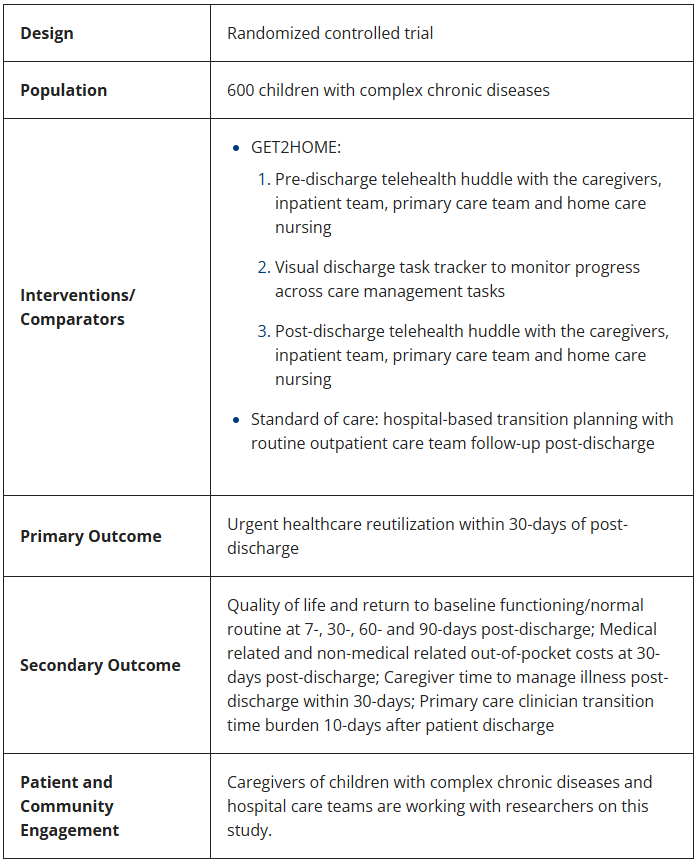
This study compares the clinical effectiveness of a hospital-to-home transition bundle intervention versus a standard of care hospital-based discharge process in children with complex chronic diseases.
Who will this research inform?
For children hospitalized with complex chronic diseases, transitioning from hospital to home can be challenging (e.g., caregivers may have trouble using medical equipment at home). Results of this study may help primary care clinicians and hospital care teams improve the hospital-to-home transition to prevent these children from having to unexpectedly return to the hospital again after a recent hospital stay.
What is an IEP, really?
An IEP (Individualized Education Program) is a written plan that lays out the program of special education instruction, supports, and services kids need to learn and thrive in school. It's also a legal document covered by the Individuals with Disabilities Education Act (IDEA).
A young boy at a classroom table smiles while talking with two adults during a school meeting.
The basics, without the jargon
Here's what an IEP includes:
A detailed description of how your child learns
Specific and measurable goals
The services and supports the school will provide — like speech therapy, or extra time on tests
One important thing to know: Parents are part of the team that creates and reviews the IEP. Your input isn’t optional. It’s required.