
What Payment Reform Means for People Who Depend on Home and Community-Based Services
Samantha “Sam” Thumma
Summary: Value-based payment ties healthcare funding to outcomes rather than service volume, but applying it to HCBS raises difficult questions. Effective reform must protect people with complex needs, strengthen the direct support workforce, measure outcomes that matter to individuals, and include people receiving services in defining value.

The 2025 reconciliation law (H.R.1) is estimated to reduce federal Medicaid spending by $911 billion between 2025 and 2034, or about 14% of what the federal government was expected to spend on Medicaid under the old law.
In 2022, the United States spent about $415 billion on long-term services and supports, and Medicaid paid for about 61% of that amount. Of that total, about $284 billion, from all payers, went to services that help older adults and people with disabilities live in their own homes and communities. These are called home and community-based services (HCBS).
Federal Medicaid rules give states a lot of flexibility in deciding which HCBS to cover, who qualifies for them, and how many people can receive services. This flexibility can be useful for tailoring services to local needs, but it also means HCBS may be especially vulnerable when funding is limited.
Most states manage the cost of HCBS with familiar tools: limiting the number of people who can enroll in services (enrollment caps), per-person spending limits, prior authorization (a review and approval process for each service being requested), and waiting lists.
Value-based payment (VBP) is often put forward as a smarter alternative. Instead of paying providers only for how much of a service they deliver, VBP ties at least part of their payment to quality or to specific results, like a person getting a job and keeping it. Supporters of VBP see it as a way to get more out of every Medicaid dollar while rewarding providers who help people thrive. Critics, however, worry that it could turn people’s lives into performance metrics.
This article asks a straightforward question: Can value-based payment support the personalized, self-directed care people deserve? The answer is that we don’t yet know. VBP could address real problems in the way HCBS is paid for today, including incentives that can work against independence. But a payment model that rewards measurable results can also create new problems when those measures fail to reflect what matters to individual people. It can disadvantage people whose progress is harder to quantify or whose needs don’t fit neatly into standard measures, encourage providers to prioritize easier-to-measure goals, and add pressure to an already strained workforce. None of this is inevitable. Whether VBP strengthens or undermines person-centered care will depend on how states design it, what evidence they require, and whether people receiving services have meaningful power in the process.
WHAT DOES HCBS LOOK LIKE TODAY?
Home and community-based services (HCBS) are the supports that allow people with disabilities and older adults to live in their own homes and communities rather than in nursing facilities or other institutions. These services include personal care assistance, supported employment, skills training, and help with daily activities.
For many people, HCBS is the infrastructure of their daily lives — the support that makes it possible to get up in the morning, take a shower, be active members in their communities, and make choices about how they want to live.
HCBS has traditionally been paid for through a fee-for-service (FFS) model: providers submit a bill for each unit of service delivered and get paid accordingly. It’s predictable and relatively simple to administer, which is a big part of why it has lasted.
But fee-for-service has a built-in problem: it pays for volume, not results. By design, the more someone depends on services, the steadier the provider’s revenue. When a person learns to cook a meal or ride the bus, they may need fewer paid hours, which results in their provider earning less. One example is Job Coaching, a form of Supported Employment. The service helps people settle into their job, learn the skills they need to succeed, and maintain employment over time. In some states, a key component is a fading plan, where supports gradually decrease until they’re no longer needed. Ideally, the job coach works themselves out of the role as each person they support gains independence. That fading, however, may mean a loss of revenue for the provider under a fee-for-service model. As a 2021 review of employment funding put it, this can mean “the more capable organization receives less funding as a result of being more capable.” This creates a structural tension: providers can lose revenue when a person needs fewer paid hours, even when that reduction reflects greater independence. Without safeguards that reward meaningful progress, the payment system can make it harder to prioritize fading support (when appropriate) and create fewer opportunities for people to do more on their own. Managed care hasn’t fully solved this problem either. In states that run long-term services through managed care, the state pays a health plan, called a managed care organization (MCO), a fixed amount for each person, but the MCO usually still pays HCBS providers by the unit. When money gets tight, the quickest way to control costs may be to cut hours or tighten who qualifies for services in the first place.
WHAT IS VALUE-BASED PAYMENT?
Value-based payment tries to change that logic by tying payment, at least in part, to whether services actually help people. The goal is reasonable, and for anyone who cares about independence and self-determination, it’s genuinely appealing: reward providers for helping people thrive, not just for showing up and documenting their hours.
One word causes a lot of confusion here: “outcomes.” In a person-centered plan, outcomes are personal — what the person wants for their own life. In a payment model, “outcomes” usually means performance measures: standard benchmarks or milestones the state or MCO picks ahead of time, often counted across everyone a provider serves. Sometimes personal outcomes and provider-level milestones align, like a person who wants a job and a benchmark that rewards employment. But they aren’t the same thing, and much of the debate over VBP comes down to the space between them.
Before making a case for or against it, it’s important to understand what VBP even means.
THE DIFFERENT FORMS VBP CAN TAKE
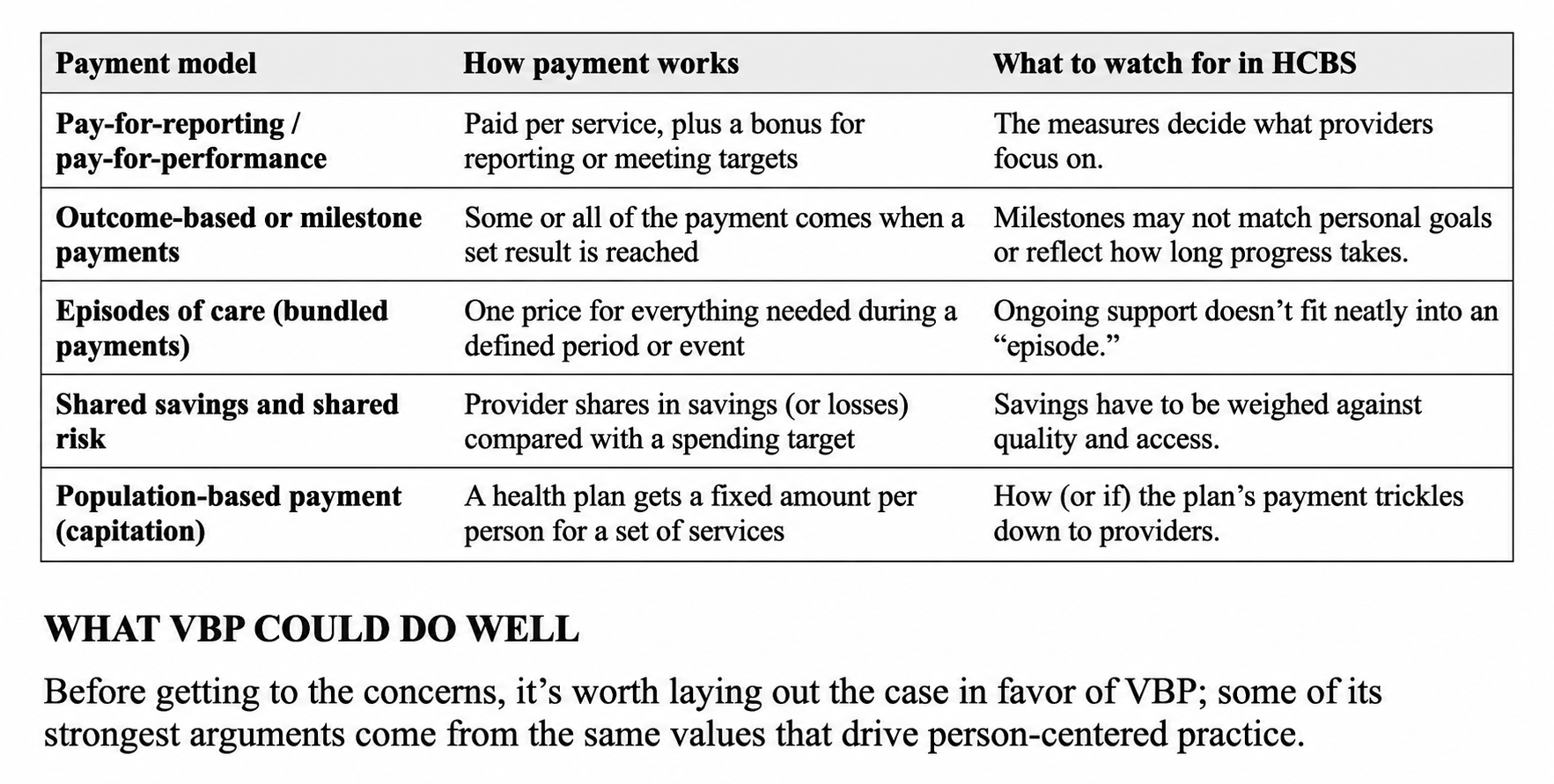
“Value-based payment” is an umbrella term, not a single model. The Alternative Payment Model (APM) Framework, developed by the Health Care Payment Learning & Action Network and widely used across the nation, treats payment models as a spectrum — from fee-for-service with no link to quality, to fully population-based payments. Each model’s place on the spectrum is largely based on how much financial risk shifts to providers.
Pay-for-reporting and pay-for-performance. These are the most common starting points. Providers are still paid per service, plus a bonus for reporting on quality measures or meeting set targets. Because the basic payment doesn’t change, the risk to providers is low, but the incentive is only as good as the measures behind it.
Outcome-based or milestone payments. Some or all of the payment comes when a specific result is reached, such as a person getting a job and keeping it for a set period of time. This approach has the longest track record in supported employment. Oklahoma began building milestone-based payments for employment services in the 1990s, and Tennessee’s Employment and Community First CHOICES program uses value-based reimbursement to align payment with milestones like competitive integrated employment (a regular job in the community, at regular pay). The upside is a focus on real results, which can line up with what a person has said matters to them. The risk is that slower-to-reach milestones become less attractive for providers to pursue or lead to less personalized care. Every milestone has two sides. If employment is a milestone, more people who want to work may finally get real support to find a job and keep it. But will providers also push people toward employment goals, even when they consider themselves retired? When thoughtfully developed, outcome-based payments create real potential to move systems in a better direction. Without that care, they could move us backward. That’s why the “who defines value” question is such an important one.
Episodes of care (bundled payments). Instead of paying for each service separately, the payer sets one price for everything needed during a defined period or event, like a move from a nursing facility back into the community. That gives providers room to organize support flexibly rather than billing unit by unit. The challenge is that much of HCBS is ongoing support with no natural start and end point. Defining an “episode” in someone’s daily life is a lot harder than defining one around a hip replacement.
Shared savings and shared risk. The payer sets a spending benchmark for a group of people. If actual costs come in below that benchmark, while quality standards are met, the provider keeps a share of the savings. In shared-risk (or “two-sided”) arrangements, providers also pay back part of any overspending. Done well, this rewards things like preventing hospital stays or crises. The concern in HCBS is where the savings come from: spending less is not the same as supporting people better, and quality requirements are the only thing standing between “savings” and cuts to the services people rely on. It gets even more complicated when you consider who pays for what. More than half of the people using Medicaid HCBS also have Medicare, which pays for their hospital care. If an HCBS provider helps someone get regular preventive care and that keeps them out of the hospital, most of the savings show up in Medicare’s budget. Since the HCBS provider isn’t paid by Medicare, it usually can’t share those savings. Federal efforts to align Medicare and Medicaid plans for people who have both could help, by putting both budgets under one health plan. But the plan, not the HCBS provider, would hold those savings, and in many states HCBS is paid for outside managed care altogether.
Population-based payment (capitation). This model sits at the far end of the APM Framework’s payment spectrum. Under capitation, a health plan receives a fixed amount per person to cover a defined set of services. In some states, that includes both medical care and long-term services and supports (LTSS), like HCBS. Whether that arrangement is genuinely value-based depends on how quality, performance, and accountability are incorporated into the payment structure. The MCO being paid a fixed amount doesn’t mean providers are; the MCO often still pays HCBS providers by the unit. And how those providers get paid is decided in contracts that people receiving services rarely see.
Each of these models shifts a different amount of financial risk to providers and creates different incentives, opportunities, and concerns.
WHAT VBP COULD DO WELL
Before getting to the concerns, it’s worth laying out the case in favor of VBP; some of its strongest arguments come from the same values that drive person-centered practice.
Paying for independence, not dependence. Outcome-based payment can reward a provider when a person reaches a milestone, like keeping a job, or comes to need fewer paid hours, which is exactly what fee-for-service penalizes.
Flexibility to do what works. Bundled and population-based payments could loosen the tie between payment and billing codes. In theory, a provider could pay for a ride, a piece of technology, or club membership fees to help someone build real friendships — things that often don’t fit into a service definition. In that sense, VBP could be more person-centered than the system we have now. But it would also take more flexible service definitions. Providers can only be as flexible as those definitions allow, and anything outside them risks going unpaid.
Making what matters count. Today, providers are generally paid the same whether or not their support is making a real difference in people’s lives. For some people, that difference means new opportunities. For others, it means holding on to the health, relationships, and routines they already have. Tools like CQL’s Personal Outcome Measures (POM) and the National Core Indicators already ask people directly about things like choice, relationships, and being part of their community. VBP could tie part of a provider’s pay to measures like these, so the things that matter most to people show up in how services are paid for, though, as the next section explains, measuring what matters is harder than it sounds.
Investing in the workforce. In models that produce savings, saved money can be reinvested money, but only if the model makes sure of it. One way to do that is to make workforce investment a measure of its own. Tennessee, for example, has described treating staff training as a quality measure so that agencies with better-trained staff are “appropriately compensated for the higher quality of care.”
Better information. HCBS has historically had far less quality data than hospitals or nursing facilities. CMS released the first nationally standardized HCBS quality measure set in 2022, and VBP gives states a reason to put that kind of measurement to work. Better data can help people and families choose providers and help states spot problems sooner.
A stronger case for funding. When budgets are tight, being able to show what services accomplish is a stronger argument to legislators than asking them to trust that the money is well spent. VBP could be a way to defend HCBS funding, not just trim it.
There’s real potential here. But the concerns are just as real.
MEASURING WHAT MATTERS
The challenge with value-based payment starts with a basic question: who decides what “value” means? In HCBS, the answer should start with the people receiving services, along with the families, friends, and advocates who know them well. They’re the ones who can tell us what they actually want and need from the system. But payment models are usually designed by state agencies, health plans, and consultants, and the voices that should matter most aren’t always built into that process.
VBP was also developed mostly for hospitals and doctors' offices, where measures tend to be clinical and fairly standard: Did the patient’s blood pressure go down? Was the person readmitted to the hospital? Even within long-term care, measures don’t transfer easily. The measures used to rate nursing facilities don’t fit services delivered in someone’s own home and community.
HCBS is different. The person receiving services, often with help from people they trust, defines the personal outcomes they want to work toward, such as building a friendship, learning to manage their medications, or taking part in a community activity for the first time. These goals are deeply personal, and they don’t always reduce neatly to numbers. That puts payment models in a bind.
There’s an old management saying that what gets measured gets managed. Systems are no different: they tend to organize themselves around whatever is being tracked. If providers are paid on standard benchmarks that have little to do with people’s personal outcomes, those benchmarks become the focus, whether or not they reflect what a person actually needs or wants.
But paying providers directly for progress on personal goals creates its own problems. Hypothetically, if a benchmark rewarded providers when people achieved their personal goals, providers might be tempted to steer people toward easier ones: “check-the-box” goals that may look good on paper but don’t lead to anything meaningful in someone’s life. The focus could shift from how well a person is being supported to how well they’re progressing (or how well their staff writes their daily notes). A person’s goals stop being theirs and start becoming the provider’s scorecard.
The word “value” itself is also part of the problem. In everyday life, we talk about values as the things we care most about — privacy, independence, belonging. In health policy, “value” is often defined as the results achieved for each dollar spent; in other words, bang for your buck. In practice, that tends to lean toward cost savings and efficiency. When a payment system is built around getting the most for each dollar, it can work in opposition to the things people value most.
There is wide agreement among researchers that person-centeredness needs to be at the core of any quality measurement in HCBS. What that looks like in practice is still evolving. The field is still working out how to design measures that are genuinely meaningful, easily trackable, and clearly and defensibly tied to payment. How to accomplish all three is arguably the most important design question for any VBP model, and it may be the most difficult to answer. Benchmarks can show whether a provider is doing well across everyone it serves, but they can’t easily capture whether one person is getting the life they described in their plan. Can a system standardize its measures when it’s built to reward highly individualized support? So far, no one has shown with certainty that it can.
WHERE VBP COULD FALL SHORT
Measurement isn’t the only challenge. Any VBP model would also need to address a few other risks.
People with the most complex needs. One of the most serious concerns about VBP in HCBS is its potential impact on people with the most complex needs.
When providers are rewarded for meeting standardized measures, there’s a financial incentive to avoid people whose situations are more complicated, because supporting them can make those measures harder to meet, especially when the benchmarks weren’t developed with them in mind. This risk is often called “cherry-picking,” and it has to be actively guarded against. To be fair, fee-for-service isn’t free of this problem: when rates don’t reflect the real cost of supporting someone with complex needs, providers can already turn people away. But payment tied to standardized measures adds a new reason to avoid anyone who might pull a provider’s numbers down.
One safeguard is risk adjustment: formally recognizing that supporting someone with high or complex needs takes more time and resources and building that into the payment itself. The research suggests risk adjustment in HCBS is still underdeveloped. Without it, VBP could end up penalizing the providers who do the hardest work and reduce options for the people who need the most support.
Equity and access. Equity is a related concern. There is very little research on how VBP models affect people differently across race, ethnicity, disability type, and geography. Small and rural providers, who often serve communities with few alternatives, may not have the staffing or data systems to take part in VBP arrangements, which could widen existing gaps in access to quality care.
The direct support workforce. None of this works without direct support workers. The people who provide the day-to-day assistance that makes community living possible are the backbone of HCBS, and no system functions without them showing up every day. Yet the workforce is chronically underpaid, and turnover is high. In a 2023 national survey, agencies reported losing the equivalent of about 4 in 10 direct support workers in a single year.
That problem did not start with VBP, but VBP models generally depend on a level of workforce stability that doesn’t exist in most HCBS systems. Continuity of relationships is central to person-centered care, and high turnover makes it harder to reach the long-term results VBP is supposed to reward. Whether a model pays for results or pays for hours, payment reform built on an unstable workforce is built on an unstable foundation.
The cost of the change itself. There’s another catch that doesn’t get talked about much: VBP isn’t free to set up. It takes data systems, staff time to track and report measures, and money for incentive payments, often well before any savings show up. That’s a hard ask when budgets are already tight. Even some supporters of moving away from fee-for-service are skeptical of how current models are funded. The Center for Healthcare Quality and Payment Reform, for example, argues that in many VBP models, “payments fall short of the cost of delivering quality care.”
The flip side is that blunt cost-cutting tools, like enrollment caps and waiting lists, have real costs too, and they don’t reward quality at all. A well-designed VBP model could be a way to spend limited dollars more wisely. The real question is whether states will have the room to build that model carefully.
WHAT THE EVIDENCE ACTUALLY SHOWS
The honest truth is that there isn’t enough research (yet) to say whether VBP models in HCBS consistently support person-centered care, but there isn’t enough to say with certainty that VBP undermines it either. Most of what exists is either conceptual or drawn from settings like nursing facilities and primary care that differ significantly from community-based disability services.
There are almost no studies examining how VBP affects people differently by race or ethnicity in HCBS. There is very little research that follows people over time to see whether their quality of life actually improved. And much of the existing literature assumes VBP is the right direction and focuses on how to implement it, rather than asking whether the model fits this environment in the first place.
Part of the reason the evidence is so thin is structural. Payment systems are, by nature, hard to change. Rates go through rate studies, waiver amendments, federal approval, public comment, and billing system updates, and once they’re in place, providers build their operations around them. That makes it hard for states to try something new at a scale large enough to know whether it works and makes it more tempting to make one big statewide change instead.
When states move to VBP before the evidence exists, the people who depend on these services absorb the risk of an approach whose effects aren’t yet known. That isn’t a reason for states never to try. It’s a reason to try in a way that lets them learn.
WHY PILOTS MATTER
This is where well-designed pilots come in. A pilot lets a state test a payment model with a smaller group of providers, a single region, or a single service before committing the whole system to it.
In states that deliver long-term services and supports through managed care, health plans can try value-based arrangements with willing providers without changing the state’s payment rates, and states can direct plans to use specific value-based approaches with federal approval. Section 1115 demonstrations, which are federal approvals that let states test new approaches in Medicaid, are another option, and they come with formal evaluation requirements. States can also limit some waiver changes to a particular region or service, like supported employment.
Pilots have their own blind spots, though. The providers who volunteer tend to be the strongest ones, so results can look better than a statewide rollout will. Pilots are often too small to show how a model affects people differently by race, disability type, or geography — the very questions the research hasn’t answered. They’re usually too short to capture outcomes like friendships, employment, or stable community living, which take years. And the extra funding, technical assistance, and attention a pilot gets — which can help it succeed — often disappear when the model goes statewide.
None of that is a reason to skip pilots. It’s a reason to design them well: set the evaluation plan before the pilot starts, include a comparison group, roll out in phases so results can be compared, check from the beginning how different groups of people are affected, involve people receiving services in choosing the measures, and protect providers from losing money while the model is being tested.
WHAT BETTER POLICY LOOKS LIKE
There’s no such thing as a perfect system. But designed thoughtfully, payment reform in HCBS could strengthen accountability, reward genuine quality, and direct resources toward helping people live the lives they choose. Change doesn’t have to be a choice between cost efficiency and quality of life. States should consider building these safeguards into the system itself:
Measure what matters to people. If people receiving services encounter quality measures at all, it’s usually as survey respondents, not as subject matter experts who help write the questions. Decisions about how to measure quality need to start with the people most affected by them. From the beginning, states should be asking people receiving services, and those who know them best, what matters to them and what success looks like in their own lives. A good test for any measure is simple: does it reflect what matters to the person, including their relationships, community engagement, and ability to make their own choices? States don’t have to start from scratch to accomplish this; they can build on existing frameworks, like CQL’s Personal Outcome Measures, to gather meaningful insight without adding new paperwork for providers or families.
Protect people who need more support. Strong risk adjustment and clear anti-discrimination safeguards are essential to make sure payment reform doesn’t create incentives to avoid serving the people who need support the most.
Invest in direct support workers. Payment reform without workforce investment is reshuffling, not reforming. Any VBP initiative should be paired with a serious commitment to wages, training, and improving working conditions for direct support workers.
Make the information visible. Medicaid already comes with plenty of transparency and reporting requirements. The problem is that the people with the biggest stake in how the money is spent — people receiving services, their families, providers, and direct support workers — often don’t know that information exists, let alone where to find it. Even those who do often have a hard time making sense of it. Without that visibility, it’s hard for anyone to trust that VBP is working as intended. States and health plans should make VBP results easy to find and easy to understand, including what’s being measured, how providers are doing, and what funding decisions are being made. States should be able to show that shared savings are being used to improve services, not left sitting in a rainy-day fund. And if the results show concerning trends, they should be willing to adjust course. Accountability starts with transparency.
Test changes before expanding them. Payment systems are hard to change once they’re built, which is exactly why they should be tested before they become the rule. Well-designed pilots let states learn what works without making everyone who relies on HCBS part of an untested experiment.
Let evidence lead the way. Long-term studies, research on how VBP affects different groups, and work centered on the experiences of people receiving services are urgently needed before VBP becomes the default approach in HCBS.
WHAT THIS MEANS FOR THE PEOPLE DOING THIS WORK
Case managers, support planners, and care coordinators are often the ones translating what payment changes mean for the people they work with. If your state is moving toward value-based payment, or already has, pay close attention to which model is being used, how “value” gets defined, and by whom. Ask whether the measures reflect what actually matters to people receiving support, or just what’s easy to count. Write down what quality services and meaningful personal outcomes look like for the people on your caseload, especially those with the most complex needs.
Case managers, providers, and state officials all have valuable input to offer, but the most important input will come from the people actually receiving these services — and too often, they’re the ones furthest from the table when decisions get made. A VBP system in HCBS should be built around the lived experience of the people it serves, which only happens if their voices are part of the process from the start, not added as an afterthought. States can make that easier by forming public-facing workgroups that include people receiving services, families and other natural supports, direct support staff, and providers. If a seat opens on a workgroup for someone with frontline, lived experience, encourage them to take it — they absolutely belong there. If you’re invited to the table yourself, use that opportunity to amplify the voices of the people you support.
WHERE THIS LEAVES US
For people with disabilities, their families, and the professionals who support them, payment reform isn’t an abstract policy question. How Medicaid pays for HCBS shapes what services exist, who can access them, and whether the people providing those services can afford to stay in the field. The Olmstead decision established that unjustified segregation of people with disabilities in institutions is discrimination, and that services should be provided in the most integrated setting appropriate to each person’s needs. But that right only goes as far as the services that make community living possible. How those services are paid for is a large part of that equation.
So, what’s the solution? There isn’t a proven payment model for truly person-centered HCBS yet. To find one, we have to test carefully, measure what matters to people, and make sure the people living with the results have a hand in defining them. In the end, the promise of value-based payment depends on whose definition of “value” ends up in the model.
NEXT UP
Payment isn’t the only part of the system that isn’t fully figured out. Most payment models, value-based or not, only see the paid part of a person’s support. The unpaid part, often provided by parents and other family members who are getting older themselves, doesn’t show up in any rate or quality measure. The final piece in this series looks at those family caregivers, who have been holding community living together all along.
About the Author

Samantha “Sam” Thumma (she/her) has worked in disability services across Pennsylvania, Maryland, and Tennessee, giving her firsthand insight into how these systems operate at different levels. She holds master’s degrees in legal studies and human services and is pursuing an MSSW at UT Knoxville.
Sam believes dignity, autonomy, and choice should anchor every service system, and hopes to eventually teach students across disciplines to design for inclusion from the start.
References
Bennett, Andrea D., Pam Curtis, and Curtis S. Harrod. Bundling, Benchmarking, and Beyond: Paying for Value in Home- and Community-Based Services. New York: Milbank Memorial Fund, 2018.
Bogenschutz, Matthew, Parthenia Dinora, Sarah Lineberry, Seb Prohn, Michael Broda, and Angela West. “Promising Practices in the Frontiers of Quality Outcome Measurement for Intellectual and Developmental Disability Services.” Frontiers in Rehabilitation Sciences 3 (2022), Article 871178.
Center for Healthcare Quality and Payment Reform. “Problems With Current Value-Based Payment Systems.” Accessed October 2026.
Centers for Medicare & Medicaid Services. “D-SNPs: Integration & Unified Appeals & Grievance Requirements.” Medicare-Medicaid Coordination Office. Accessed October 2026.
Centers for Medicare & Medicaid Services. “Delivery System and Provider Payment Initiatives Under MCO, PIHP, or PAHP Contracts.” 42 C.F.R. § 438.6(c).
Centers for Medicare & Medicaid Services. “HCBS Waiver Payment and Financing Trends.” U.S. Department of Health and Human Services, September 2021.
Centers for Medicare & Medicaid Services. “Home and Community-Based Services Quality Measure Set.” State Medicaid Director Letter #22-003, July 21, 2022.
Centers for Medicare & Medicaid Services. “Medicare Program; Changes to the Medicare Advantage and the Medicare Prescription Drug Benefit Program for Contract Year 2024—Remaining Provisions and Contract Year 2025 Policy and Technical Changes to the Medicare Advantage Program, Medicare Prescription Drug Benefit Program, Medicare Cost Plan Program, and Programs of All-Inclusive Care for the Elderly (PACE).” Federal Register 89, no. 79 (April 23, 2024): 30448.
Chidambaram, Priya, and Alice Burns. “10 Things About Long-Term Services and Supports (LTSS).” KFF, July 8, 2024.
Chidambaram, Priya, Alice Burns, and Robin Rudowitz. “Who Uses Medicaid Long-Term Services and Supports?” KFF, December 14, 2023.
Conrad, Douglas A., Matthew Vaughn, David Grembowski, and Miriam Marcus-Smith. “Implementing Value-Based Payment Reform: A Conceptual Framework and Case Examples.” Medical Care Research and Review 73, no. 4 (2016): 437–457.
Friedman, Carli, and Mary C. Rizzolo. “Value-Based Payments: Intellectual and Developmental Disabilities Quality Indicators Associated with Billing Expenditures.” Intellectual and Developmental Disabilities 59, no. 4 (2021): 295–314.
Health Care Payment Learning & Action Network. Alternative Payment Model (APM) Framework: Refreshed for 2017. McLean, VA: The MITRE Corporation, 2017.
Hecht, Madison, James Marzolf, and Ryan D. Castle. “Financing Whole-Person Health.” Global Advances in Health and Medicine 11 (2022).
Libersky, Jenna, Julie Stone, Leah Smith, James Verdier, and Debra Lipson. Value-Based Payment in Nursing Facilities: Options and Lessons for States and Managed Care Plans. Integrated Care Resource Center, 2017.
Mills, Lisa A. Value-Based Payment Methodologies to Advance Competitive Integrated Employment: A Mix of Inspiring Examples from Across the Country. Washington, DC: U.S. Department of Labor, Office of Disability Employment Policy, 2021.
Mohamed, Maiss, Alice Burns, and Molly O’Malley Watts. “States' Management of Medicaid Home Care Spending Ahead of H.R. 1 Effects.” KFF, November 20, 2025.
National Core Indicators–Intellectual and Developmental Disabilities. “State of the Workforce 2023 Survey Results: At a Glance.” Human Services Research Institute and National Association of State Directors of Developmental Disabilities Services.
National Quality Forum. Quality in Home- and Community-Based Services to Support Community Living: Addressing Gaps in Performance Measurement. Washington, DC: NQF, 2016.
Olmstead v. L.C. ex rel. Zimring, 527 U.S. 581 (1999).
Porter, Michael E. “What Is Value in Health Care?” New England Journal of Medicine 363, no. 26 (2010): 2477–2481.
Tennessee Division of TennCare. “Long-Term Services and Supports.” Accessed October 2026.