
Connecting the Dots: Understanding Your Loved One’s SPD Story
Dr. Janice Ryan
Summary: Sensory processing disorder may become easier to understand when behaviors, reactions, preferences, and personal history are viewed as parts of one larger pattern. The AAMSE Clinical Story Sensemaking Process helps practitioners and families connect those details and use them to guide care.

The AAMSE Clinical Story Sensemaking Process helps practitioners use a person’s history and first evaluation to understand what may happen and choose helpful starting goals for care. It is not just a paperwork step. It helps practitioners notice patterns, understand what matters most right now, and choose next steps that make sense for the person and the people who care about them.
Benefits to Assessment: A Constellation Metaphor One way to understand the AAMSE Clinical Story Sensemaking Process is to picture the night sky. At first, the stars may look separate from one another. But when you look longer, you may begin to see how they connect and form a bigger picture. In the same way, a person’s behaviors, reactions, and life history may seem separate at first, but together they can reveal an SPD pattern that helps guide care.

Small details can connect into a bigger sensory story.
The “stars” are the behaviors, reactions, and life details that may seem separate at first.
The “constellation” is the bigger SPD pattern that may help explain what the person is experiencing and what kind of support they may need.
The practitioner’s job is to notice those connections and use them to choose helpful, thoughtful goals for care.
Benefits: Moving Assessment into Treatment For families, this means that small details matter. A reaction, a preference, an avoidance, or a change in energy may be part of a larger sensory story. When those details are shared and understood, they can help practitioners choose care that feels safer, more respectful, and more useful in everyday life.
Families often hold important pieces of the story. This same pattern-finding process also helps move assessment into treatment. For example, a practitioner may learn that someone has a hard time relaxing, startles easily, or avoids certain places. Those details may seem unrelated at first. But when they are looked at together through an SPD lens, they may point to a pattern in how the person’s body and nervous system respond to stress and sensory input.
If history shows that the person feels anxious in new places or around new people, the practitioner may set goals around feeling safer, building trust, and learning ways to calm and settle.
If the first evaluation shows that certain sounds, smells, or textures are upsetting, the practitioner may create goals that help the person notice triggers, practice grounding skills, and discover what kinds of environments feel more comfortable.
If the person seems checked out or disconnected from what is happening around them, the first goals may focus on helping them feel more connected to their body, more aware of the present moment, and more able to make choices for themselves.
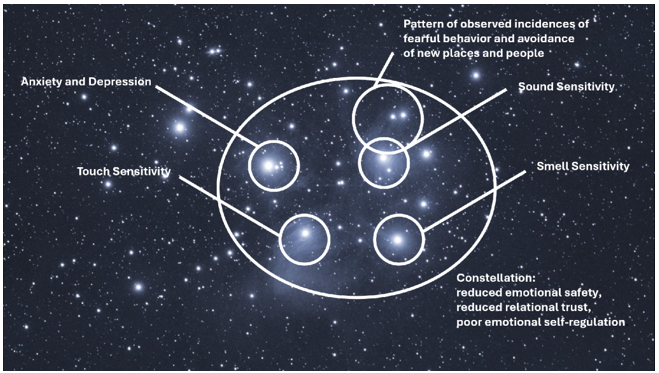
AAMSE Certified Practitioners strive to write a shared story.
Benefits: Practitioner, Client, and Family Education When a person has SPD, their story can become easier to understand when everyone around them is using the same words, the same picture, and the same sense of what helps. A story is like a constellation: many small details gather around one central meaning. In the same way, SPD often shows up as a pattern of sensory, emotional, and behavioral responses. When practitioners, service providers, clients, and family members can see that pattern together, care becomes more compassionate, more consistent, and more likely to protect the gains a person has worked hard to make.
There is great benefit when practitioners, service providers, clients, and family members understand a person’s unique constellation of sensory, emotional, and behavioral patterns in the same way. I learned this through painful experiences in practice, when a lack of shared understanding meant that a person’s needs were misunderstood after progress had been made. One story still stays with me because it shows how much can be lost when a person’s SPD story is not carried forward by everyone involved in their care.
The following story is sad, but I share it because it reveals something many families already know in their hearts: behavior is never just behavior. Sometimes it is a message. Sometimes it is a sign of distress. And sometimes, as in this story, it may be a sign that a person is beginning to reconnect with their body, their choices, and the people around them.
I once treated a 39-year-old woman with Down syndrome and previously unidentified SPD. She lived in a long-term care community and received therapeutic MSE effects in her room. She had been referred to my practice because she was becoming increasingly passive and disoriented. The medical team suspected early onset dementia, but one hopeful caseworker wondered whether something else might be happening and made the referral. During her initial evaluation, I saw that her present-moment awareness was disconnected from her body and from what was happening around her.
I used MSE effects to help ground this young woman in her body, and her awareness of her room and larger environment improved quickly. After four sessions, she was no longer simply drifting through the day. She was aware enough of the present moment to make clear decisions about what she wanted to do with her time. I researched her favorite activities and wrote a discharge plan that gave her opportunities to return to favorite crafts and social activities.
This clinical story could have had a beautiful ending, but it did not. This young woman no longer wanted to spend her days lying passively in bed. After four sessions, she had an activity plan that supported her interests and gave her a way back into crafts, social activities, and choice. But when I returned to visit her after discharge, I found her lying passively in bed again, disoriented in the same way she had been during the initial evaluation.
This is the part of the story that is hardest to tell, and it is also the reason the story matters.
When I asked caregivers what had happened, I was told that they were restraining her in bed because she was moving around too much in her room and calling out to people in the hallway to come visit. What looked like “too much movement” to them may have been a sign that she was more awake, more engaged, and ready for connection. Because they did not understand her earlier SPD condition or the meaning of her progress, decisions were made that did not match the sensory support and meaningful life activities she needed.

This story, and others like it, became a strong motivator for me to develop a way for everyone serving each client to understand and carry the same SPD story. It led to the story sensemaking tool that AAMSE now uses to train practitioners in our approach. My hope is that no person’s hard-earned therapeutic gains are lost simply because the people around them do not share the same understanding. For families, the meaning of this story is painful but important: when we understand the sensory story behind a person’s behavior, we are better able to protect their dignity, support their progress, and notice when what looks like a problem may actually be a sign of life returning.
Shared understanding helps protect dignity, choice, and connection.
When families and care teams carry the same story together, support becomes more than a plan; it becomes a way of protecting a person’s voice, choices, and place in the world.
If you are a family member reading this, let this be an invitation to speak up for the sensory story you know best. Share the small details. Ask what behaviors may be communicating. Help the team see the person behind the moment, so care can protect not only safety, but dignity, connection, and choice.
About the Author

Dr. Janice Ryan, OT, HSDP, is a certification trainer for the American Association of Multisensory Environments (AAMSE) and Founder/Director of Attunement Solutions, where she helps improve quality of life and relationships for neurodivergent children and adults. With five decades of clinical psychology experience, advanced degrees in Occupational Therapy, and 20 years as a Certified Human Systems Dynamics Practitioner, Dr. Ryan brings a broad, whole-person view of mental health and well-being. Her approach supports small, meaningful life changes that help clients build more satisfying lifestyles. She has published peer-reviewed articles and family-focused resources, trains new practitioners in her treatment model, and develops online quality-of-life communities for neurodivergent adults.
Connect with Dr. Ryan at janice@attunementsolutions.com.