
A Doll Like Me
Barbie’s history reflects changing cultural views on representation, body image, and disability inclusion. From early criticism over unrealistic beauty standards to newer dolls representing Down syndrome, autism, and medical conditions like Type 1 diabetes, Mattel’s evolving Barbie line highlights both progress and ongoing debate about how toys shape identity and belonging.
The Barbie Doll is considered to be a cultural icon. It is the most diverse doll line in the world, supposedly inspiring young girls to imagine they could be anything when they grow up. It means something different to everyone. It has impacted society by evolving from a fashion doll into a cultural phenomenon promoting female empowerment, diverse representation, and career ambition.
Most people are familiar with its history evolving from an idea by Ruth Handler, the co-founder of Mattel, which was inspired by her daughter Barbara, who played with paper dolls. While traveling in Switzerland in 1956, Ruth purchased a Bid Lilli doll based on a comic strip character who had an adult figure whose physical proportions did not reflect the body of a typical healthy women, and in fact, had been widely criticized as being biologically impossible. Existing dolls at that time were all baby like and Ruth had a vision that young girls would embrace a doll that they could imagine themselves to be like when they became an adult. Little did Ruth realize how this idea would transform and impact societies throughout the world.
“A doll is a silent listener, a loyal companion, and a source of comfort in times of need.”
On March 9, 1959, at the New York Toy Fair, Mattel launched the Barbie Doll named Barbara Millicent Roberts. She wore a black and white striped swimsuit and had her signature ponytail. Despite pushback from male employees at Mattel who were skeptic that mothers would purchase dolls with adult figures, Barbie became an instant hit with over a billion dollars in sales.
In the 1960’s, Barbie began to reflect upon the shifts and aspirations of the post-World War Two era. She evolved to depict the cultural and social changes of the times by demonstrating fashion changes and individuality.
In 1965, Barbie introduced a doll celebrating women’s potential for space exploration, inspiring young girls to envision a career in STEM fields. During this decade concerns arose about the unrealistic body image projected by Barbie and studies evolved demonstrating an unhealthy perception of body ideals that were unattainable.
In 1968, “Christie” became the first black Barbie, breaking new ground for diversity and inclusion, encouraging children to see the beauty in all races during our nation’s pivotal times in civil rights history.
The 1970’s, reflected upon the societal role change of women in career roles and Barbie doctors, politicians, and businesswomen were introduced as a symbol of empowerment and encouragement for women to challenge traditional gender roles.
In the 1980’s, Barbie went beyond the original blonde hair, blue eyed doll and featured a variety of hair types and different eye colors. This was Mattel’s first big step for cultural diversity, allowing children to play with toys that represented them.
It was also the first time that Mattel’s designers acknowledged the fact that Barbie had become an obsession for young girls. Pediatricians and Psychologists began associating the dolls with body dissatisfaction, eating disorders, and anorexia nervosa. They brought this phenomenon to the media, and clinicians observed the effects on adolescents and college aged women.
In the 1990’s Mattel released the “My sized Barbie,” a 38 inch tall doll. She was designed to share clothes with children, further encouraging girls to emulate the dolls’ unrealistic proportions.
In 1996, a survey was conducted of girls between the ages of 3-11. Data revealed that 97% of girls in the United States had Barbies, with each child having an average of 7 dolls, compared to those in France with 86% having 2 dolls, and Germany with 98% and having 3 dolls.
In 1998, Mattel launched its first Barbie doll with a disability. It was Becky, Barbie’s friend, and the school photographer, who used a purple wheelchair and was designed to promote inclusion. Becky had blonde hair, wore a preppy outfit, had a camera, yearbook, and a backpack. Shortly thereafter, a young girl with Cerebral Palsy wrote to Mattel stating that Becky’s wheelchair didn’t fit inside Barbie’s dream house elevator. Mattel’s response was to discontinue the doll with a disability.
In 2018, the specific term, “Barbie Syndrome” was coined to describe individuals pursuing extreme, often with surgical modifications to look like the doll. The girls and young women who took Barbie as a role model could develop a body image disturbance or distortion, possibly leading to dissatisfaction, anxiety, shame, and contempt for their bodies.
Since 2019, the Barbie line has expanded to include dolls with prosthetic limbs, hearing aids, vitiligo, and other differences. Barbie also returned with a realistic wheelchair and a ramp that fit inside her Dream House. The project was in collaboration with UCLA Mattel Children’s Hospital.
The background and history of Barbie is important because in the past few years we have seen praise and respect for Mattel for making their Barbie dolls representative and bringing awareness to having an inclusive society, yet much criticism and controversy have occurred at the same time.
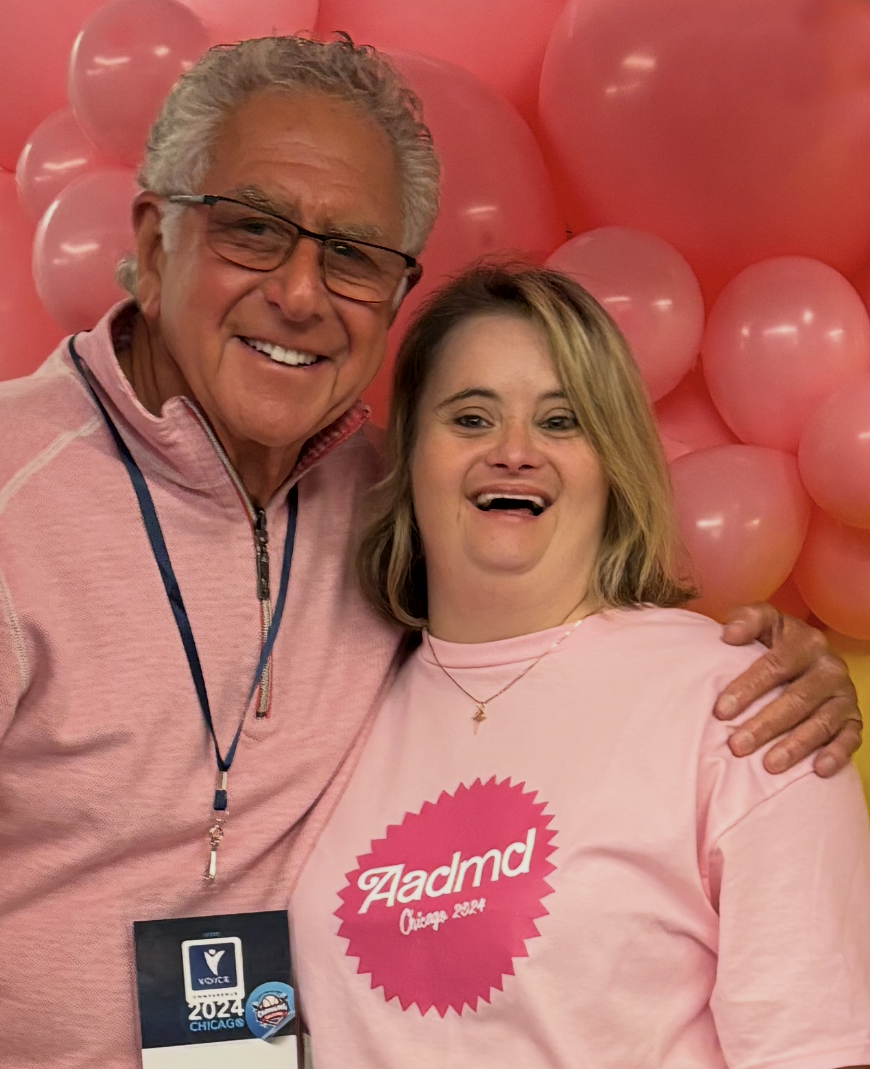
In 2023, Mattel released the first Barbie with Down syndrome. It sparked mixed reactions, with praise for being inclusive and criticism for the physical aspects of the doll. Working with the National Down Syndrome Society (NDSS) and the American Academy of Developmental Medicine and Dentistry (AADMD) the doll had a shorter frame, and a longer torso than the other Barbies. Her face was rounder, with almond shaped eyes, smaller ears, and a flat nasal bridge. Her palms even include a single line called a single transverse palmar crease which occurs in 40-60% of individuals with Down syndrome (Ds). She is dressed in a puff-sleeved frock adorned with butterflies and flowers in yellow and blue, colors associated with Ds
awareness. Accessories include a pink necklace with 3 upwards chevrons representing the 3 copies of the 21st chromosome, as well as pink ankle orthotics.
Pictured Above: Dr. Steve Perlman poses at the AADMD conference with Kayla McKeon, the woman whom Down Syndrome Barbie is modeled after.
In 2024, Mattel added a blind Barbie and a black Barbie with Ds who had braided hair texture and wore pink eyeglasses representing those children who often experience difficulties with vision.
On July 8, 2025, Mattel released its first Barbie doll with Type 1 diabetes (T1D). Again, good intent sparked controversy. While praised for improving representation and reflecting real life experiences, reactions confusing Type 1 (which is an autoimmune condition), with Type 2 (is a metabolic condition), this led to accusations that Mattel was turning a serious condition into a toy were unfair. Physicians and families praised the doll for normalizing medical devices and reducing isolation felt by children with that condition. Working in collaboration with T1D the doll featured an insulin pump and a continuous glucose monitor (CGM) with pink heart shaped tape to keep it in place. Her phone displayed a CGM app to track her blood sugar levels throughout the day, and a blue purse to carry her T1D supplies including snacks when she is on the go. She had brown hair and eyes, wears a blue and white polka dot outfit, the global symbols representing diabetes awareness.
In January 2026, after working over 18 months with input from the Autism Self Advocacy Network (ASAN) to authentically represent Autism, Mattel launched a Barbie with Autism. As in the past, the purpose of the doll was to portray neurodiversity through play by helping children see themselves in toys and fostering inclusion. The immediate response was celebratory, but troubling implications and backlash was swift. Autism is a neurological difference that can be visually identified and has the potential to be inaccurate and harmful. The doll has a softened eye gaze to one side to avoid direct eye contact, noise canceling headphones, flat Mary Jane shoes to promote stability, bendable elbows and wrists so she can be posed in different ways that are similar to stimming gestures like hand flapping, and sensory friendly loose fitting clothes. Her accessories include a fidget toy and a pink tablet to support augmentative and alternative communication. The most popular criticism of this Barbie is that branding one specific set of traits and anecdotal aids could have too much influence on how people perceive Autism. True representation does not require visual branding.
A Doll Like Me
While all of us in the field applaud Mattel for their recognition of children with disabilities and their attempts to provide them with a doll they can relate to, I want to acknowledge Amy Jandrisevits and her superhuman effort in creating “A Doll Like Me!”
Amy is a pediatric oncology social worker who completed her Master’s thesis on the healing power of play. She understood the sometimes fragile psyches of children and that often their language is communication through play. Psychologists, like her husband, agree that dolls can play a critical part of therapy for all children. Amy’s goal/idea was simple. To provide a doll that looks like the child does and to see that being unique is beautiful. “The kids I sew for aren’t the ones you’d see on the store shelves. ‘My kids’ have limb differences and hand differences, albinism, scars from fires, birthmarks, cancer, medical equipment ranging from cochlear implants to feeding tubes, facial anomalies. Let’s be honest…. when was the last time you walked into a toy aisle and saw a doll with one of these options? I’m going with never. In fact, these kids rarely see a likeness of themselves anywhere.”

Three happy customers of “A Doll Like Me” and their custom-made dolls that match their disabilities.
Dolls are a multibillion-dollar industry and research has demonstrated the power of children seeing themselves in the dolls they play with. Who they see and how they see themselves matters to the millions of children that don’t look like the images they are bombarded with.
Amy wants to change the narrative, how her simple act can be a catalyst for change. She can make approximately 200 dolls a year, but over 2000 families are waiting for her to make a doll for their child. Her labor of love is amazing. No one pays for a doll, her nonprofit raises the money to cover her expenses, but she is struggling to figure out her next step as demands on her time increases daily. We need to help her.
Thank you, Mattel! Thank you, Amy, for bringing awareness, happiness, and love into the lives of children with disabilities.
About the Author

Steve Perlman, DDS, MScD, DHL (hon) President, People Advocating for Optimal Health (PAOH) Special Projects Sr., Editor Helen: The Journal of Human Exceptionality
Declaration of Generative Al and Al-assisted technologies: During the preparation of this work, Helen Journal Editorial staff used ChatGPT to write the summary at the top of this article. Helen Editorial staff take full responsibility for the content of the publication.