
HELEN Editorial
Summary: Dr. Rick Rader highlights the discovery of Neanderthal remains in Iraq's Shanidar Cave, which indicate that a severely disabled individual survived due to the care of his group. This evidence suggests that compassion and caregiving for the vulnerable are deeply rooted in human evolution rather than being unique to modern Homo sapiens.

Rick Rader, MD, FAAIDD, FAADM, Editor-in-Chief, Helen Journal
“The purpose of anthropology is to make the world safe for human differences.”
-Ruth Benedict
The first week I was in college they held a round table meeting for freshmen who were undecided about what major to choose. I was on the fence between a couple of them and decided to attend. There were professors from virtually every department who were given five minutes to quickly describe what their discipline offered. I listened to pitches on Astrophysics, Linguistics, Accounting, Molecular Biology and Statistics…and all of them left me cold.
This one professor (had a corduroy sports coat with leather elbow patches) got up and said, “These anthropologists found a group of people whose religion forbids them from being angry……. They’re called the Nomads.” That sealed the deal. I became an anthropology major.
The idea of learning about primitive tribes and digging up stuff in the dirt was appealing. Let me begin by apologizing for offering those two topics as being the description of anthropology. The discipline is divided into two major categories, cultural and physical. The chairman of the Anthropology Department was Dr. Malcom Arth who also served as the Chair of Education at the American Museum of Natural History in New York. So, he wasn’t simply a professor of anthropology, he was a “rock star” who was my mentor in my senior year. I spent many hours at the Museum, my claim to fame was helping to set up the glass encased dioramas. For six months I literally had lunch twice a week with the Neanderthals.
The Neanderthals are hominins (a group including humans and all of our close evolutionary relatives) who are closely related to our own species, Homo sapiens. They derived their name from finding their fossil remains in the Neander Valley in Germany in 1858.
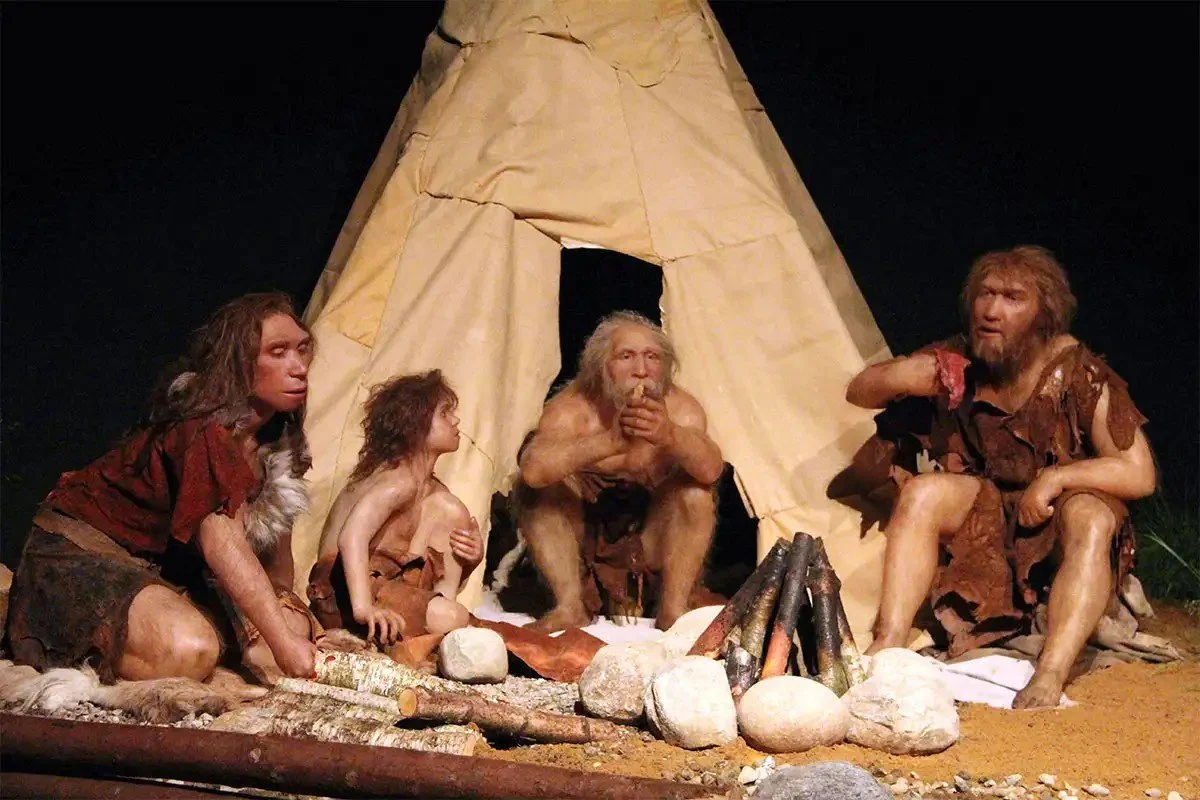
From the Shanidar Cave project we get the real scoop on who exactly these “cavemen” (and cavewomen) were. “Many early interpretations of Neanderthals saw them as a ‘missing link’ between apes and modern humans. They were often depicted as unintelligent and hunched over – a stereotypical caveman. As we learn more about Neanderthals, it is becoming clearer that this stereotype is wrong and they were more similar to us than we previously thought. Just how similar is still a matter of intense debate!”
One cultural characteristic that separates ‘primitive behavior’ from ‘modern behavior’ (unfortunately the current profile of our human behavior is not far removed from being primitive) is the demonstration of compassion towards one another.
In the 1950’s an American anthropologist (Ralph Solecki) excavated a cave in northern Iraq called the Shanidar Cave. The discoveries made there have provided great insight into the lives of our evolutionary cousins and provided more of an actual connection between “them” and “us.”
Greg Beyer writing in the magazine The Collector (The Skeletons of Shanidar Cave, Jan. 13, 2025) shares the story of Shanidar 1. This was an adult male who was approximately 5 feet 7 inches tall. From skeletal remains it was evident that he suffered terrible injuries during his 35-to-45-year lifespan. The left side of his head had received a traumatic blow, causing injuries that may have blinded him in the left eye and brain trauma that probably had impacted on the control of the right side of his body. His right arm was withered, and his right leg crippled. There was also evidence that his right foot had been fractured. These injuries could have caused his premature death, but he lived out his life without the ability to contribute to the hunting practices that was the backbone of the tribe’s survival. What is of note is that all his injuries show signs of healing. It is unlikely that he would have survived or been able to contribute to his own survival without the care of those around him. Thus Shanida 1 is among the earliest examples of caregiving to a person with a disability. It is evident that Neanderthals cared for each other and had the skills to look after disabling injuries. It provides the assurance that compassion had its roots in early humankind and was not a characteristic that was unique to our species.
Tens of thousands of years of human evolution have demonstrated one thing, we still have a lot to learn about compassion, empathy, and inclusion. People alive today typically have 1 – 3% of their total DNA that comes from Neanderthal ancestors…maybe we needed more.
Declaration of Generative Al and Al-assisted technologies: During the preparation of this work, Helen Journal Editorial staff used ChatGPT to write the summary at the top of this article. Helen Editorial staff take full responsibility for the content of the publication.