
Sickle Cell Trait and Malaria
How Sickle Cell Trait Protects Against Malaria: A Simplified Scientific Explanation
Tii Ngwachi Munghieng, MD
Summary: This article explains how the sickle cell trait can offer natural protection against severe malaria, especially in regions where malaria is common. It describes the genetic inheritance of sickle cell trait and sickle cell disease, the biological mechanisms that make malaria parasites less likely to survive in sickled red blood cells, and the public health trade-offs faced by communities where both malaria and sickle cell disease remain significant concerns.
Introduction
Did you know that up to 30% of people in sub-Saharan Africa carry the sickle cell trait? This physical trait not only affects health but has helped shape human survival (evolution) in regions where malaria is common.
The relationship between the sickle cell trait (SCT) and malaria is one of the most interesting examples of how human traits that are passed from parents to their children (genetics) adapt to environmental challenges.
Found predominantly in regions like sub-Saharan Africa where malaria is common, SCT offers natural protection against severe malaria caused by Plasmodium falciparum, the deadliest of the malaria parasites carried by the anopheles mosquito.
However, this protective trait comes with trade-offs, as it increases the likelihood of sickle cell disease (SCD) in certain populations.
This article explains the scientific link between SCT and malaria protection, explores its development over generations and its public health implications.
What is the Sickle Cell Trait (SCT)?
To understand SCT, we need to know a little about hemoglobin, the protein in red blood cells that carries oxygen throughout the body.
In people with normal hemoglobin genes, red blood cells are round and flexible, allowing them to flow freely through blood vessels. But in people with the sickle cell gene (HbS), red blood cells sometimes become stiff and shaped like a crescent (half-moon) or sickle.
Inheritance pattern of the sickle cell trait and disease
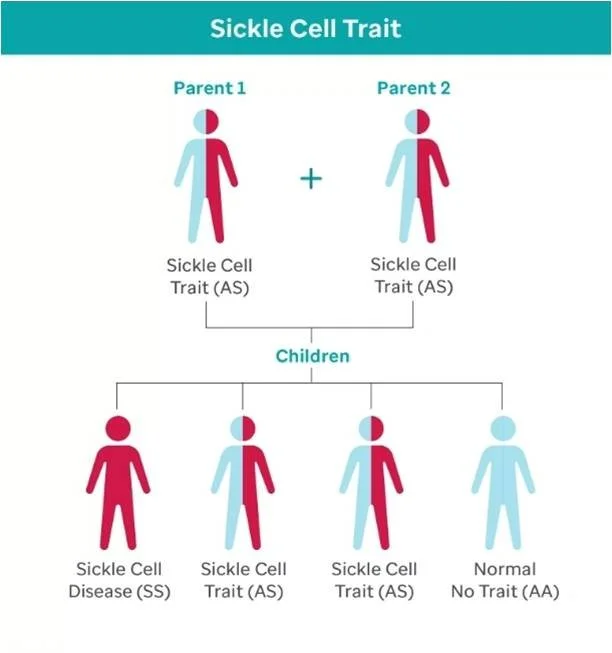
Fig. 1: Showing inheritance pattern of the sickle cell trait and disease
When you inherit one normal hemoglobin gene (HbA) and one sickle cell gene (HbS) from your respective parents you will carry the Sickle Cell Trait (HbAS) (see fig. 1). This does not cause health problems in most cases.
When you inherit two sickle cell genes (HbS). from your parents, you will have Sickle Cell Disease (HbSS) (see fig. 1). This condition leads to severe complications such as anemia, pain crises, and organ damage.
People with SCT (HbAS) have a unique advantage. They are better protected against malaria compared to those with normal hemoglobin (HbAA) or sickle cell disease (HbSS).
Why the Sickle Cell Trait Offers Natural Malaria Protection
How the sickle cell trait protects against malaria
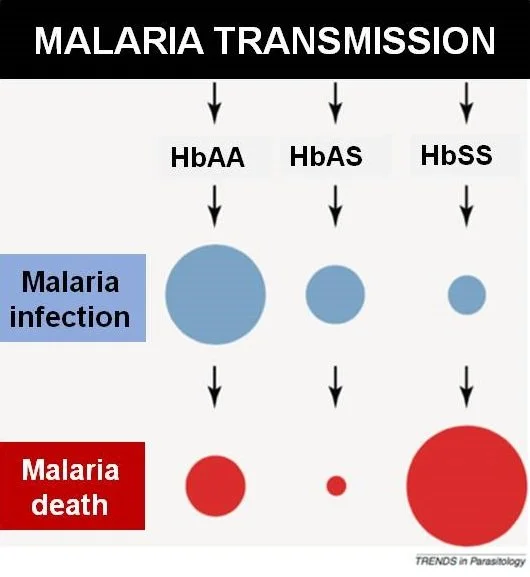
Illustration showing how the sickle cell trait protects against malaria transmission. Image credit: Williams TN, Obaro SK, 2011.
Malaria is caused by parasites called Plasmodium species with the most severe form being Plasmodium falciparum that invades red blood cells. In people with SCT, several mechanisms make it difficult for the parasite to survive:
Impaired parasite growth
The sickle-shaped red blood cells in SCT carriers are less hospitable to malaria parasites. When the parasite enters these cells, it struggles to grow and multiply because the environment is not ideal. [1]Rapid removal of infected cells
In SCT carriers, the sickled cells that contain parasites are quickly detected and destroyed by the immune system. This prevents the parasite from spreading further. [2]Reduced oxygen levels
Malaria parasites need oxygen to survive, but sickled red blood cells cells have lower oxygen levels. This creates an unfriendly environment for malaria parasites to survive and gives people with SCT a natural protection against severe malaria. [3]
Scientific Evidence Supporting Sickle Cell Trait and Malaria Protection in Africa
The connection between sickle cell disease (SCT) and malaria protection was first observed in 1954 by Anthony Allison. He discovered that individuals with SCT in East Africa were far less likely to die from malaria than those without the trait. [1]
Further studies have confirmed this protective effect:
Research in Kenya found that children with SCT had a 50% lower risk of developing severe malaria compared to children with normal hemoglobin. [4]
In regions with high malaria transmission, SCT prevalence can reach up to 30%, reflecting its evolutionary advantage. [5]
These studies show how natural selection has played a critical role in maintaining the sickle cell gene in areas where malaria is common.
Evolutionary Significance of the Sickle Cell Trait
The widespread presence of SCT in malaria-prone regions is a clear example of balancing selection, where a genetic trait persists because it offers both benefits and risks.
Natural selection in action
Individuals with SCT are more likely to survive malaria and live to have children.
Over generations, this advantage leads to more SCT carriers in populations where malaria is common.Geographical patterns
SCT is most common in sub-Saharan Africa, where malaria transmission rates are highest.
It is also found in other regions affected by malaria, including India, the Middle East, and the Mediterranean. [6]Trade-Offs
While SCT protects against malaria, it increases the likelihood of SCD when two carriers reproduce. This shows the evolutionary compromise: the benefit of surviving malaria outweighs the risk of producing children with SCD at the population level. [7]
Public Health implications of the Sickle Cell Trait
The relationship between SCT and malaria presents both opportunities and challenges for public health. These include;
Addressing Sickle Cell Disease (SCD)
SCD is a significant health burden in regions with high SCT prevalence. Without proper care, it can lead to severe complications and early death. Solutions include:Genetic Counseling: This involves teaching couples about the risks of passing on SCD.
Access to Healthcare: This will improve early identification and treatment for SCD patients.
Fighting Malaria
By reducing malaria transmission, the burden of SCT may also be reduced. Key strategies include;Insecticide-Treated Nets: This protects people from mosquito bites.
Antimalarial drugs: Treating malaria effectively in infected individuals.
Vaccination: Malaria vaccines like RTS, S are being developed to prevent infections.
Education and Awareness
Public health campaigns can help communities understand the benefits and risks of SCT. This will help them to make informed decisions about health and reproduction.
Case Study of Kenya on Sickle Cell Trait and Malaria
Kenya, a country in East Africa, shows the dual impact of SCT and malaria:
In malaria-endemic areas, up to 20-30% of the population carries the sickle cell trait, offering protection against severe malaria. [8]
However, the country also faces a high burden of SCD, which requires significant healthcare resources.
Kenya has responded by:
Establishing specialised clinics for SCD patients.
Distributing mosquito nets and providing antimalarial drugs.
Educating families about genetic risks through counseling programs.
Possible Solutions for the Challenges Posed By Sickle Cell Trait and Malaria
Advances in science and medicine offer hope in addressing the challenges posed by Sickle Cell Trait and malaria. Some of the possible solutions include;
Gene editing
Technologies like CRISPR could potentially “fix” the sickle cell gene, and cure SCD while preserving malaria resistance. [9]
Advances in science and medicine offer hope in addressing the problems created by SCT and malaria.
Improved malaria prevention
If malaria can be eradicated, the selective pressure for SCT would disappear, which will reduce the burden of SCD over time.Integrated healthcare
The combination of efforts between researchers, healthcare providers, and governments can ensure better outcomes for individuals affected by both malaria and SCD.
Conclusion
The sickle cell trait is a good example of how human traits and behaviours that pass through generation (i.e., genetics), adapt to environmental challenges. Its ability to protect against malaria has saved countless lives, but it also comes with the risk of sickle cell disease.
Understanding the sickle cell trait's role in protecting against malaria could transform global health efforts to fight both conditions. Genetic counseling and malaria prevention programs remain critical in reducing malaria and sickle cell disease burden in Africa.
By combining malaria control programs with genetic counseling and advanced treatments for SCD, the health and well-being of millions of people in Africa and worldwide can be improved consierably.
About the Author
Dr. Tii Ngwachi Munghieng is a preventive health advocate, medical writer, and clinician based in Cameroon. She is dedicated to reducing the burden of Non-Communicable Diseases (NCDs) and improving health literacy.