
Karen Proudford, Zemoria Brandon, and Mary LaMar
Summary: Meet Aaron Turpin, an actor, producer, model, and sickle cell warrior whose life has been shaped by chronic pain, loss, resilience, and determination. The article explains the realities of sickle cell disease, highlights the Shine the Light on Sickle Cell movement, and connects Turpin’s story to Positive Exposure’s mission to portray people with medical conditions through humanity, beauty, strength, and possibility.
“You have to know your enemy. That’s why they call us warriors. You’re literally fighting a battle against your own body.”
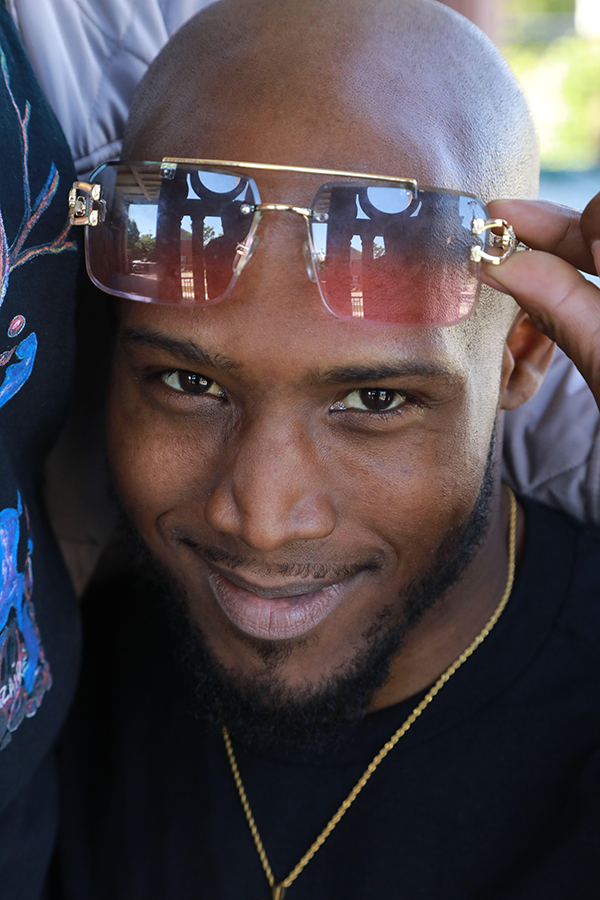
Aaron Turpin (shown, right) speaks about sickle cell disease the way a strategist speaks about war. Know your enemy. Study its movements. Learn its patterns. Never enter a battle unless you believe you can win. At 40 years old, Turpin has spent nearly his entire life in combat with his own blood. Born a twin in New Jersey in the early 1980s, he and his brother were both diagnosed with sickle cell disease shortly before their third birthday. But his twin brother never made it to that milestone. He died during his first sickle cell crisis before the age of three.
“In the ’80s, there wasn’t a lot known about sickle cell,” Turpin says quietly. “I’ve been lucky to live long enough to see the advancements.” Today, he carries himself with the poise of someone who has learned not only survival, but also resilience. An award-winning actor turned producer and international model, Turpin recently returned from Paris and is preparing for Milan Fashion Week. But behind the cameras, fashion shoots, and film festivals lies the relentless reality of a disease that never truly rests.
“It’s not easy to pursue a career while being a sickle cell patient,” he says. “But it is doable. It is possible.” That possibility and the insistence on living fully despite chronic pain, medical trauma, and physical uncertainty sit at the heart of Turpin’s story. It is also at the center of a growing movement dedicated to shining a light on sickle cell disease and demanding greater understanding, expanded research, and ultimately, a universal cure.
A Disease Few Understand
Sickle cell disease (SCD) is the most common inherited blood disorder in the United States, affecting more than 100,000 Americans and millions more worldwide. Still, public awareness remains startlingly low. The genetic mutation that causes Sickle Cell Disease is one that also provides a protective advantage against malaria. For that reason, the incidence of Sickle Cell Disease is more common both in regions where malaria is endemic and in the populations that originated in those regions. For example, Sickle Cell Disease disproportionately affects individuals of African descent. And Hispanic descent, too. Sickle Cell Disease alters the shape of red blood cells, transforming them from soft, round carriers of oxygen into rigid, crescent-shaped cells that can clog blood vessels and restrict circulation. Those blockages trigger episodes of excruciating pain known as sickle cell crises and, overtime, damage nearly every organ in the body. Patients may experience stroke, acute chest syndrome, chronic organ damage, anemia, fatigue, infections, and shortened life expectancy, earning them the nickname “sickle cell warrior.” Emergency rooms can be especially difficult places for sickle cell patients. The longer a pain crisis continues untreated, the more damage can occur to the body. Turpin knows all of it intimately. “Every minute that you’re in a sickle cell crisis is an eternity,” Turpin says. He has undergone countless hospitalizations, blood transfusions, and emergency room visits. At 32, he required a hip replacement after developing avascular necrosis, the medical term for bone tissue death caused by a lack of blood supply, frequently to the hip.
Living In the Fight
The scale of what sickle cell warriors endure is exceptional. In Turpin’s case, the discipline with which he approaches survival is, too. “I like to go, go, go,” he says with a laugh. “But I’ve had to learn that rest is just as vital as pushing yourself.” Managing sickle cell disease, he explains, requires constant vigilance. Hydration matters. Diet matters. Temperature matters. Sleep matters. Stress matters. He carries a gallon of water with him daily. He drinks antioxidant-rich teas, eats foods that support circulation, and works out intentionally to maintain cardiovascular strength. “You have to ask yourself with everything, how is this helping the fight?” he says. Turpin draws inspiration from The Art of War, by ancient Chinese general and philosopher Sun Tzu, and from Miyamoto Musashi, the legendary Japanese swordsman and strategist whose writings emphasize preparation, patience, and understanding one’s opponent. “When I was younger, my mom found books about sickle cell for me,” he recalls. “I read everything I could. I lined up symptoms. I studied what was happening to me.” At 15, that self-education helped him recognize the signs of avascular necrosis before doctors confirmed the diagnosis. “That’s what I mean by knowing your enemy,” he says. “Don’t ever go to battle unless you know you can win.” For warriors like Turpin, winning involves essential support systems, like family, friends, doctors, support groups, and fellow warriors. He also credits spiritual grounding with helping him endure. “There’s something bigger than me,” he says. “If my struggle can help somebody else, even one person, then it’s worth it.”
Shining the Light on Sickle Cell and The Power of Positive Exposure
That spirit is what inspires awareness-building efforts like Shine the Light on Sickle Cell. Each year, community-based organizations and medical providers throughout the Northeast U.S. host events, organize blood drives, and illuminate structures and skylines in red around World Sickle Cell Awareness Day, June 19. Shine the Light on Sickle Cell symbolizes urgency, resilience, and solidarity. It is about involving communities, educating the public, supporting warriors, and together, advocating for a universal cure. That visibility and connection is precisely what drew photographer Rick Guidotti to this work. Guidotti, founder of Positive Exposure, has spent decades using photography to challenge conventional ideas of beauty, disability, and difference. A former fashion photographer, he became increasingly disturbed by the ways medical conditions were portrayed through clinical or stigmatizing imagery. Positive Exposure was born from his desire to create portraits grounded in humanity rather than diagnosis. Turpin recently participated in one of Guidotti’s photo sessions at The Sickle Cell Association of New Jersey, Inc. The resulting photographs present sickle cell warriors in a different light, showcasing their ambition, humor, beauty, and strength. That visibility matters. Too often, people living with chronic illness disappear into medical charts or public misconceptions. Positive Exposure, much like the broader movement to Shine a Light on Sickle Cell, pushes back against that invisibility and asks society to look closer.
Lighting the Way Forward
There is reason for cautious hope within the sickle cell community. Advances in treatments like hydroxyurea, exchange transfusions, gene therapy, and stem-cell research have transformed outcomes for many patients. Turpin himself credits hydroxyurea and regular exchange transfusions with dramatically reducing the frequency of his sickle cell-related pain crises. Still, barriers remain enormous. Access to specialized care is inconsistent. Costs are high. Many patients continue to experience stigma, inadequate treatment, and delayed diagnosis. Which is why stories like Turpin’s matter. Not because they offer easy inspiration, but because they reveal the complexity of the fight. He is not pretending the disease is easy. He is honest about exhaustion, fear, surgeries, trauma, and loss. He is honest about the fact that the effects of decades of sickle cell crises accumulate over time. And yet, he refuses to surrender. “If somebody hears my story and decides not to give up,” he says, “then it’s worth it.” On the cover of Helen, Aaron Turpin’s portrait invites readers to see sickle cell disease differently, not through pity or stereotype, but through humanity, resilience, and possibility. The image is a reminder that human exceptionality is found in endurance, vulnerability, courage, and the willingness to remain visible despite struggle. That is what Rick Guidotti’s camera captures. And that is what Aaron Turpin, simply by continuing forward, embodies.
In Memory of Deidre Woods

Deidre Woods. Photo by Rick Guidotti, Positive Exposure
The loss of Deidre Woods, a sickle cell warrior, is a heartbreaking reminder of the challenges faced by individuals living with sickle cell disease. Beyond the diagnosis was a person filled with strength, courage, and resilience while enduring the daily pain and complications that often accompany this illness.
Sickle cell disease affects not only the body but also the emotional well-being of patients and their families. Many suffer through repeated hospital visits, severe pain crises, and misunderstanding from those unfamiliar with the condition. Deidre Woods’ journey reflects the silent battles many sickle cell patients fight every day. Her passing also highlights the need for greater awareness, compassion, improved healthcare access, and continued research for better treatments and a cure. Remembering her life should encourage communities to support sickle cell patients with empathy and understanding.
Although her life was cut short, Deidre Woods’ memory can continue to inspire advocacy, education, and hope for a future where sickle cell disease no longer takes lives too soon