
Sensory Rooms That Work
Designing Multi-Sensory Environments in Healthcare Settings: Clinical, Operational, and Design Considerations
By David Cox, EdD, MBA
Summary: The development of sensory rooms within healthcare environments, particularly for individuals with Sensory Processing Disorder (SPD)—requires a nuanced, interdisciplinary approach that integrates clinical, operational, and environmental considerations. Given the heterogeneity of sensory processing profiles, no singular design solution is sufficient. This article outlines key principles for designing multi-sensory environments (MSEs) in hospital settings, emphasizing individualization, safety, accessibility, infection control, and sustainability. Additionally, it highlights the importance of clearly defined clinical objectives, staff competency, and outcome evaluation to ensure long-term efficacy and institutional support.
Abstract
The development of sensory rooms within healthcare environments, particularly for individuals with Sensory Processing Disorder (SPD)—requires a nuanced, interdisciplinary approach that integrates clinical, operational, and environmental considerations. Given the heterogeneity of sensory processing profiles, no singular design solution is sufficient. This article outlines key principles for designing multi-sensory environments (MSEs) in hospital settings, emphasizing individualization, safety, accessibility, infection control, and sustainability. Additionally, it highlights the importance of clearly defined clinical objectives, staff competency, and outcome evaluation to ensure long-term efficacy and institutional support.
Introduction
As vice president of the American Association for Multi-Sensory Environments (AAMSE), I’m frequently asked for recommendations on which sensory items would be best in a newly created sensory room. Often, these questions result from a grant received for a sensory room or the organization has seen the need and agreed to fund such a project. My answer is always the same, “That depends.” There is no standard answer to this question. Before recommending any sensory item, this article talks about considerations around maintenance and design, before any items can be recommended. In other words, it is not wise to find a vacant room, throw in some sensory tools, and consider it done. There are many other considerations if the sensory room is to be successful.
Sensory Processing Disorder (SPD) is characterized by atypical responses to sensory stimuli, which may manifest as sensory seeking, sensory avoiding, or sensory modulation difficulties. Importantly, SPD is not a homogeneous condition; individuals present with highly individualized sensory profiles that necessitate flexible and adaptable therapeutic environments. As such, the design of sensory rooms in healthcare settings must move beyond standardized models and embrace a system-level approach that accounts for variability in need, context, and use.
Within hospital environments, these spaces are more accurately conceptualized as multi-sensory environments (MSEs)dynamic therapeutic settings that support sensory regulation, emotional de-escalation, and patient engagement.
Foundational Design Principles
Individualization and Flexibility
Given the variability inherent in SPD, a “one-size-fits-all” approach is neither
clinically appropriate nor operationally effective. A well-designed MSE should offer a range of sensory inputs (e.g., tactile, visual, auditory, proprioceptive) that can be selectively engaged based on individual needs. The goal is to enable personalized sensory experiences that promote regulation without contributing to sensory overload.
When feasible, larger multi-sensory studios with defined zones—such as calming, active stimulation, and transition areas—provide optimal flexibility. However, in space-constrained healthcare settings, careful planning is required to ensure that even compact environments support safe movement, intentional engagement, and sensory modulation.
Infection Control and Environmental Hygiene
In hospital settings, infection prevention is a critical operational consideration. Sensory rooms often include tactile and high-contact items that are subject to frequent handling, compression, and potential exposure to bodily fluids. Consequently, material selection must prioritize durability, cleanability, and infection control compliance.
Routine cleaning protocols—potentially on a daily or per-use basis—must be clearly defined. This raises key questions regarding ownership and responsibility for maintenance. While easily sanitized materials may reduce operational burden, they may also limit the richness of sensory experiences. Thus, design decisions must balance clinical value with infection control requirements.
Accessibility and Universal Design
Accessibility is foundational in healthcare design. MSEs must accommodate individuals using wheelchairs, mobility devices, or hospital beds. Considerations should include:
Adequate door width and clearance
Sufficient turning radius
Reachable placement of sensory equipment
Unobstructed pathways
Universal design principles ensure that the environment is usable by all patients, regardless of physical ability.
Auditory and Lighting Considerations
Auditory sensitivity is common among individuals with SPD, making sound management a high priority. Design interventions may include acoustic dampening materials, soundproofing, and controlled auditory inputs. While noise-canceling headphones can be beneficial, they are not universally tolerated and should not be relied upon as a singular solution.
Lighting design is similarly critical—and often underestimated. Adjustable lighting systems, such as dimmable fixtures and color-changing LEDs, allow for tailored sensory input. Harsh fluorescent lighting should be avoided in favor of adaptive, calming illumination that supports regulation.
Infrastructure and Safety
Electrical infrastructure must support the demands of modern sensory equipment, including lighting systems, projectors, and interactive technologies. Additionally, backup power systems are strongly recommended to prevent abrupt sensory disruptions that could distress patients.
Physical safety considerations are equally essential, including:
Ligature risk mitigation (some common ligature points could include cords, rope, bedsheets, shower rails, door handles, pipes, radiators, etc. so that there are no sustainable points for harm or self-harm)
Safe use and supervision of weighted items
Fall prevention (e.g., padding, appropriate flooring)
Equipment durability and secure installation
Operational and Clinical Considerations
Defining Purpose and Use Criteria
A critical early step in implementation is defining the primary clinical purpose of the space. This may include:
De-escalation and crisis stabilization
Sensory regulation
Therapeutic intervention
Patient engagement and distraction
Clear patient selection criteria should also be established, including age range (e.g., pediatric vs. adolescent populations) and behavioral considerations such as aggression risk. The age of the patients is vital in designing the appropriate sensory environment. It is not practical nor advisable to design a sensory room for everyone from an infant to adult; or even from infant to teen as these rooms require different sensory tools and room design.
Staff Training and Competency
One of the most frequently overlooked determinants of success is staff training. Without appropriate education and competency development, sensory rooms risk being underutilized or misused as merely recreational spaces. Staff must be trained to:
Assess sensory needs.
Facilitate appropriate use of equipment.
Apply de-escalation and regulation strategies.
Effective implementation depends on integrating the MSE into clinical workflows rather than treating it as an ancillary feature. It is certainly beneficial to consult with an occupational therapy department or occupational therapists as sensory processing is often a part of their expertise and training.
Scheduling, Access, and Workflow
Clear protocols are needed to determine whether access to the sensory room is scheduled or on-demand, and who is authorized to approve its use. Workflow considerations are essential to ensure equitable access while maintaining safety and oversight.
Family and Caregiver Inclusion
In pediatric and adolescent settings, family or caregiver presence may be beneficial. Design considerations should include seating and sufficient space to accommodate caregivers without compromising functionality or safety.
Portable Sensory Interventions
While dedicated MSEs offer significant value, smaller portable sensory tools—such as fidget devices, pop-its, and sensory tubes—can extend therapeutic benefits beyond the room. These items enable clinicians to bring sensory interventions directly to the patient, particularly in situations where transport is impractical or unsafe.
Operational planning should address storage, distribution, and expectations (e.g., whether items are single-use or intended for patient retention).
Financial Sustainability and Resource Planning
Although initial funding (e.g., grants) may support implementation, long-term sustainability requires ongoing financial planning. Key considerations include:
Replacement of worn or damaged equipment
Lifecycle costs of sensory tools
Integration into operating budgets
These factors directly influence material selection and scope of implementation. A one-time budget funding for sensory rooms is not sufficient to maintain its on-going usefulness.
Evaluation and Outcome Measurement
To maintain institutional support, particularly in space-constrained healthcare environments, it is essential to demonstrate effectiveness through measurable outcomes. Potential metrics include:
Reduction in agitation or behavioral incidents
Decreased use of restraints.
Improved patient satisfaction scores.
Staff-reported effectiveness.
Establishing evaluation frameworks early enhances credibility and supports continued investment.
Conclusion
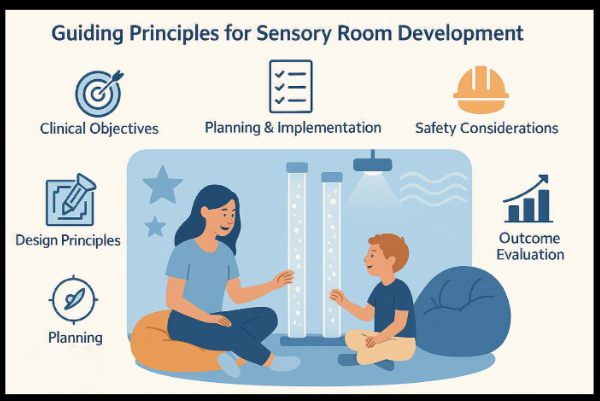
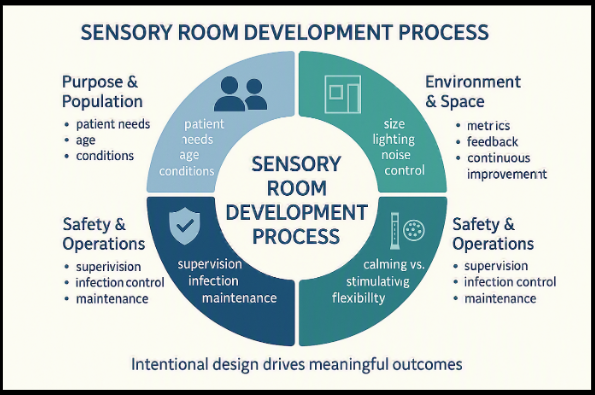
The development of sensory rooms in healthcare settings is a complex undertaking that extends far beyond equipment selection. Effective implementation requires a comprehensive approach that integrates clinical objectives, design principles, operational logistics, safety considerations, and outcome evaluation.
While stakeholders may seek prescriptive recommendations regarding specific sensory tools, such determinations are premature without first addressing foundational questions related to purpose, population, and environment.
About the Author

David Cox, EdD, MBA
Assistant Director of Case Management, Orange Grove Center, Chattanooga, TN
Inspired by his sister, who is a member of the IDD community, David has worked in residential services for people with IDD, case management, and compliance. He is a part-time professor at the University of Tennessee at Chattanooga, and holds a Doctor of Education in Higher Education Leadership and Organizational Studies.
He works with the Chattanooga Police Department as an advisor for Crisis Intervention Teams on working with people with IDD. His research interests are autism, sensory processing disorders, dementia, and community engagement for people with disabilities. He has served as Vice President of American Association of Multi-Sensory Environments; Board of Directors of The Arc Tennessee; as a Gallup Certified Strengths Coach; as a Certified Special Olympics Coach and as a Member of People First Tennessee.