
Dementia-Capable Supports for Adults with Intellectual Disability
A planning framework for residential and day supports for adults with intellectual disability and dementia.
By Matthew P. Janicki, PhD
Summary: As adults with intellectual disability (ID) experience longer life expectancies, more are developing dementia, particularly individuals with Down syndrome. This growing need challenges traditional residential and day-service models, which were designed for relatively stable support needs. The article introduces dementia capability as a practical framework for helping organizations recognize cognitive decline, adapt services, and maintain quality of life as individuals' needs change over time. Rather than relying on specialized dementia programs, dementia capability can be incorporated into group homes, supported living, day programs, and community-based services.
A dementia-capable environment extends beyond the physical setting to include staffing, communication practices, routines, organizational policies, healthcare coordination, and person-centered planning. Effective environments feature clear layouts, good lighting, reduced noise, predictable but flexible routines, familiar people and activities, and staff who understand how dementia affects individuals differently based on their lifelong abilities. Organizations must also develop policies that support aging in place, provide ongoing staff training, coordinate with healthcare providers, and adjust services as dementia progresses.
The article distinguishes dementia capability from related concepts such as dementia-aware, dementia-friendly, and dementia-inclusive by emphasizing that true capability integrates workforce knowledge, environmental adaptations, and organizational systems to provide sustained support. Residential and day-service providers must work collaboratively, sharing information to recognize changes early and coordinate care. The illustrative case of a woman with Down syndrome and Alzheimer's disease demonstrates how individualized planning, environmental modifications, and coordinated support enabled her to remain in familiar settings while preserving comfort, identity, and meaningful participation. Ultimately, dementia capability is an ongoing organizational commitment that enables people with intellectual disability and dementia to age with dignity, safety, and the highest possible quality of life.
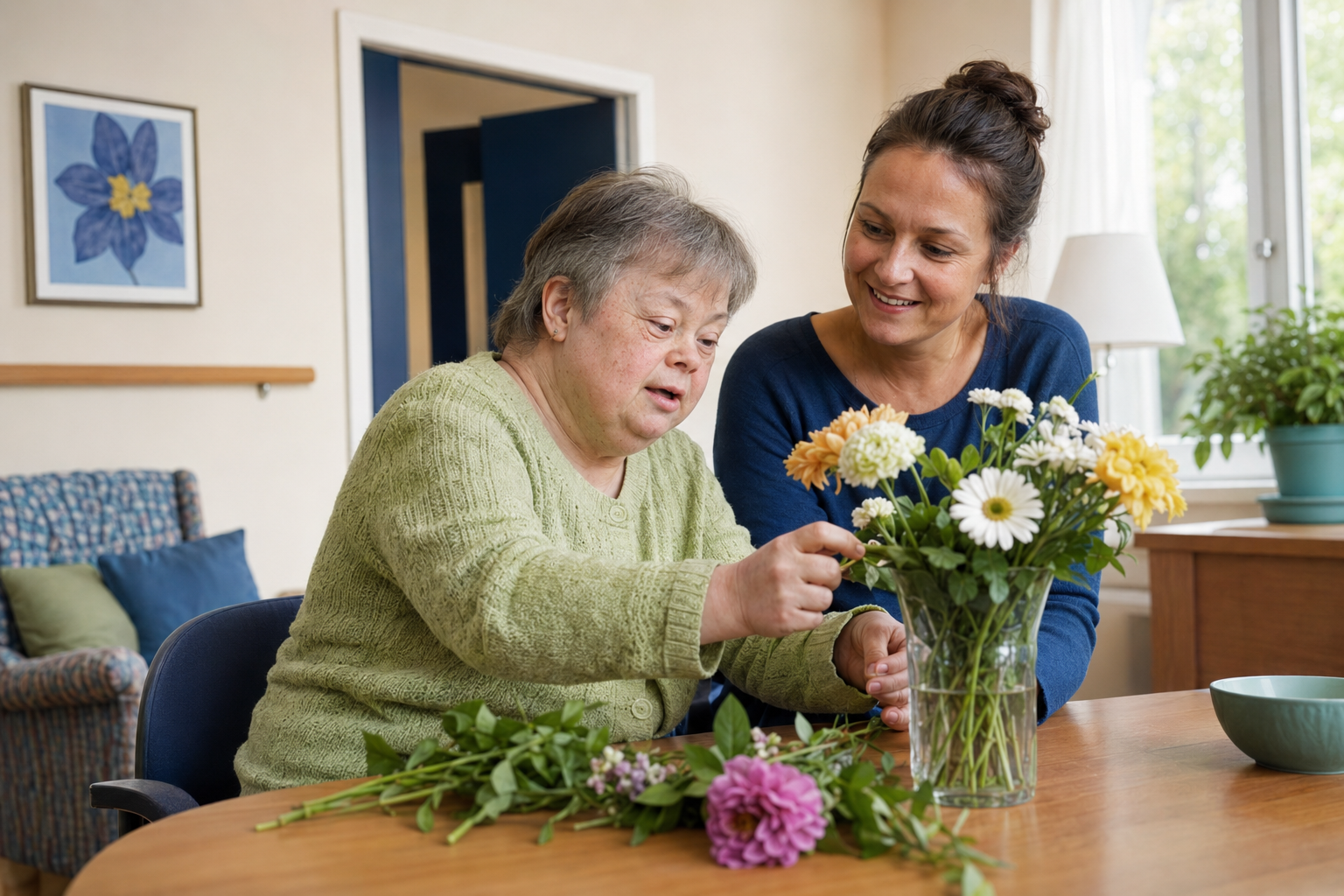
A dementia-capable environment does not merely accommodate decline. It anticipates change and organizes space, routines, personnel, and policy so that adults with intellectual disability can remain safe, engaged, known, and supported.
As adults with intellectual disability live longer, residential, and day-service organizations are increasingly supporting people who develop dementia resulting from Alzheimer’s disease or other underlying conditions. This is particularly evident among adults with Down syndrome, but dementia also affects older adults with other intellectual disabilities. The resulting changes in memory, communication, judgment, mobility, sensory processing, and self-care can challenge service models originally designed around relatively stable support needs.
The concept of dementia capability offers a useful way to frame the response. Rather than asking whether a program is a specialized dementia program, it asks whether the setting can recognize dementia-related change, adapt its supports, and sustain an appropriate quality of life as needs evolve. This shift is important because capability can be developed in many settings: a group home, supported apartment, adult day program, vocational program, community hub, or specialized service. The essential question is not the label on the building. It is whether the environment and the organization can respond.
What “dementia-capable” means
The term is established, although not uniformly defined, in applied gerontology and aging-services policy. In its strongest sense, dementia-capable describes the operational ability of a system, organization, workforce, or program to recognize and respond to the changing needs of people living with dementia and those who support them. It encompasses knowledge, staffing, policies, assessment, care coordination, caregiver support, environmental adaptation, and quality improvement. It therefore means more than being aware of dementia or expressing a commitment to inclusion.
Applied to service environments, dementia capability should also be understood broadly. The environment is not only the building. It includes the physical surroundings, the sensory climate, the rhythm of the day, communication practices, staff expectations, relationships, transportation, and the rules that determine who may remain in a program as needs change. A well-designed room cannot compensate for hurried routines or unprepared staff; likewise, skilled staff may struggle in a noisy, confusing, or physically unsafe setting.
The relevance of dementia capability within the intellectual disability service system lies in its flexibility across people, diagnoses, and stages of dementia. Adults with intellectual disability are a heterogeneous population whose lifelong cognitive, communication, adaptive, health, and sensory profiles influence how dementia-related change is expressed and recognized. Although dementia due to Alzheimer’s disease is especially prevalent among adults with Down syndrome, adults with other intellectual disabilities may develop dementia arising from Alzheimer’s disease, cerebrovascular disease, Lewy body disease, frontotemporal degeneration, or multiple co-occurring pathologies, each producing potentially different patterns of cognitive, behavioral, functional, and physical change. Support needs also evolve from early, sometimes subtle departures from the person’s baseline to increasing assistance with daily activities, mobility, communication, health management, and end-of-life care. A dementia-capable framework helps intellectual disability providers plan for this variability without relying on a single service model. It directs organizations to establish meaningful baselines, recognize individualized patterns of change, adapt environments and routines as dementia progresses, coordinate residential, day, and healthcare supports, and sustain person-centered care across the course of the condition.
Related language, but different emphases
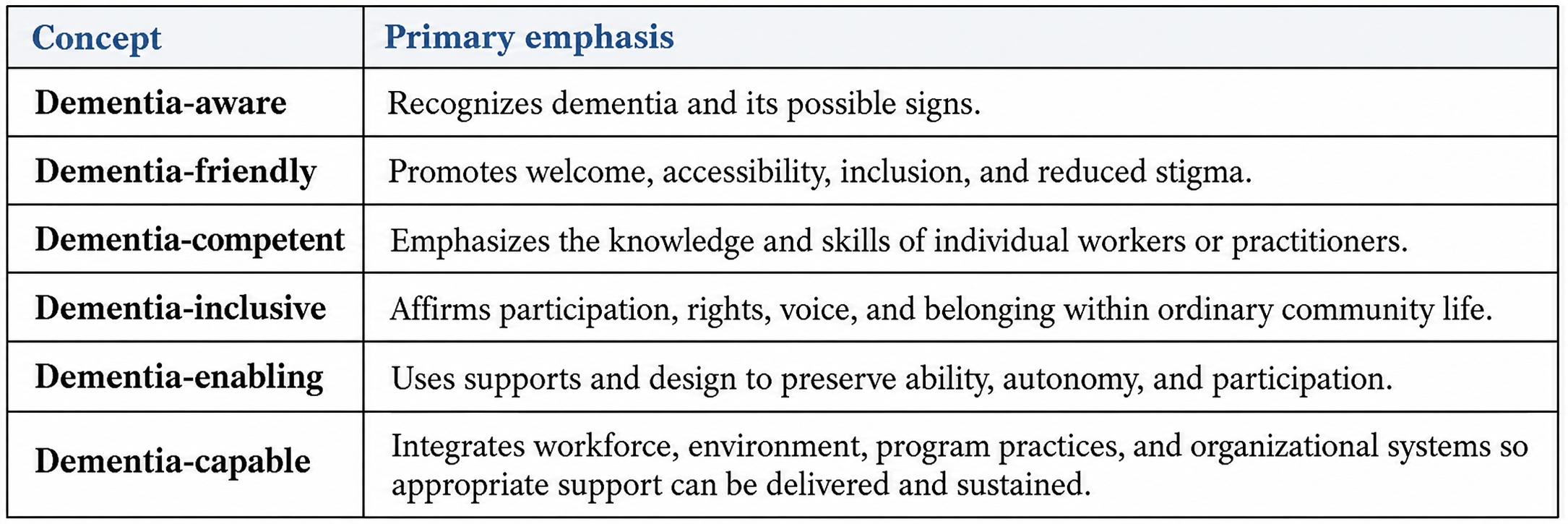
These concepts overlap and should be complementary. A setting may be friendly and inclusive yet lack the staffing flexibility, environmental adaptations, or clinical connections needed to support advancing dementia. Conversely, a technically capable program can still fail if it becomes overly restrictive or loses sight of identity, choice, and belonging.
The dimensions of a dementia-capable service environment
Physical legibility and safety. People experiencing cognitive and perceptual change benefit when spaces are understandable at a glance. Useful adaptations include consistent landmarks; clear routes to toilets, dining areas, and activity spaces; good lighting with limited glare; contrast between floors, walls, furniture, and fixtures; reduced visual clutter; accessible handrails and seating; and safe, inviting access to outdoor areas. These features should support movement rather than simply prevent it. Excessive barriers and locked spaces can reduce autonomy and turn risk management into unnecessary restriction.
A manageable sensory environment. Noise, crowding, competing conversations, glare, patterned surfaces, and frequent transitions can become increasingly difficult to interpret. Residential settings need quiet places for rest and recovery. Day programs may need smaller activity groupings, predictable seating, reduced background noise, and alternatives to large multipurpose rooms. Sensory adaptations must also account for the person’s lifelong profile; changes that help one individual may unsettle another.
Predictable but flexible routines. Dementia-capable programming relies on familiar sequences, meaningful cues, repetition, and enough time to respond. It avoids treating slower performance as refusal or noncompliance. In a residence, this may mean adjusting waking, bathing, meals, and bedtime to the person’s changing rhythms. In day services, it may mean shorter attendance, fewer transitions, rest periods, simplified activities, or replacing productivity-based expectations with engagement, companionship, and retained purpose.
Continuity and recognition of the person. The environment should preserve familiar people, objects, roles, and experiences wherever possible. Personal histories, communication patterns, cultural preferences, and long-standing sources of comfort should guide support. Familiarity is not merely sentimental; it reduces the cognitive work required to interpret everyday life. This is especially important for adults whose communication may already have been limited before the onset of dementia.
A workforce and organization that can adapt. Environmental capability depends on staff who recognize change from the person’s own baseline, communicate without confrontation, interpret behavior as possible communication, and adjust assistance as abilities fluctuate. Organizations must reinforce this through supervision, staffing patterns, cross-shift communication, health advocacy, medication review, access to clinical consultation, and policies that do not automatically exclude a person when care needs increase.
Residential and day services require different applications
In residential services, dementia capability is closely tied to home, continuity, nighttime support, personal care, mobility, and the possibility of remaining in a familiar setting. Planning should anticipate increasing supervision, changing sleep patterns, continence support, falls risk, swallowing difficulties, and end-of-life needs. Adaptations should be introduced gradually and reviewed as the person changes.
In day services, capability centers more strongly on transportation, arrival and departure, the pace and scale of activities, fatigue, meals, toileting, communication with residential or family caregivers, and the fit between program expectations and changing abilities. A day program becomes less capable when continued participation depends on maintaining former work speed, attention span, or independence. It becomes more capable when it can modify the day while preserving social connection and meaningful participation.
The two settings must also operate as a connected support environment. A change observed during the day may be the first indication of illness, pain, medication effects, sensory loss, or dementia progression. Shared documentation and timely communication allow patterns to be recognized across settings rather than interpreted as isolated incidents.
Illustrative Case: A Coordinated Response to Changing Needs
Maria, age 56, has Down syndrome and has lived in the same neighborhood group home for 15 years. She attends a community-based day program and has a diagnosis of Alzheimer’s disease. Staff first noticed that she was becoming confused during transportation, withdrawing from group activities, and requiring more prompting with meals and personal care. A dementia-capable response began with information from people who knew Maria well. Her caseworker worked with her family, residential staff, day-service personnel, and health-care providers to distinguish recent changes from her lifelong abilities and preferences. Her care plan was revised as her dementia progressed. At home, staff improved lighting, added visual cues, reduced evening demands, and maintained familiar routines. Her day program shortened her schedule, provided a quieter activity space, and replaced complex tasks with familiar music, household activities, and opportunities for companionship. Staff across settings shared observations about sleep, appetite, mobility, behavior, and medication effects. Dementia capability in this situation did not depend on moving Maria to a specialized program. It resulted from coordinated planning, knowledgeable staff, adaptable environments, and continuing attention to her identity, comfort, abilities, and changing support needs.
Using the concept for service planning
Dementia capability is most useful when treated as a developmental framework rather than a promotional label. Organizations can examine whether they are prepared across several linked domains: the people being served; the competencies and stability of the workforce; the accessibility of physical and sensory environments; the adaptability of daily programming; connections to health and dementia expertise; support for families and other caregivers; and policies governing admission, retention, transfer, and end-of-life care.
Planning should begin before a crisis. Baseline information can help staff recognize meaningful change. Environmental reviews can identify confusing routes, poor contrast, noise, glare, and unnecessary transitions. Workforce plans can specify who requires training and how new knowledge will be translated into everyday practice. Program policies can be evaluated against a practical question: would this rule help the service adapt to dementia, or would it shift the person elsewhere when support becomes more difficult?
Because there is no universally validated threshold for declaring a dementia-capable program, organizations should avoid using the term without evidence. Capability should be demonstrated through observable practices and outcomes: fewer preventable disruptions, sustained participation, appropriate health follow-up, reduced distress, support for caregivers, and preservation of choice and quality of life. Input from people with intellectual disability, families, direct support professionals, and day- and residential-service staff is essential in judging whether an environment works as intended.
A practical way forward
The value of dementia capability lies in bringing otherwise separate concerns into one planning frame. Environmental design, staff education, person-centered practice, health advocacy, and organizational policy are not independent improvements. Together they determine whether a person can understand the setting, take part in daily life, receive appropriate help, and remain connected to familiar people and places.
For residential and day-service providers, becoming dementia-capable does not necessarily require creating a new building or a segregated program. It requires the disciplined capacity to notice changes, learn from the person, modify the surroundings and the day, and plan for needs that are likely to increase. A capable environment is therefore not static. It evolves with the people who use it—and makes adaptation the responsibility of the service, rather than expecting the person with dementia to continue fitting into an unchanged program.
About the Author

Dr. Janicki is a psychologist and expert on aging and dementia in people with IDD. He co-leads the National Task Group on Intellectual Disabilities and Dementia Practices and has authored numerous publications shaping public policy and care models for aging individuals with developmental disabilities.
Research Associate Professor at Institute on Disability and Human Development, University of Illinois Chicago
References
Janicki, M. P. (2011). Quality outcomes in group home dementia care for adults with intellectual disabilities. Journal of Intellectual Disability Research, 55(8), 763–776. https://doi.org/10.1111/j.1365-2788.2011.01424.x
Lin, S.-Y., & Lewis, F. M. (2015). Dementia friendly, dementia capable, and dementia positive: Concepts to prepare for the future. The Gerontologist, 55(2), 237–244. https://doi.org/10.1093/geront/gnu122
Quirke, M. (2023). Environmental design for people living with dementia. Encyclopedia, 3, 1375–1389. https://doi.org/10.3390/encyclopedia3030099
Silverstein, N. M., Wong, C. M., & Brueck, K. E. (2010). Adult day health care for participants with Alzheimer’s disease. American Journal of Alzheimer’s Disease & Other Dementias, 25(3), 276–283. https://doi.org/10.1177/1533317510361237
Watchman, K., Janicki, M. P., & Members of the International Summit on Intellectual Disability and Dementia. (2019). The intersection of intellectual disability and dementia: Report of the International Summit on Intellectual Disability and Dementia. The Gerontologist, 59(3), 411–419. https://doi.org/10.1093/geront/gnx160