
Disability Beyond Awareness
On Awards, Effort, and Authenticity
Summary: ReelAbilities critiques mainstream media for reducing disability to award-worthy performances and tired tropes, calling for authentic, complex narratives over predictable, sentimental stories. The piece advocates for year-round representation that reflects the multifaceted, often un-sanitized, reality of disabled lives. To explore authentic disability-driven stories, visit the ReelAbilities Stream platform.
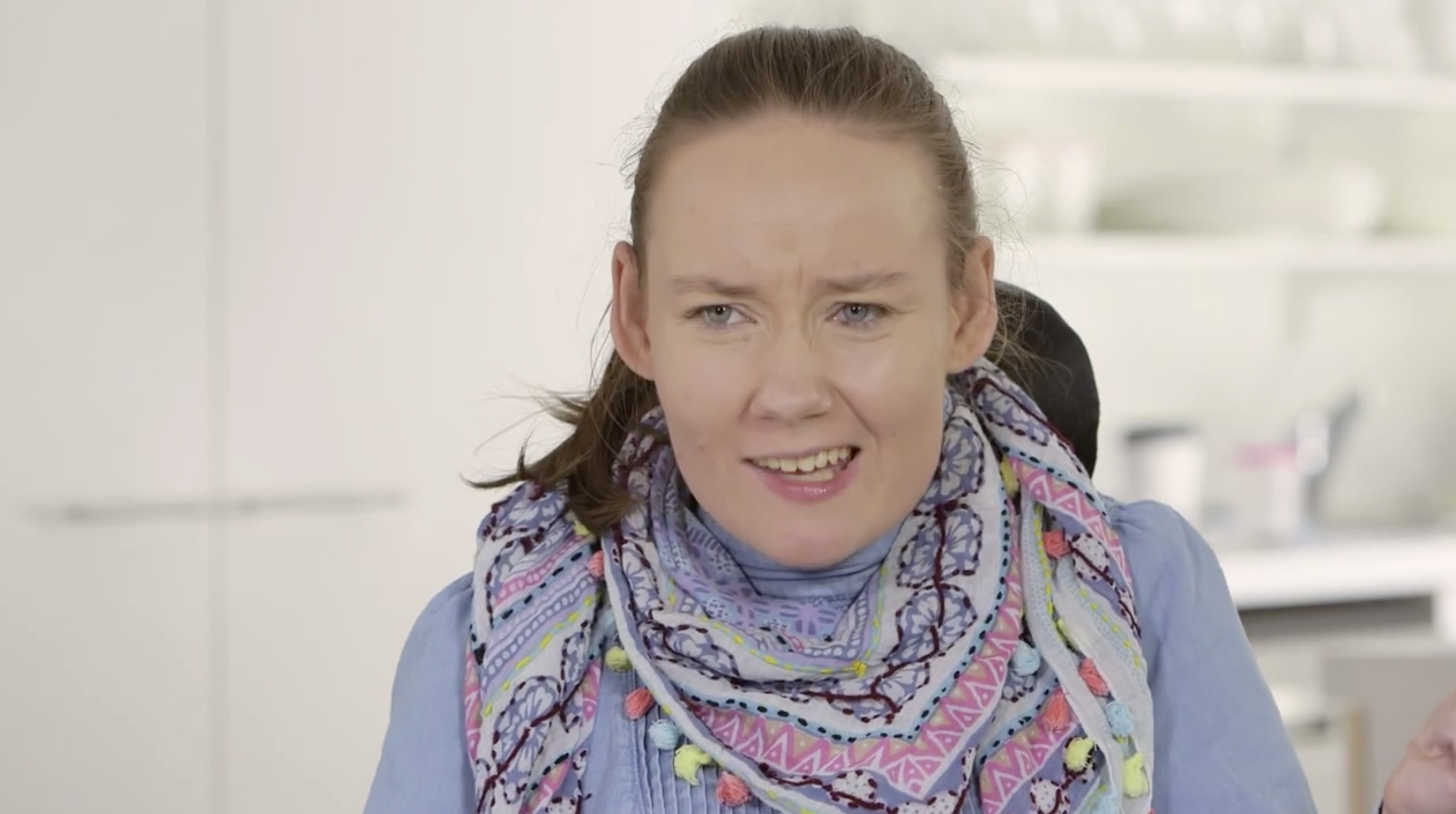
Actress Emily Dash in a scene from the movie “The Milky Pop Kid”. In the short film, a disability consultant (Dash) is challenged by her task to coach an aspiring actor to play ‘disabled’.
As we transition into April, a look back at the calendar reminds us that March is one of those months when disability suddenly becomes very popular. Developmental Disabilities Awareness Month. Cerebral Palsy Awareness Month. Panels, proclamations, hashtags, pastel graphics, earnest declarations. You’ve probably seen it to some degree.
Alongside all that, for film folks, specifically, the spectre of awards season also fades into memory with its own familiar rituals: another round of applause for stories that treat disability as a stand-in for depth, hardship, inspiration, or transformation. Another actor praised for making a big show of imagined suffering. Another performance admired for overcoming. Another reminder that society loves disability, but conditionally – when it can be performed, admired, and redeemed predictably on cue.
We’ve seen this before. Names and faces change, but the patterns remain.
Too often, disability shows up on screen as metaphor, mood, morality lesson, or accessory. A substitute for a complicated, messy, surprising, or unexpected person. And somehow, after all this time, we are still expected to clap when someone limps meaningfully into awards contention.
Enough.
ReelAbilities has spent 18 years pushing back against this conditioning. What started in New York as a film festival has grown into a broader disability-centered platform spanning year-round programming, education, industry engagement, including ReelAbilities Stream, bringing films by and about disabled people directly to your laptops and living rooms.
All of the above is why two films currently available on ReelAbilities Stream, The Milky Pop Kid and Extra Special, feel especially worth your time this month. They surprise and subvert in ways best discovered firsthand, not spoiled in advance. Better to watch, wrestle with them a bit, then compare notes after the fact.
Because here’s the thing: The stories that stay with us are rarely the ones that behave. They are not the ones peacocking for moral approval or making a big show about their importance in the most obvious possible ways. They surprise, catch you off guard, and perhaps most surprisingly, trust audiences to keep up.
Disability-informed storytelling – when it is actually allowed to – can do all of this and more. Disability is a lot of things. It can be funny, sly, uncomfortable, intimate, odd, messy, gorgeous, irritating, unresolved. In other words, like life. Not the cleaned-up, awards-friendly version. The real thing is seldom predictable. More often than not, it is complex.
Which is also why the word inspiration deserves a little side-eye. Despite conventional assumptions, inspiration is more than a warm fuzzy feeling. And it isn’t passive. At its core, inspiration is a verb. To matter, it requires action. Some shift in thought, behavior, expectation, or result. Anything less is just aspiration – another way of saying hot air.
What matters most is what comes next. What we watch. What we reward. What assumptions we carry into the room with us. What we hold on to. Whether we are willing to move beyond the same old formulas and let disability be something other than shorthand for tragedy, heroism, somebody else’s character development, or someone else’s shame.
That is where ReelAbilities Stream earns its keep. Not as a container for “issue-related” content, but as part of a larger effort to widen, reframe and make room for stories too often sidelined, sanitized, or softened for someone else’s comfort.
Don’t get me wrong, the change of seasons is a useful prompt. So, let’s take advantage of the occasion.
Then put it to good use.
Start with The Milky Pop Kid and Extra Special. Watch. Consider. Share. Discuss.
Argue even.
Because we all know that while disability is many things – community, culture, history, and identity among them – disability is not a genre. It shouldn’t be minimized as metaphor, limited to an acting exercise, or reserved solely as a seasonal theme.
Disability is life. With needs that change like the seasons. Odds are that if you’re lucky to live long enough, one day you’ll join the club.
And life, when lived to its fullest, is almost always more interesting when we refuse to behave.
NOTE: Readers can use promo code HELEN to stream their first film free on ReelAbilities Stream.
About the Author

Lawrence Carter-Long is Director of Engagement for ReelAbilities International and a leading voice on disability in media. He has created, curated, critiqued, and consulted on projects for organizations including the National Endowment for the Arts, Sundance, SAG-AFTRA, AFI, NPR, the BBC, and Disney+. His writing has appeared in Film Quarterly, PBS, The Atlantic, and USA Today, and he is a regular contributor to Able News. He has also lectured and curated programs on disability history and representation at the Library of Congress, the Academy Museum of Motion Pictures, and the United Nations.
Photo by Positive Exposure