
President’s Message
Abuse: The Ultimate Betrayal
Summary: This narrative highlights the high risk of abuse faced by individuals with intellectual and developmental disabilities (I/DD) and the critical, often missed, role of dental professionals in identifying such cases. Despite high rates of victimization, particularly for those with limited communication skills, systemic barriers and failures to investigate often leave these crimes against vulnerable individuals unprosecuted.

In 1990, I was appointed as an advisor for a Dental Coalition to combat child abuse and neglect that was formed in Massachusetts as a result of significant increase in reported cases to the State Department of Social Services. In the previous year, one out of every twenty eight children were reported as being abused or neglected. Fifteen children died from child abuse. Three out of every ten children in an average dental practice were reported to have been sexually molested. The issue was so urgent that as of November 15, 1990, all dentists in the state were required to sign a statement that advised them of their legal responsibility to report abuse.
Why were we, the dental professionals, targeted for this awareness campaign? Sixty-five percent of physical child abuse includes injury to the head, neck, or mouth. Dentists and dental hygienists may be the only health care professionals to see an abused child on a regular basis. Many times, an abusive parent won’t take their child to the same pediatrician or emergency room, but they will take them to the same dentist. The experience I had, and lessons learned had a profound influence on my career as a clinician, educator, and creator of the dental program for Special Olympics International.
Before the 1960’s, injuries to children were frequently misdiagnosed as accidents or diseases as health care professionals were reluctant to believe parents or caregivers would intentionally harm their children. Systemic awareness of child abuse in the United States began in the early 1960’s but it had not gained medical attention until Dr. Henry Kempe, and his associates published an article in the Journal of the American Medical Association in 1962 when he coined the term “battered-child syndrome.”
Following this article, from 1963-1967 the Children’s Bureau proposed legislation for reporting abuse and by 1967 all states enacted mandatory child abuse reporting laws. The Child Abuse Prevention and Treatment Act (CAPTA), Public Law 93-247 established federal funding for state reporting and investigative systems.
Children with disabilities are 3.7 times more likely to be victims of physical abuse, 2.9 times more likely to experience sexual violence, and 1 in 5 will be neglected. While all children with disabilities are at a higher risk, children with behavior disorders are 7 times more likely to experience neglect, physical, or emotional abuse. Deaf or hard of hearing children have twice the risk of neglect and emotional abuse and 4 times the risk of physical abuse.
Awareness of the abuse of adults with intellectual disabilities lagged behind child abuse, emerging prominently in the 1960-1970’s through institutional exposés. While abuse was documented in individual cases earlier, widespread societal recognition of the systemic, widespread violence against adults with disabilities did not occur until the deinstitutionalization movement exposed horrific conditions. Media exposés such as Burton Blatt’s “Christmas in Purgatory” (1966) and Geraldo Rivera’s “Willowbrook; The Last Great Disgrace” (1972) revealed widespread abuse to the public.
Current data confirms that adults with IDD experience abuse, neglect, and exploitation at 2.5 times more than the general population and 90% experience sexual abuse in their lifetime. Individuals with cognitive disabilities have the highest rate of victimization and in 96% of the cases the perpetrators are caregivers, family members, or peers; all being known to the victim. Forty-nine individuals with I/DD will experience 10 or more incidents of abuse and the more severe or profound the disability, the higher their risk of abuse or neglect is.
As a barrier to justice, abuse reporting of adults with I/DD is hindered by fear of retaliation, e.g., loss of care, communication difficulties, or the fact that the victims may not recognize the perpetrators’ behavior as abuse. SERIOUS CRIMES AGAINST ADULTS WITH I/DD are prosecuted at a rate of only 5% compared to 70% FOR THOSE WITHOUT DISABILITIES.
“Abuse manipulates and twists a child’s natural sense of trust and love. Her innocent feelings are belittled or mocked, and she learns to ignore her feelings. She can’t afford to feel the full range of feelings in her body while she’s being abused—pain, outrage, hate, vengeance, confusion, arousal. So, she short-circuits them and goes numb. For many children, any expression of feelings, even a single tear, is cause for more severe abuse. Again, the only recourse is to shut down. Feelings go underground.”
Several months ago, a friend and neighbor approached me with an unconscionable predicament. Every week he visits his 59 year old daughter and takes her out to lunch. She has Autism and I/DD with minimal verbal skills and resides in a group home. He is a very involved parent, calls daily to check in with her, and staff to ensure that all her needs are met.
This week when he picked her up, he was horrified to see that she had suffered severe facial injuries, and he had not been informed about any accident. The supervisor of the group home explained that she had fallen out of the bed, they had taken her to the emergency room where she received treatment for a broken nose, black eyes, and bruising of the peri-oral area. She was discharged, returned home, and went to work the following day. They did not think it was important enough to inform him of the accident. When he asked his daughter about what happened to her, she was unable to articulate any answers. She had no idea what happened.
Her dad is a retired law enforcement officer who throughout his career investigated countless cases involving domestic violence, assault and battery, abuse and neglect cases. He immediately and clearly identified the injuries as a result of a physical assault.
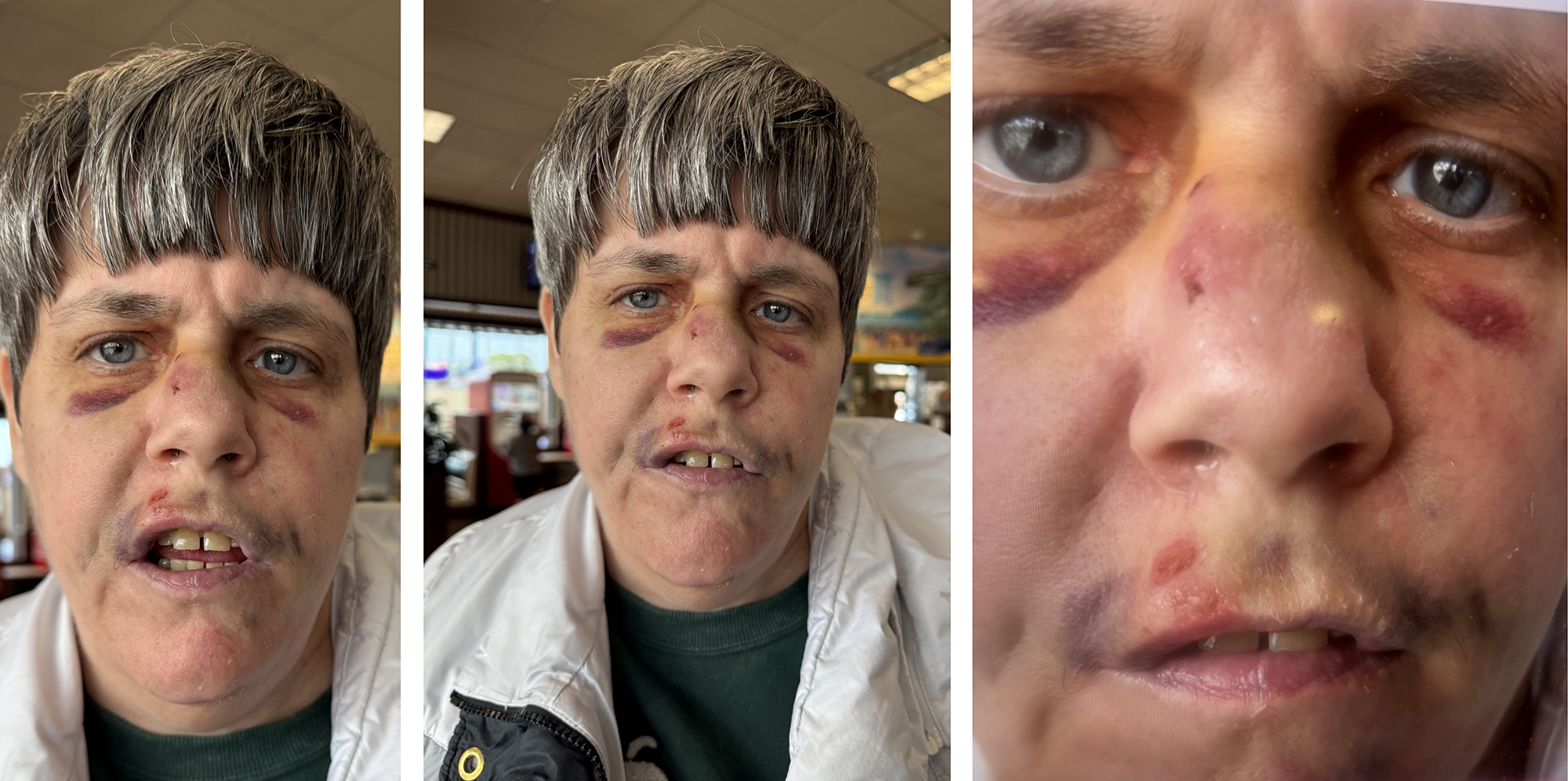
The injuries observed after “falling out of bed.”
He shared her photos with multiple professionals for their expert opinions. The consensus was that it was not a falling out of bed accident, but a deliberate physical assault. He then notified the State Department of Developmental Services, The Disabled Persons Protection Commission, and filed a report with the local police department. He was convinced that the bruising of the lips was caused by a hand to prevent her from crying out.
One month after the charges were filed, two staff members of the group home were interviewed, but her dad was not allowed to be present. Both police investigators determined it was a fall. The District Attorney refused to investigate the case. His daughter is being supervised by the same staff members who were on duty the evening of the accident.
A necessary piece of evidence that would be vital in determining whether this was a fall or abuse would be to have a forensic review of the photographs. The police and agencies denied the request, claiming they did not have the funds to spend on it. Her dad attempted to pay for it and was denied.
He requested a change of group homes, and it was denied. The Department of Developmental Services told him if he was unhappy about it then he should take her home to live with him. He is 85 years old and has another daughter who is 50 years old with a disability as well. He is also taking care of his 83 year old sister who has dementia.
His last quote to me was “I feel abandoned by people responsible for caring for my daughter with severe disabilities.”
Shame on everyone involved in this case whose main job is to keep people with intellectual and developmental disabilities–our most vulnerable population, safe, healthy, and happy. To protect them from harm’s way, to advocate for them, especially when they are unable to communicate for themselves and help their families throughout their lifespan.
No wonder crimes against people with /IDD are only prosecuted at a 5% occurrence rate.
I doubt that I would be sharing this story if my friend’s daughter were neurotypical and verbal.
As violence and abuse against people with Intellectual and Developmental Disabilities remains persistent with evidence suggesting that severe abuse and neglect are increasing, we all need to be their advocates.
If not us, then WHO!!
About the Author

Steve Perlman, DDS, MScD, DHL (hon) President, People Advocating for Optimal Health (PAOH) Special Projects Sr., Editor Helen: The Journal of Human Exceptionality