
An Inclusive Dementia Plan
Ensuring That Adults with an Intellectual Disability Are Included in the US National Dementia Plan
By Matthew P. Janicki, PhD, and Seth M. Keller, MD
Summary: The National Task Group on Intellectual Disabilities and Dementia Practices is urging federal planners to explicitly include adults with intellectual disabilities, including people with Down syndrome, throughout the National Plan to Address Alzheimer’s Disease through 2035.
The authors call for better diagnosis based on changes from an individual’s baseline, greater inclusion in Alzheimer’s research and treatment, stronger coordination between dementia care and disability services, better workforce training, and outcomes that reflect quality of life, relationships, communication, and the ability to remain in familiar homes and communities.

The United States is preparing a comprehensive update of the National Plan to Address Alzheimer’s Disease through 2035. In response to a Request for Information from the U.S. Department of Health and Human Services (HHS), the National Task Group on Intellectual Disabilities and Dementia Practices (NTG) urged that adults with intellectual disabilities, including those with Down syndrome, be explicitly incorporated throughout the Plan’s research, detection, treatment, care, workforce, data, and accountability strategies.
The concern is straightforward. Adults with intellectual disabilities develop Alzheimer’s disease and other dementias, yet the systems supporting them have largely developed apart from the nation’s aging and dementia systems. As a result, they may be underrepresented in research, experience delayed diagnosis, encounter barriers to treatment, and remain disconnected from dementia programs even when eligible for them.
For adults with Down syndrome, the issue is particularly urgent. Alzheimer neuropathology develops decades earlier than in the general population, with symptomatic cognitive and functional decline commonly emerging in midlife. Adults with other intellectual disability also develop dementia, but recognition can be difficult because lifelong cognitive and functional differences complicate conventional assessment. New decline may be attributed to intellectual disability, psychiatric conditions, behavior, or aging rather than investigated as possible dementia. Conversely, the high risk of Alzheimer’s disease associated with Down syndrome can result in treatable conditions being mistaken for dementia.
The NTG’s central recommendation to HHS is that inclusion must be operational, not simply nominal. Adults with an intellectual disability should not disappear within broad designations such as “underserved populations,” “other disabilities,” or “younger-onset dementia.” They should be identifiable within federal objectives, research programs, clinical initiatives, data systems, and outcome measures, with clear responsibility for implementation and accountability.
As illustrated in Figure 1, achieving meaningful inclusion requires a connected dementia pathway that extends from research and brain-health promotion through early detection, diagnosis, treatment, coordinated community supports, and end-of-life care. The pathway must be supported by knowledgeable caregivers and professionals, integrated health and disability services, and policies and data systems that promote equity and accountability.
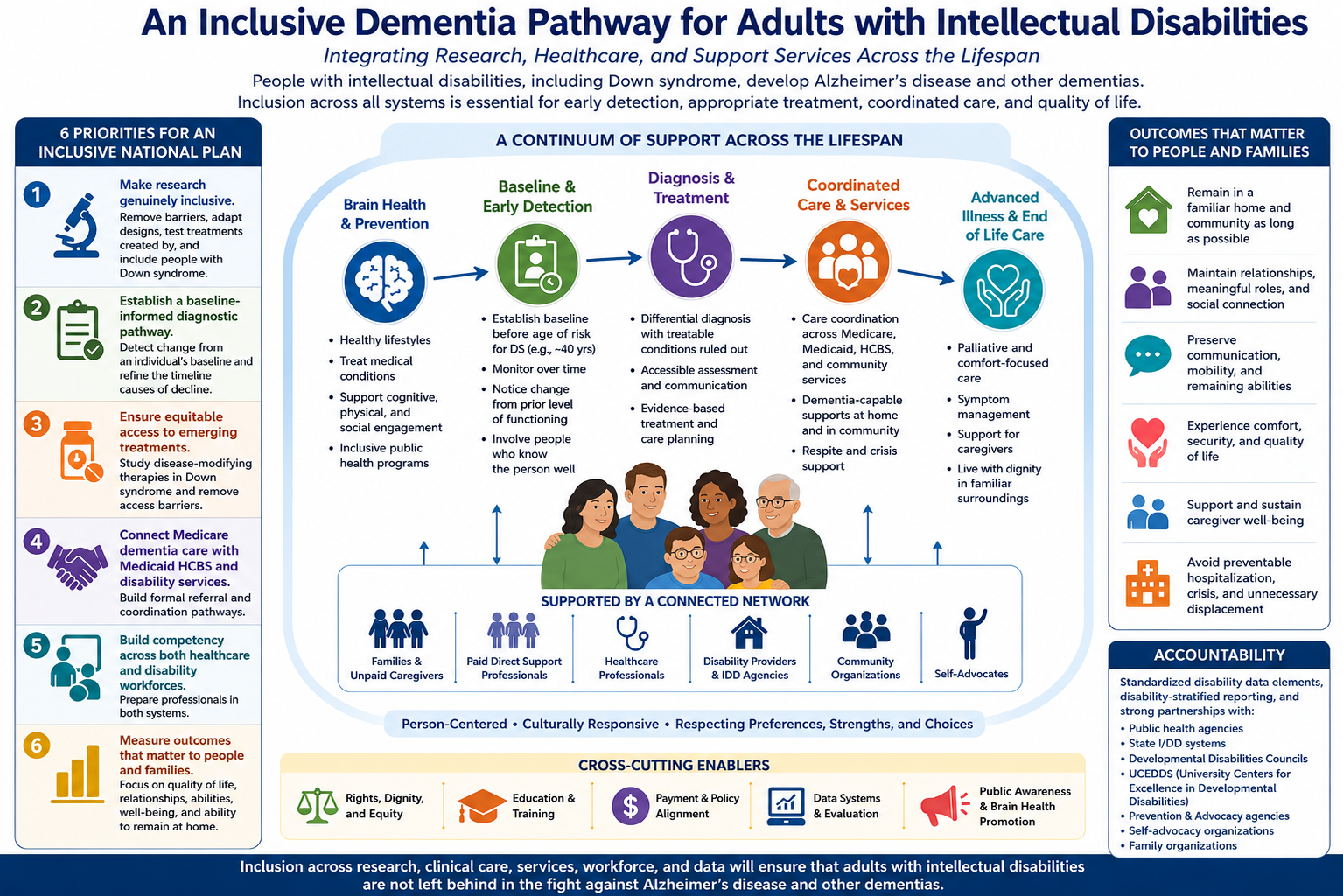
Figure 1. An Inclusive Dementia Pathway for Adults with Intellectual Disabilities. The framework illustrates the NTG's proposed continuum linking research, detection, diagnosis and treatment, coordinated healthcare and disability services, and advanced dementia care, supported by cross-cutting attention to workforce competency, rights and equity, financing, data, and public awareness.
Diagnosis Requires a Different Starting Point
Most conventional approaches to dementia assessment assume previously typical cognition and functioning, an ability to report symptoms, and meaningful comparison with population norms. These assumptions frequently do not apply to adults with lifelong intellectual disability.
For this population, the essential question is: What has changed from this person’s previous level of functioning?
The NTG recommends a national clinical pathway built around documented baseline functioning, longitudinal observation, knowledgeable informants, adapted assessment, and systematic consideration of conditions that can cause, mimic, or contribute to apparent decline. Pain, depression, medication effects, hypothyroidism, sleep apnea, hearing or vision loss, seizures, and environmental disruption are among the factors that should be considered before changes are attributed to dementia.
The intellectual disability population is itself heterogeneous, and dementia risk, age of onset, clinical presentation, communication ability, and support needs vary substantially across individuals and etiologies.
For adults with Down syndrome, baseline cognitive, behavioral, and functional information should be established before the age when symptomatic change is expected, with periodic review beginning by approximately age 40. Adult primary care and other clinicians also need clear referral pathways so that emerging cognitive or functional changes lead to appropriate assessment rather than remaining unrecognized within healthcare systems poorly prepared for aging and dementia in people with intellectual disabilities.
Research Advances Must Become Accessible Treatment
Major federal investments have substantially advanced understanding of Down syndrome-associated Alzheimer’s disease. Yet scientific progress does not automatically translate into equitable access to treatment.
Adults with an intellectual disability may be excluded explicitly or functionally from Alzheimer clinical trials because of cognitive eligibility criteria, consent procedures, inaccessible study materials, transportation requirements, behavioral assumptions, or failure to provide reasonable accommodations. Research involving adults with an intellectual disability other than Down syndrome remains particularly limited.
The emergence of Alzheimer disease-modifying therapies brings this issue into sharper focus. Adults with Down syndrome face restricted access to treatments such as lecanemab and donanemab because evidence concerning safety and efficacy in this population remains insufficient. The NTG therefore called for dedicated clinical trials of approved and emerging disease-modifying treatments in adults with Down syndrome, including investigation of whether intervention earlier in the disease course may provide meaningful therapeutic benefit.
“People should not be excluded from the benefits of scientific advances because they were inadequately included in the research that produced them.”
Connecting Dementia Care and Disability Services
Perhaps the most consequential problem identified in the NTG comments is fragmentation. Families and providers may have to navigate Medicare, Medicaid, home- and community-based services (HCBS) waivers, primary care, specialists, hospitals, aging services, and state intellectual/developmental disability (I/DD) systems, often without any entity responsible for connecting the pieces.
The solution is not another parallel service system, but mechanisms that connect existing dementia initiatives with the disability services people already use.
The Centers for Medicare & Medicaid Services’ Guiding an Improved Dementia Experience (GUIDE) Model illustrates the opportunity. GUIDE provides comprehensive dementia care management, caregiver education and support, and respite intended to help people remain in their homes and communities. For eligible adults with an intellectual disability to benefit fully, however, GUIDE participants and similar dementia programs need practical referral relationships with state I/DD agencies, disability service providers, families, and community organizations that can identify potentially eligible individuals and help connect them to services.
Medicaid HCBS must likewise become more dementia-capable. When dementia progresses, increasing support needs should lead, whenever possible, to more support coming to the person rather than the person having to move to obtain more support. Environmental adaptations, enhanced staffing, nursing and clinical consultation, behavioral support, palliative care, and end-of-life services can help people remain in familiar homes and communities as their needs change.
Supporting the People Who Provide the Care
Dementia caregiving in the intellectual disability community extends beyond conventional models of family caregiving. Support may come from aging parents, siblings, shared-living providers, direct-support professionals, or group-home staff. Those who have known the person for years may be among the first to recognize subtle changes in behavior, communication, abilities, or everyday functioning.
Yet paid caregivers and disability provider organizations are not consistently recognized as partners by mainstream dementia programs. Both unpaid and paid caregivers need access to dementia education, resources and support, including consultation, respite, crisis support, and care planning. Maintaining workforce stability is equally important: repeated staff turnover can result in the loss of precisely the longitudinal knowledge needed to recognize change and provide individualized dementia care.
Workforce competency must also extend in both directions. Healthcare professionals need greater understanding of intellectual disability, lifelong patterns of functioning, and the clinical presentation of acquired decline. At the same time, the disability workforce needs practical preparation to recognize and respond to dementia. Training alone will not be enough; competency must be reinforced through consultation, professional education, payment policy, clinical standards, and organizational support.
Six Priorities for an Intellectual Disability-Inclusive National Dementia Plan
Make research genuinely inclusive. Remove unnecessary participation barriers, adapt research procedures, report outcomes by disability status, and expand research beyond Down syndrome.
Establish a baseline-informed diagnostic pathway. Assess dementia as acquired change from the individual’s prior cognitive, functional, behavioral, communication, and neurological status, while systematically evaluating treatable causes of decline.
Ensure equitable access to emerging treatments. Conduct dedicated studies of Alzheimer disease-modifying therapies in adults with Down syndrome and ensure that lack of prior research participation does not become a continuing barrier to treatment.
Connect Medicare dementia care with Medicaid HCBS and disability services. Build referral and coordination pathways among dementia programs, I/DD agencies, disability providers, healthcare systems, and families.
Build competency across both healthcare and disability workforces. Prepare healthcare professionals to recognize dementia in adults with an intellectual disability and equip disability professionals to respond effectively as dementia progresses.
Measure outcomes that matter to people and families. Look beyond diagnosis and cognitive scores to quality of life, communication, remaining abilities, relationships, caregiver well-being, avoidance of unnecessary hospitalization or displacement, and the ability to remain in a familiar home.
“Adults with intellectual disabilities should not have to leave the disability system to obtain dementia expertise, nor should they be excluded from dementia services because those services were designed without them in mind.”
Measuring What Matters
Inclusion also requires changing how success is measured. Outcomes designed around independently living older adults may not capture what matters to adults with intellectual disabilities and their families.
Timely diagnosis is important, but diagnosis should activate a pathway to care. Meaningful outcomes include quality of life, comfort and security, preservation of communication and mobility, continued participation in valued relationships and activities, caregiver well-being, access to appropriate treatment, and avoidance of preventable hospitalization, crisis transfer, or institutionalization. Improvement should be judged in relation to the individual’s baseline, preferences, and goals—not solely against normative expectations of independence.
Accountability requires data showing whether adults with intellectual disabilities actually receive timely diagnosis, appropriate treatment, coordinated dementia care, respite, and dementia-capable HCBS. The NTG therefore recommended standardized disability data elements, disability-stratified reporting, and stronger partnerships among public health agencies, state I/DD systems, the Developmental Disabilities Act network, self-advocacy organizations, and families.
From Parallel Systems to a Connected Pathway
The National Plan through 2035 offers an opportunity to correct the longstanding separation between intellectual disability and dementia policy. This does not require creating a separate dementia system for people with intellectual disabilities. It requires making mainstream dementia research and services genuinely inclusive while strengthening the dementia capability of the disability systems in which many people already receive support.
The goal is a connected pathway extending from inclusive research and brain-health promotion through baseline-informed detection, competent diagnosis, equitable treatment, coordinated Medicare and Medicaid services, dementia-capable HCBS, knowledgeable caregivers, and palliative and end-of-life care. Success should ultimately be measured by whether these systems preserve the person’s relationships, rights, abilities, choices, quality of life, and home.
Adults with intellectual disabilities should not have to leave the disability system to obtain dementia expertise, nor should they be excluded from dementia services because those services were designed without them in mind.
About the Authors

Dr. Janicki is a psychologist and expert on aging and dementia in people with IDD. He co-leads the National Task Group on Intellectual Disabilities and Dementia Practices and has authored numerous publications shaping public policy and care models for aging individuals with developmental disabilities. Research Associate Professor at Institute on Disability and Human Development, University of Illinois Chicago

Dr. Seth Keller specializes in the evaluation and care of adults with Intellectual and Developmental Disabilities (IDD) with neurologic complications. Dr. Keller is on the Executive Board of the Arc of Burlington County as well as on the board for The Arc of New Jersey Mainstreaming Medical Care Board. He is the co-president of the National Task Group on Intellectual Disabilities and Dementia Practices (NTG). He is also the founder and past chair of the Adult IDD Section with the American Academy of Neurology.
Dr. Keller is actively involved in national and international IDD health education as a speaker, and webinar and workshop participant. He is a co-author on a number of articles and book chapters relating to aging and dementia in those with IDD.