
Helping Children With Down Syndrome Thrive
Jana Iverson, PhD
Summary: Independent mobility is a critical part of early childhood development, but infants and toddlers with motor disabilities often face delays in getting the support they need. Jana Iverson explains how early mobility can influence social, cognitive, and language development and highlights tools such as the PUMA system that help young children move, explore, and participate more fully.
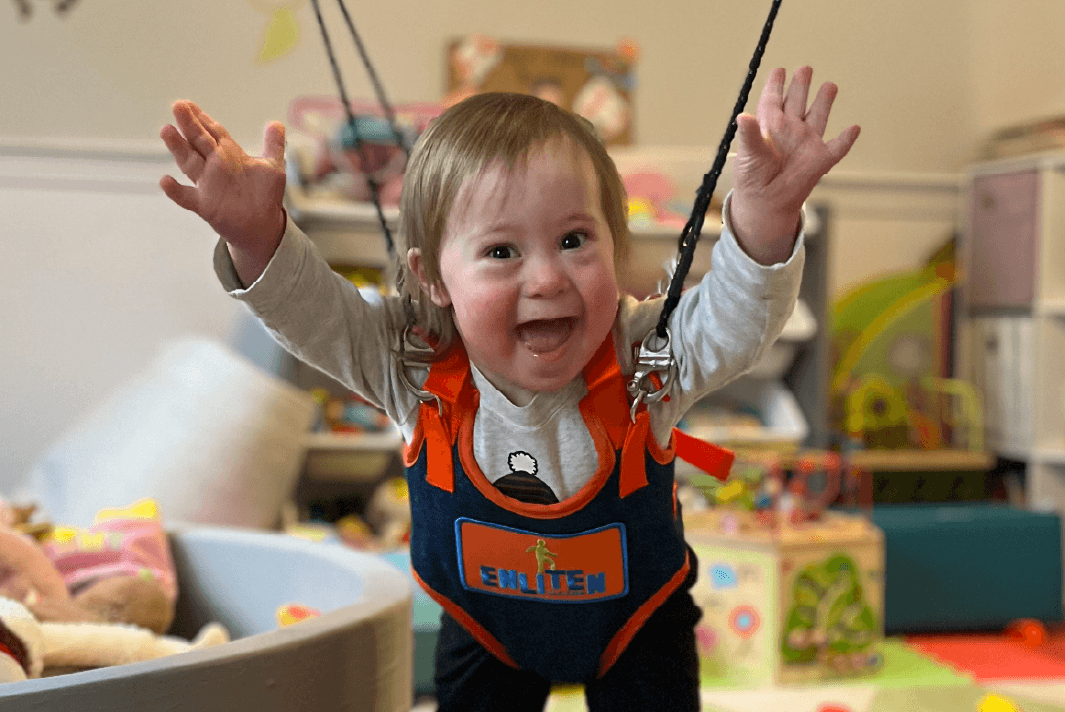
Chasing peers down the street. Exploring a playground. Carrying toys to a sibling’s room for joint play. These and many other everyday activities of early childhood rely on a child’s ability to move independently. For very young children with neurodevelopmental conditions that impact the emergence of gross motor skills, these activities are inaccessible. Infants and toddlers with significant motor delays or disabilities often spend large amounts of time immobile, in lying or seated positions on the floor or in furniture, or in strollers in which they are moved from one place to another by someone else.
The United Nations (Article 20, Convention on the Rights of Persons with Disabilities) has declared that mobility is a human right, yet it is a right that is often not extended to the youngest humans. For infants and toddlers with motor disabilities, there are numerous barriers to accessing mobility equipment even when it is clearly necessary. Equipment is costly, making it inaccessible to under- or uninsured families. Even with insurance, families may experience extremely long wait times and face significant challenges obtaining new equipment when their child outgrows current devices. For children who will eventually become mobile but whose timelines for doing so are extended (e.g., infants with Down syndrome), mobility supports can be beneficial in the short term as they work toward moving on their own. However, the incorrect belief that mobility devices interfere with skill development, along with the stigma associated with using equipment, means that providers often do not raise this possibility with families. Without mobility supports, children with motor challenges are left without a key means of accessing their environments, initiating social exchanges, and participating in the core activity of childhood—play.
The fundamental problem with this state of affairs is that mobility drives development. Nearly two decades of research in developmental science has made it increasingly clear that early experiences and opportunities provided by movement and motor activity play a fundamental role in supporting advances in social, cognitive, and language development. This is a fundamental premise of research in my laboratory, research that is guided by the developmental cascades framework. Central to this framework is the idea that development in its various domains is deeply interconnected. Development in one domain (e.g., motor) has far-reaching, downstream effects on achievements in others (e.g., language). Thus, for example, in neurotypical development, the onset of walking is accompanied by a series of changes in infant communication and language. Infants who are now upright and moving begin to produce more vocalizations and gestures to communicate. Caregivers respond with language rich with action words that describe the child’s activities and with labels for objects, and children’s word vocabularies rapidly increase. Increased travel within the environment and the greater access to objects that accompanies it, in other words, has a positive, cascading effect on children’s and caregivers’ communication.
The developmental cascades framework and its associated evidence base underscore the need to view delayed motor development with a real sense of urgency. Early motor delays are not isolated and confined to the motor domain, and even small delays can ripple downstream to impact language, cognitive, and social development. While we often wait for children to be “ready” for new experiences or supports, the reality is that waiting to address early motor delays is costly because their effects compound over time. Nowhere is this more the case than in infancy. The barriers and obstacles created by motor delays and difficulties are amplified in infancy because infants learn about the world by exploring their environments via movement. Movement allows infants to learn about themselves as agents as they observe the effects of their actions on objects (e.g., knocking over a block tower) and on the people around them (e.g., the reaction that ensues when an infant approaches a fragile object or the top of a staircase). The toddler years in particular are a time ripe with opportunities for children to test limits and learn to advocate for themselves, opportunities that come about as they explore and move about the world. For very young children with motor challenges, motor limitations significantly constrain access to the kinds of age-appropriate experiences that follow naturally from independent mobility.
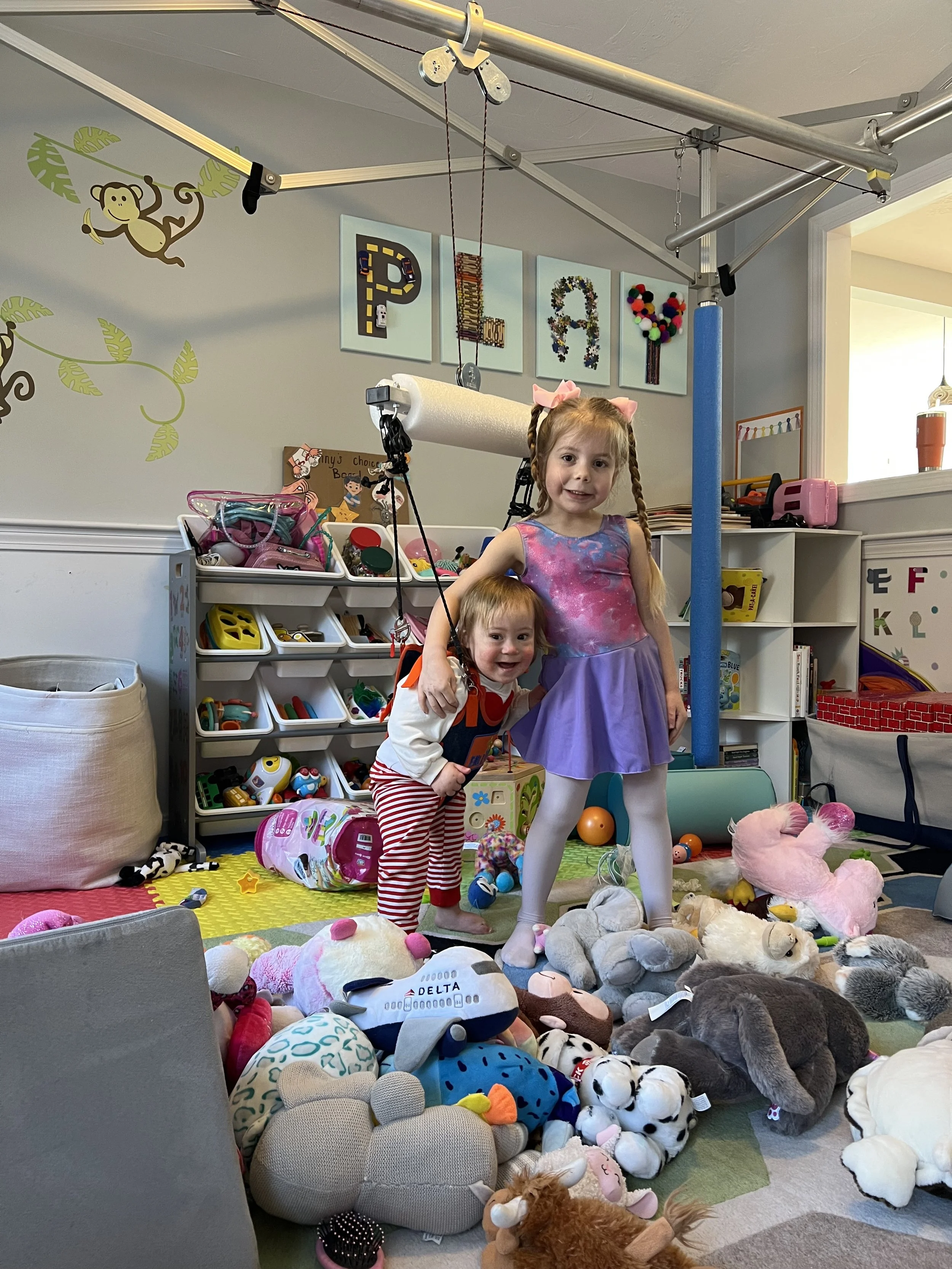
Because movement is crucial for early learning and exploration, the “wait and see,” “it’s part of the syndrome,” and “it’s just a motor delay” attitudes can no longer be justified. There is an urgent need to create opportunities for self-generated mobility for all children, and especially for the youngest children. Rather than waiting for ‘readiness,’ we need to work actively to identify solutions that meet infants and toddlers with motor delays and disabilities where they are and facilitate developmentally appropriate opportunities for exploration and play. Organizations such as Make Good and Go Baby Go address this challenge head-on by creating low-cost, accessible mobility supports for young children with motor challenges of all kinds. Work being done by our team and other groups around the country uses the Portable Mobility Aid for Children (PUMA; Enliten LLC), a body-weight support system that allows children to move freely within a portable 9’ x 9’ frame with adjustable support provided by bungee cords or sandbags that offset their body weight. The additional support allows them to be upright and move when they cannot yet do so independently. With the addition of toys and play partners, the PUMA creates a space for mobility-supported exploration, play, and social interaction.
We are currently using the PUMA in our work with infants with Down syndrome. Hypotonia and joint laxity can make movement difficult for these infants. As a result, they typically experience extended timelines for acquiring gross motor skills such as walking and moving about during play much less frequently than typically developing same-age peers. Given this profile, infants with Down syndrome are ideal candidates for an early supported-mobility experience that facilitates the kinds of opportunities for exploration, play, social interaction, and participation that we anticipate and encourage in same-aged peers. Although our work is still in its early stages, we have already observed that infants with Down syndrome quickly learn to be upright and move in the PUMA, practicing skills that they are not yet able to produce on their own (e.g., standing). Perhaps more importantly, they engage in active play while in the PUMA, often with siblings and others joining in the fun. Approaches like using the PUMA system for play demonstrate what is possible when we prioritize early mobility access rather than waiting for “the right time.” Early supported mobility creates important developmental opportunities and ensures that infants and toddlers with motor delays and disabilities have equitable access to the core experiences of early childhood: play, participation in family life and activities, and having fun.
About the Author

Jana M. Iverson, Ph.D. is Christopher A. Moore Professor of Pediatric Rehabilitation and Associate Dean for Research at Sargent College of Health & Rehabilitation Sciences, Boston University. Her research, funded by NICHD, NIDCD, and Autism Speaks, focuses primarily on the interface between the development of early motor skills and the emergence of communication and language in neurotypical infancy and in infants with or at risk for neurodevelopmental conditions.
Dr. Iverson has published a co-edited book and more than 100 articles and book chapters. She is on the editorial boards of the Journal of Child Language and Language Learning and Development and is a Fellow of the Association for Psychological Science.