
Antonio “Tony” Torres
Summary: Accessibility should create real opportunities for participation, growth, and independence. Through wheelchair motocross, Antonio “Tony” Torres shows how adaptive sports can build confidence, skills, community, and a stronger sense of what is possible for people with disabilities.
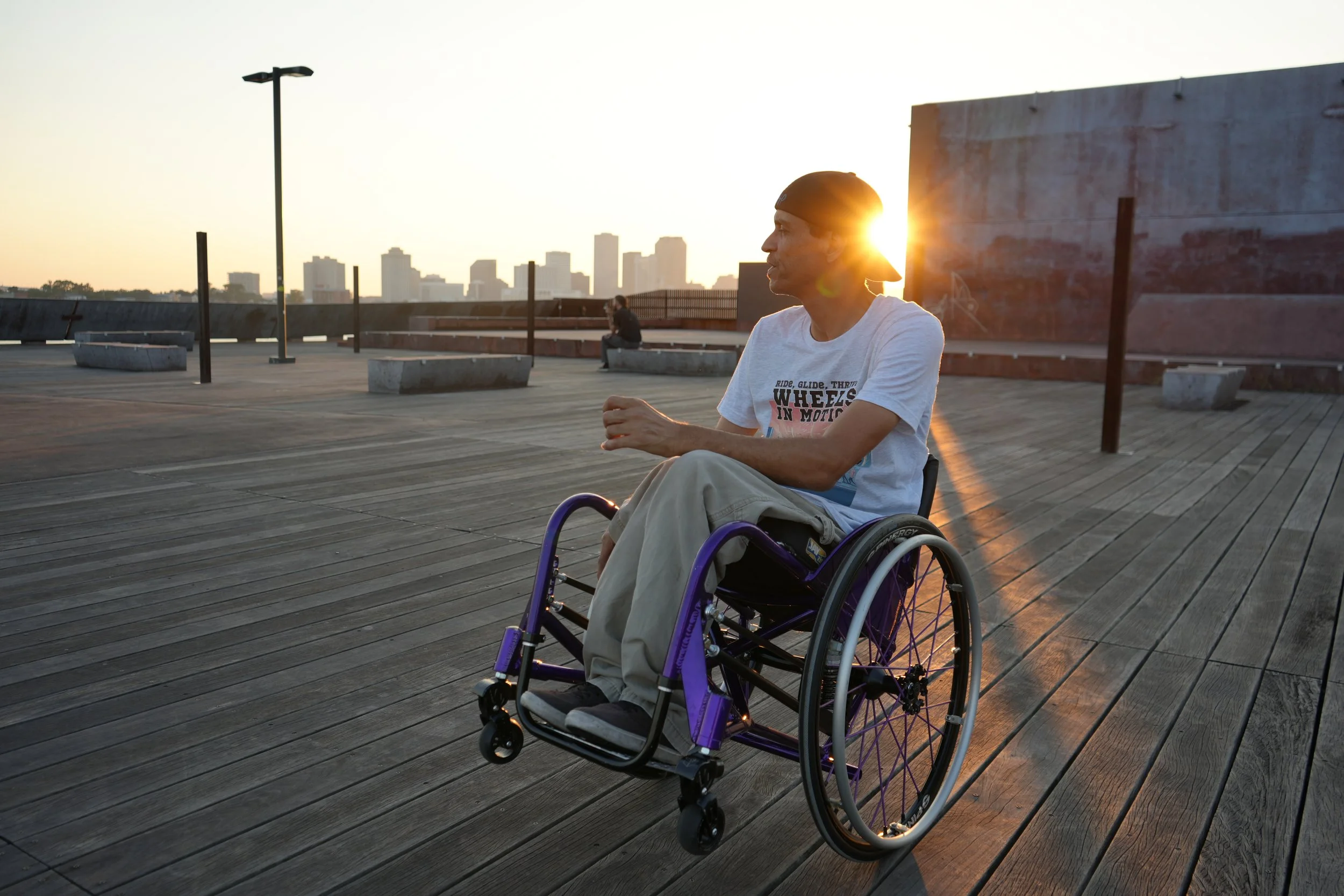
Antonio “Tony” Torres at sunset in his wheelchair. For Torres, discovering wheelchair motocross transformed his chair from a means of transportation into sports equipment—and opened the door to greater confidence, independence, and possibility.
I’ve been thinking a lot lately about what accessibility really means. We hear that word all the time. Is the building accessible? Does the park have a ramp? Is there an accessible bathroom? Can somebody in a wheelchair get through the door? All of that matters. Believe me, I’ve spent my whole life dealing with places that were accessible and plenty that weren’t. But I think we’re missing part of the conversation. Okay, you got me through the door. Now what? Can I actually participate? Can I play? Can I learn something new? Can I challenge myself? Can I be part of the same community as everybody else? That’s where WCMX came into my life. For somebody who has never seen it before, WCMX stands for wheelchair motocross. The easiest way I can explain it is by taking a wheelchair into the same kind of environment you would see BMX riders or skateboarders using—ramps, bowls, rails and skateparks—and learning how to ride that environment in a completely different way. But for me, WCMX has never been just about doing tricks. I was born with spina bifida, and I’ve used different types of mobility equipment throughout my life. For a long time, a wheelchair was simply something I needed to get from one place to another. Then I discovered WCMX. That changed the way I looked at my chair. Instead of only seeing something connected to disability, I started seeing a piece of sports equipment. Something I could learn with. Something I could push myself with. Something that could take me places I never expected. And once I started experiencing that for myself, my thinking started changing. If WCMX could do that for me, what could it do for somebody else? That’s really where my passion for this started, and it’s a big part of why I created the Wheels in Motion WCMX and Skate Program. I don’t want us to just create more accessible places. I want to create opportunities for people to actually use those places, try something new and discover what they’re capable of. That’s a big part of why I created the Wheels in Motion WCMX and Skate Program.
I See More Than Ramps and Concrete
I can look at a skatepark completely differently now than I probably would have years ago. Most people see ramps, rails, and concrete. I see opportunity. I see somebody learning how to control their wheelchair better. I see a kid overcoming fear. I see somebody falling, laughing about it, and trying again. I see confidence being built right in front of me. That’s what hooked me on WCMX. I was born with spina bifida, so disability isn’t something that came into my life later. I’ve lived this my entire life. My mobility has changed over the years too. There was a time when my wheelchair was simply something I needed to get around. Then WCMX changed the way I looked at it. All of a sudden, this thing everybody associated with disability and limitations became my piece of sports equipment. Think about that for a second. The same wheelchair somebody might look at and think, I feel sorry for that guy, became the thing I was using to hit ramps, learn tricks, compete, and push myself farther than I thought I could go. That changes something inside you. It changed something in me. And once I experienced that for myself, I wanted other people to have the chance to experience it too.
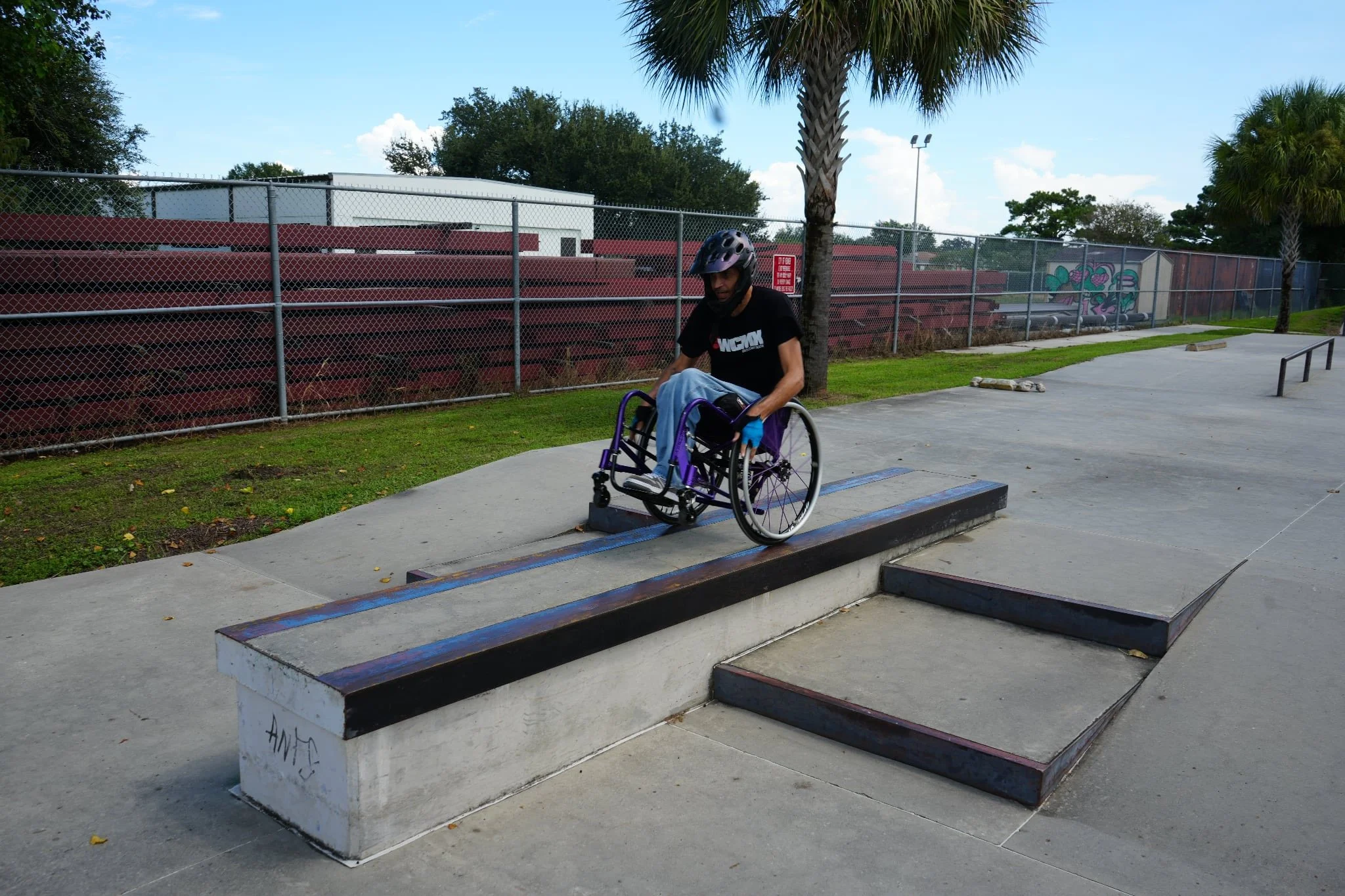
Torres practices wheelchair motocross at a Louisiana skatepark, using the balance, wheelchair control, and persistence he now helps others develop through the Wheels in Motion WCMX and Skate Program.
Sometimes It Starts With One Ramp
One of the coolest things for me at our clinics isn’t necessarily watching somebody do the biggest trick. Sometimes it’s watching somebody do the smallest thing for the first time. I’ve watched people sit at the top of a ramp and stare at it. You can see them thinking about it. I don’t know about this. And I understand that feeling. But one young rider I’ve been working with really showed me what that kind of progress can look like. When we first started working together on some of the steps and obstacles at our Wheels in Motion clinics, he was scared. You could see it in the way he would roll up, look at the steps, and hesitate. Part of him wanted to try it, but another part wasn’t sure he could. So, we didn’t rush it. We worked through it together. We talked about how to approach the obstacle. We worked on chair control, balance, body position, and where he needed to put his wheels. I would show him what I wanted him to try, stay close, and let him work through it one step at a time. At first, just getting through it was a big deal. Then he’d come back to another clinic and try it again. And again. Every time, there was a little less fear. Then something started changing. The same kid who used to stop and stare at those steps started attacking them. Now I watch him work through some of those same obstacles almost like a pro. He knows how to position his chair. He knows how to approach the steps. And when something doesn’t go perfectly, he doesn’t immediately think he can’t do it. He resets. He figures it out. And he tries again. That’s the transformation I want people to understand. It isn’t really about the steps. It isn’t even about learning a WCMX trick. It’s watching somebody go from: I don’t know if I can do this. to: I know how to figure this out. I’ve watched that change happen over multiple clinics. I’ve watched the fear get smaller and the confidence get bigger. And one of the coolest parts is that now he’s not just participating. He’s becoming one of those kids somebody else can watch and think: Maybe I can do that too. That’s why this means so much to me. Maybe everybody else just sees a set of steps at a skatepark. I see a kid discovering what he’s capable of. That’s confidence. And confidence doesn’t have to stay at the skatepark.
You Don’t Have to Become a WCMX Athlete
This is something I really want people to understand. My goal isn’t to turn every wheelchair user who comes to Wheels in Motion into a WCMX competitor. If they want to compete, I’m going to help them get there. But that’s not the only reason we’re doing this. Maybe somebody comes out and learns better wheelchair control. That’s a win. Maybe a kid makes a new friend.
That’s a win. Maybe a parent watches their child do something they never thought was possible. That’s a huge win. Maybe a therapist comes out and starts looking at their patients' abilities differently. Maybe a doctor or another medical professional sees adaptive sports as another tool that can help someone build confidence and independence. Maybe a recreation director starts thinking differently about what an accessible recreation program could actually look like. Maybe a skateboarder who’s never been around somebody with a disability spends the afternoon skating next to a wheelchair rider and realizes we’re really not that different. And yeah, maybe somewhere in that group is the next great WCMX or adaptive skate athlete. We don’t know. That’s why you create the opportunity. Let people figure out where they want to take it.
Stop Putting Everybody in Separate Boxes
This is probably one of the biggest things I believe in. Why does everything involving disability have to be separate? Here’s the disabled program. Here’s the regular program. Here’s the adaptive event. Here’s the regular event. I understand why specialized programs exist. Sometimes we absolutely need specialized equipment, instruction, and support. But that doesn’t mean we have to separate people from the community. That’s what I love about what we’re building with Wheels in Motion. Come out to one of our clinics and look around. You’ll see wheelchairs. You’ll see skateboards. You’ll see kids. You’ll see adults. You’ll see beginners and experienced riders. You’ll see parents. You’ll see people from the medical and mobility community. You’ll see community organizations. You’ll see people who know exactly what WCMX is standing next to somebody who probably didn’t know it existed until that morning. And they’re all there together. That’s inclusion to me. You don’t need somebody standing there giving a speech about disability awareness all day. Just let people spend some time together. Let them watch somebody in a wheelchair attack the same ramp as everybody else. Let them cheer for each other. Let them struggle together. Let them laugh together. Pretty soon, the wheelchair isn’t the most interesting thing anymore. The person is.
But We Have to Build a Path
This is where I think the future of WCMX really matters. We can’t just keep doing one clinic here and another clinic there and expect the sport to grow on its own. There has to be somewhere to go next. I’ve been thinking about it almost like a road: Exposure. Opportunity. Training. Community. Progression. Competition. Leadership. First, somebody has to know WCMX exists. Then they need somewhere to try it. Then they need somebody who can teach them safely. They need equipment. They need somewhere to practice. They need other people around them. If they start progressing and want to compete, there needs to be somewhere for them to compete. Then someday I want some of those same riders coming back as coaches, mentors, ambassadors, and leaders. That’s how this grows beyond any one of us. That’s also a big part of what I see for the World WCMX Federation. Yes, I want real competitions. I want championships. Like many of us involved in WCMX around the world, I would love to see the sport reach the Paralympics someday. I want athletes to have something meaningful to train for, and I want WCMX recognized as the legitimate action sport that it is. But I’m just as interested in the person who hasn’t discovered WCMX yet. Where are they? How are they going to find us? Where will they get a chair? Who’s going to teach them? Where can they practice? What’s their next step? Those questions matter just as much to me as what happens at a championship. Because you can’t have a world championship without first creating opportunities for somebody to become an athlete.
Louisiana Is Showing Me What’s Possible
What we’ve been doing here in Louisiana has really reinforced this for me. We’re not perfect. We’re still figuring things out. I’m still figuring things out too. But I’ve watched people come together around this. I’ve watched organizations support it. I’ve watched families come back. I’ve watched people travel to be part of it. I’ve watched a skatepark become a gathering place for something much bigger than just skating. And I’ve watched people progress. That’s probably the part that gets me the most. You see somebody at one clinic, and then you see them again. They’re a little more comfortable. They try something new. Then they come back again. Now they’re helping somebody else. That’s how community starts. It doesn’t always begin with a million-dollar facility or some giant national program. Sometimes it starts with a few people saying: Let’s try this. That’s a lot of what I’ve seen happening here in Louisiana. We started doing something. People saw what was happening. Families came back. Organizations started supporting it. More people wanted to be part of it. And we’re still building.
I’m 50 Now. So, What Comes Next?
Turning 50 has definitely made me think about all of this differently. If you would’ve told me years ago that at 50, I’d still be throwing myself around skateparks in a wheelchair, working to grow WCMX, and trying to build all of this, I don’t know what I would’ve said. Life definitely hasn’t taken me in a straight line. There have been some really hard chapters. But somehow, I’m still here. Still rolling. Still trying things. Still getting excited about what’s next. The difference now is that I’m thinking more about what I’m leaving behind. When I was younger, a lot of it was about figuring out what I could do. Now I think a lot more about the next person. I don’t want everything I’ve learned to end with me. I don’t want the next kid in a wheelchair to spend years wondering where they fit. I don’t want them to discover possibility by accident. I want us to build possibility into their communities. I want a kid to see a skatepark and think: I wonder what I can do in there. I want parents to know these opportunities exist. I want doctors, medical professionals, therapists, and others who support people with disabilities to see recreation and adaptive sports as another tool for building independence, confidence, and a better quality of life. I want cities and recreation departments to stop asking only: Is this accessible? I want them asking: Are people with disabilities actually using it? That’s a completely different question. And for that kid who falls completely in love with WCMX? I want there to be a path. From that first nervous roll down a ramp. To their first trick. To their first competition. Maybe someday to a World WCMX Championship. And then maybe they’re the person standing beside the next kid at the top of that first ramp saying: You got this. That’s how I see the future. Not adaptive sports over here and everybody else over there. Not disability being treated as something we need to work around. Just people. Different bodies. Different equipment. Different abilities. Different goals. But sharing the same space and getting the same opportunity to find out what they’re capable of. Because after 50 years of living this life, there’s one thing I believe more than ever:
Accessibility shouldn’t be where the conversation ends. It’s where opportunity should begin.
About the Author
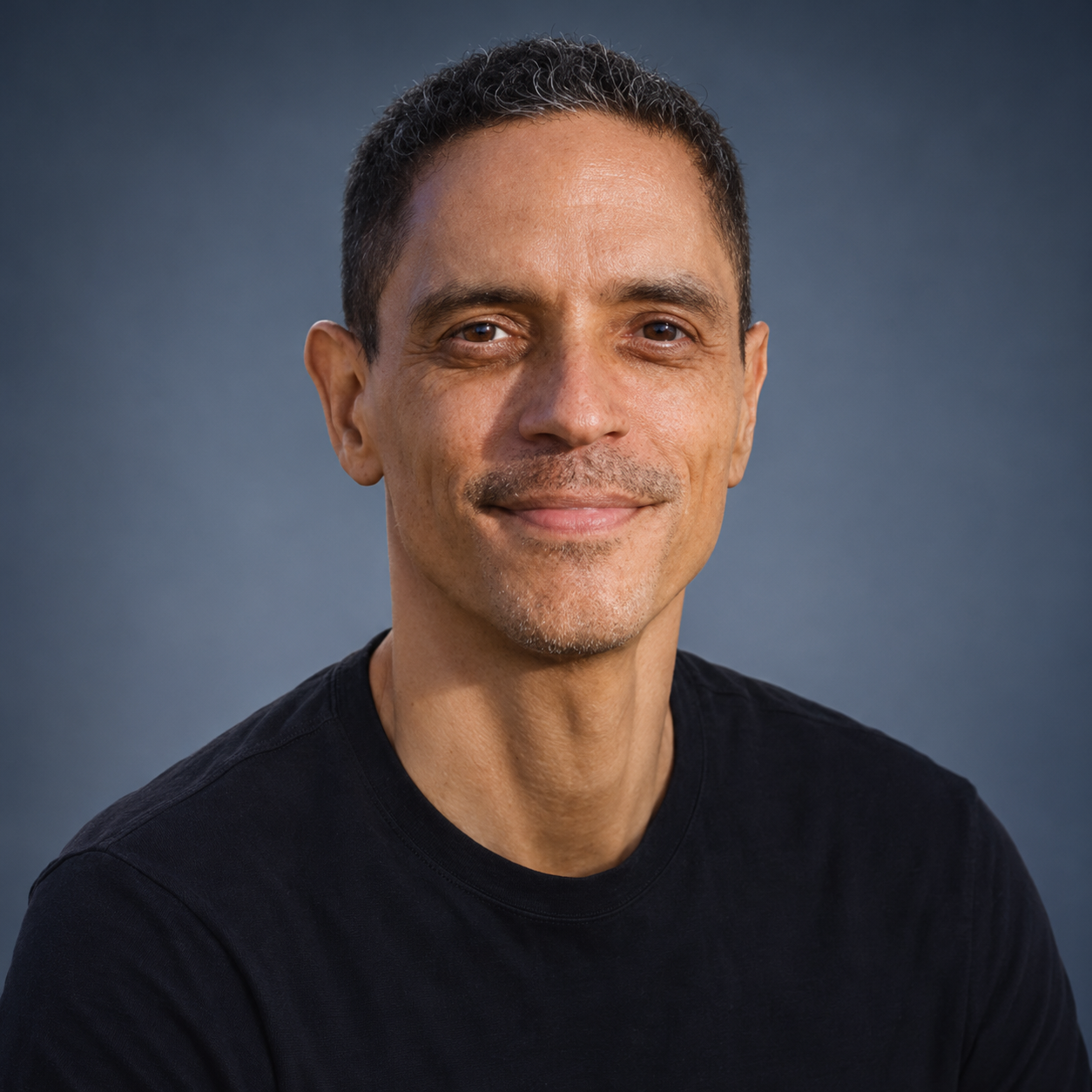
Antonio “Tony” Torres is a WCMX athlete, adaptive sports advocate, and owner of TNT 360 Mobility in New Orleans. Born with spina bifida, Tony draws on his lived experience to help others discover what is possible. Through the Wheels in Motion WCMX and Skate Program and his work with the World WCMX Federation, Tony brings people of all abilities together through wheelchair motocross and adaptive skateboarding, creating opportunities to build confidence, independence, and community.