
What TechConnect Gave Me
Summary: Denise Baker, a 58-year-old blind woman, shares how Vinfen’s TechConnect program empowered her with technology, providing increased independence and confidence through individualized training and AI tools. Vinfen CEO Jean Yang highlights the program’s success in bridging the digital divide, while warning that federal funding cuts threaten the future of these crucial, person-centered services.
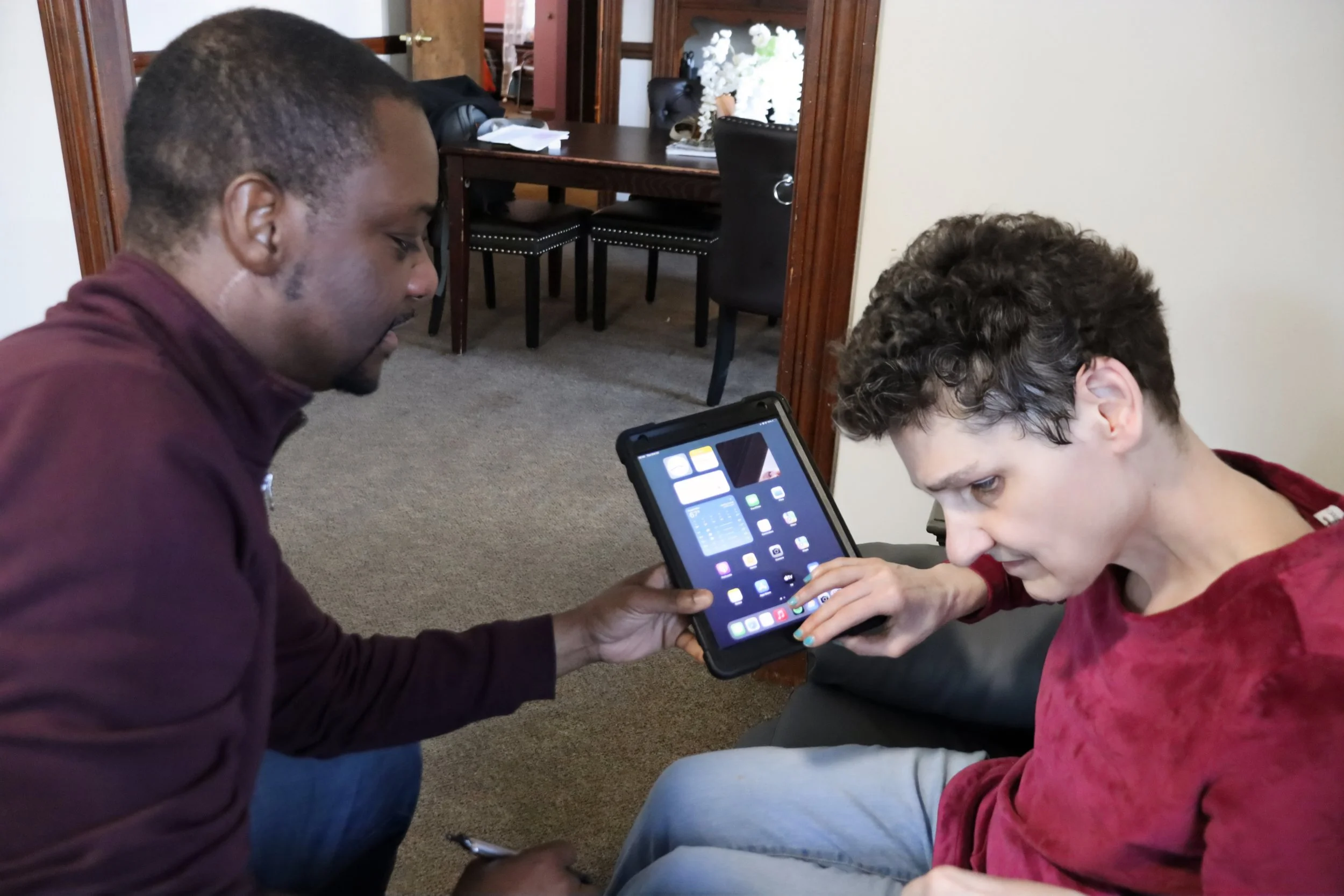
The author receives ipad training from a TechConnect employee.
My name is Denise and I live in residential group home for adults outside of Boston, run by Vinfen. I am 58 years old and have been totally blind since birth. For a long time, my world felt small. Not because I didn’t want to participate in life, but because so many everyday things were hard or simply out of reach for me. Listening to music, finding my way safely in the community, knowing what was happening around me, even choosing my clothes in the morning all required someone to help me. This made me feel isolated, even when I was surrounded by family, friends, or staff here at the house.
That changed when I became part of Vinfen’s TechConnect program.
Stanley is my digital navigator; I remember when he gave me my first iPad, I was nervous. When you’re blind, trying something new can feel overwhelming. I was worried I would make a mistake or break something. I didn’t want to look foolish. Stanley was great, he didn’t rush me. We started small. He first taught me how to use Alexa. I liked it, but once I realized what the iPad could do, I knew that was what I really wanted. I could feel the possibilities, sitting right there in my hands.
One of the first things I learned to do was something that made me smile: creating an Elvis playlist. I grew up listening to Elvis records. His 45’s meant the world to me. Being able to ask my iPad to play his music whenever I wanted felt like reconnecting with a part of myself. I could ask about the weather, the news, the time. I could listen instead of guessing. I could choose. Those might sound like small things, but they add up to something much bigger: independence.
The biggest change came when I started using an AI app on my phone that narrates what my camera is pointing at. The first time I used it, I was amazed. I could hold up my phone, take a picture, and hear it tell me exactly what was in front me, like people, objects, and the room itself. It was specific and clear. For the first time, I wasn’t relying on someone else to tell me what was there. I could hear it for myself.
I take the app everywhere I go. I’ve used it at Dunkin’ Donuts, walking around a nearby shopping center, and out in the community with friends. I can hear when I’m approaching something. I can identify objects. I can count money. I can label things in my home, so I know exactly what I’m touching. One day, after Stanley showed me how it worked, I said I wanted to use it the next time I was out with my boyfriend because I wanted to hear what he looks like. That may sound funny, but I was so curious. That stuff really matters.
Technology has also helped me feel more confident in my daily routines. I use my iPad to help me choose my clothes. I lay them out the night before and use the app to let me know what I’ve picked. I use Siri to check the weather, so I know how to dress and plan my day. I listen to articles instead of struggling to access printed text. These are things that let me move through the world with more assurance and less fear.
What makes TechConnect special isn’t just the devices. It’s the way the program treats people. Stanley didn’t just hand me technology and walk away. He took the time to understand what motivated me, what I cared about, and what would actually make a difference in my life. That personal approach made all the difference. It helped me feel capable, not overwhelmed.
I didn’t grow up thinking of myself as a “technology person.” But now, I proudly call myself a technology geek. Not because I know everything, but because I’m curious and not afraid to try. That confidence didn’t come out of nowhere. It came from being shown how technology could work for me, not against me.
What worries me now is knowing that this could disappear. I’ve learned that the federal funding that supports TechConnect isn’t guaranteed beyond next year, and that it could run out. That’s frightening. Not just for me, but for everyone who hasn’t had this opportunity yet.
I can’t imagine going back to the way things were before. And I hope others won’t have to. Because everyone deserves the tools to live as independently as possible. TechConnect didn’t just give me an iPad or a phone. It gave me more of my life back.
From Jean Yang, CEO of Vinfen
Denise’s story captures what this work looks like in real life. When she talks about how accessible technology expanded her independence, confidence, and sense of possibility, she is describing what we see every day through Vinfen’s TechConnect program.
Over the past two years, the program has supported 582 people with disabilities, while more than 3,200 individuals throughout Massachusetts have been served through the Human Services Alliance for Digital Equity. During that same period, 332 devices were distributed by Vinfen, and more than 2,100 devices statewide, each paired with individualized training and ongoing support. This work is now at risk. Last year’s loss of $14 million in Massachusetts funding through the federal Digital Equity Act directly jeopardizes the sustainability of programs like TechConnect.
The message I want to share with policymakers in Washington is what Denise’s story makes clear: people with disabilities are too often excluded from tools and systems that the rest of us now rely on every day. Technology is no longer optional. It is how people communicate, navigate their communities, access information, manage daily tasks, and stay connected. Yet many people with disabilities have been left out; not because they lack ability, but because they have lacked access, training, and individualized support.
That is exactly what TechConnect provides. When people with disabilities are introduced to accessible technology in a thoughtful, person-centered way, we see confidence grow quickly. People want to learn. They want to participate. They want the same opportunities others already have. With the right tools and guidance, they can and do succeed.
When funding disappears, opportunities disappear with it. Programs like Vinfen’s open doors, and once those doors close, they are difficult to reopen. Denise should not be the exception. Everyone deserves the chance to live safely, independently, and fully in a world that is increasingly digital. Sustaining this work is not optional. It is a commitment to equity, dignity, and opportunity for all.
Vinfen is a Cambridge, Massachusetts-based nonprofit, health and human services organization and a leading provider of community-based services to individuals with Autism, Behavioral Health Challenges, Brain Injuries, Intellectual and Developmental Disabilities, and Mental Health Conditions.
About the Author

Denise Baker is a 58-year-old resident of a Vinfen-supported group home outside Boston. Blind since birth, she is an advocate for accessible technology and digital inclusion. Through Vinfen’s TechConnect program, Denise has discovered how assistive technology can expand independence, confidence, and everyday opportunities for people with disabilities.