
Cody’s Wish
A Boy, a Racehorse, and a Fight for Life
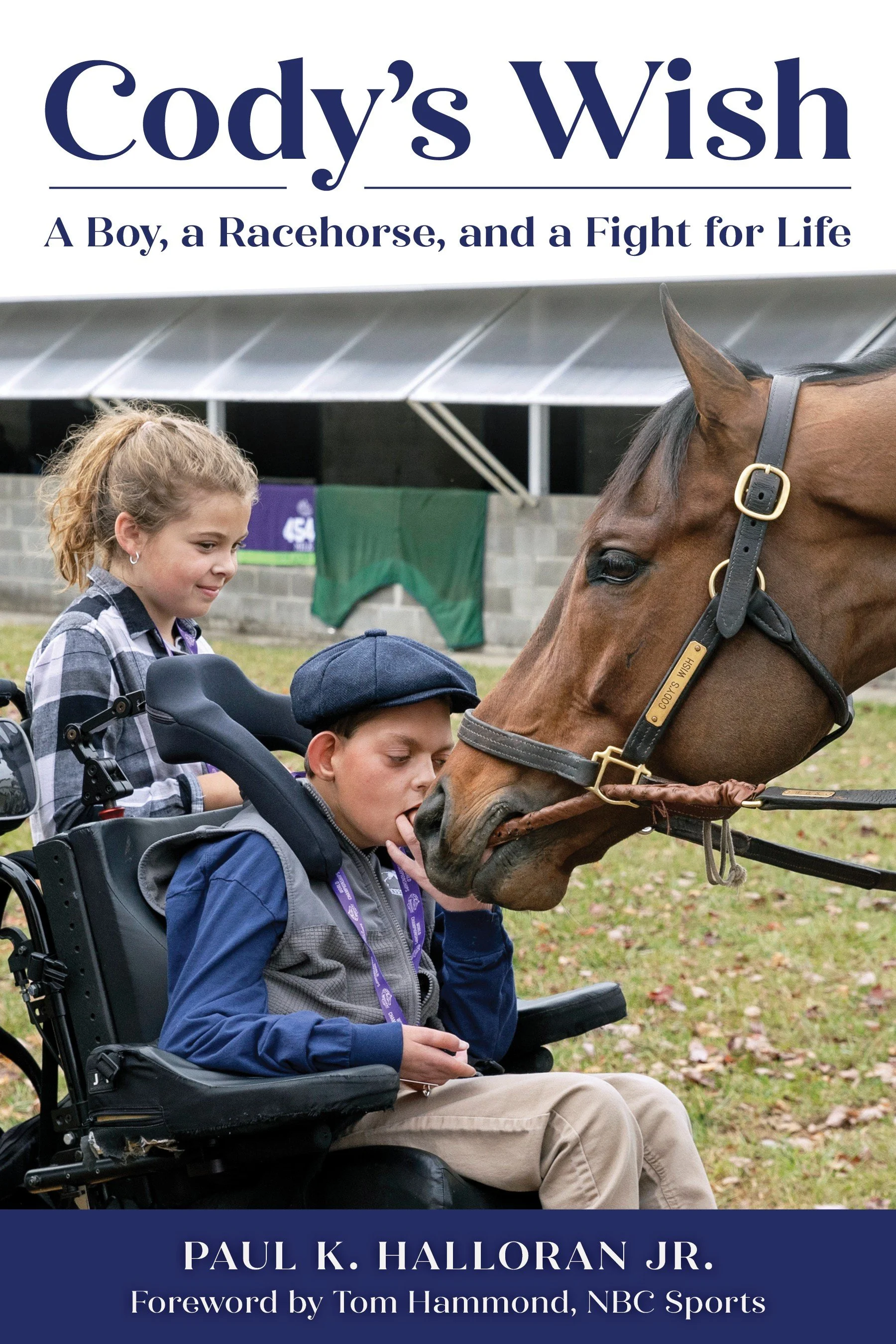
What started out as a routine story about a horse race ultimately led to a book about a boy with Wolf-Hirschhorn Syndrome and the Thoroughbred who became his best friend.
It was August 27, 2022, and I was at iconic Saratoga Racecourse in upstate New York working for the Saratoga Special newspaper. I was assigned to cover the Forego stakes race, in which there was a heavy favorite who looked like a sure thing, but you know what they say about sure things.
The favorite, Jackie’s Warrior, was caught near the finish line by Cody’s Wish, a horse whose name came with a story that I had not been aware of before the race. That led to a phone conversation with Kelly Dorman of Richmond, Kentucky, who told me about the inexplicable yet undeniable connection his son, Cody, had with Cody’s Wish.
Almost immediately after Cody was born on December 18, 2005, his mother, Leslie, sensed something was wrong when, instead of her new baby being laid on her chest, nurses whisked him away. She also noted that Kelly did not look nearly as happy as a new father should.
Leslie was not aware that Cody was being taken to the NICU, on oxygen. And when Kelly also left her room, she started to think something could be wrong. Within a few hours, Kelly was called into a doctor’s office and given sobering news: His son was very sick, and it was highly likely there would be long-term ramifications.
Of immediate concern was a heart murmur that would require surgery, sooner rather than later. Cody had a valve in his heart that was not opening fully, restricting blood flow. But the heart issue and need for oxygen were not the only red flags.
“He just ran down a list of potential problems Cody would have,” Kelly said.
That proved be the start of an almost 18-year journey traveled by Cody, his parents and little sister, and the army of healthcare professionals who were committed to not only helping him survive, but also thrive, albeit within the context of a mountain of medical maladies.
Kelly and Leslie were able to take Cody home after 12 days at Baptist Health in Lexington, Kentucky, but within a month they were at University of Kentucky Medical Center for a catheterization procedure to address his pulmonary valve stenosis.
Several hours after the start of what was supposed to have been a relatively routine procedure, the cardiac surgeon emerged from the OR with bad news: The surgery was not successful, leaving open-heart surgery as the only option to keep Cody alive.
Cody survived that open-heart surgery and another before he turned 3. In between, he was diagnosed with Wolf-Hirschhorn, which in a way was a relief for his parents because at least they knew what they were up against.
In researching the book, I learned that Wolf-Hirschorn occurs in about 1 of every 50,000 births and is caused when someone is missing a small piece of Chromosome 4. It can cause a litany of serious medical issues—heart defects, kidney failure, developmental disability, difficulty swallowing, seizures, cleft lip—and it can be deadly. One doctor told Cody’s parents he wouldn’t live to see his second birthday.
The syndrome is named for Dr. Kurt Hirschhorn, an Austrian-born physician who first diagnosed the genetic defect in 1961, and Dr. Ulrich Wolf, a German geneticist who documented a similar case in 1965. Hirschhorn’s family fled to Switzerland to escape the Nazis in 1938 when he was 12 and came to the U.S. in 1940, settling in Pittsburgh. Hirschhorn left the University of Pittsburgh after one semester to join the Army and enrolled at New York University when he returned, earning his bachelor’s and medical degrees. He started a research lab at NYU in 1958.
When Cody was only eight months old, he became a patient of Dr. Robert Hopkin, a geneticist at Cincinnati Children’s Hospital. The Dormans felt fortunate to find Hopkin, who helped rebuild the hospital’s Human Genetics division founded by Dr. Josef Warkany, a pioneer and leading expert in the study of prenatal health and birth defects.
Hopkin served as the lead on a team that included a cardiologist, neurologist, nephrologist, nephrologist, feeding teams, etc. He had come to Cincinnati Children’s for a fellowship in 1994 and never left. He didn’t plan on studying genetics, but a traumatic experience in medical school set him on that path.
As a third-year student at the University of Nevada Medical School, Hopkin came across two babies born with severe chromosomal abnormalities. When he requested a geneticist consult, he was startled to learn that the only geneticist in Nevada at that time (1990) was on vacation and there was no one filling in. The two babies got sicker and died, prompting Hopkin to rethink his career path.
When I interviewed Hopkin for the book in April of 2023, I asked him if he thought he would one day be talking about a 17-year-old Cody in the present tense. “No,” he told me. “Actually, I had a couple of other kids that were in a similar situation, and I was worried about all of them. The other ones are not around anymore.”
Cody’s life was enhanced greatly at the end of 2017 when his therapists recommended he get a ChatFusion 10 communication tablet. Dr. Cameron Thomas, Cody’s neurologist, recalled the first clinic visit after Cody got the tablet, when he was pleasantly surprised to have his patient use it to tell him a few “knock-knock” jokes.
As he watched Cody navigate his tablet, it occurred to Dr. Thomas that one of his children who was about the same age was working on geography in school. He started quizzing Cody on state capitals and was amazed at the accuracy of the answers.
“He probably rattled off 20 different states and capitals for me right there in the clinic,” Thomas told me, confirming Cody’s parents’ belief their physically incapacitated son was indeed an intelligent boy.
In 2018, Cody was referred to Make-A-Wish and he asked for a trip to Bass Pro Shops headquarters and the Wonders of Wildlife National Museum and Aquarium in Springfield, Missouri. It made sense when you consider he grew up with a father who was a competitive angler whose passion for fishing had been passed on to his son.
Six weeks after returning from that trip, Cody was asked to be an ambassador for Make-A-Wish Day at Keeneland Racecourse, a spectacular track located in the heart of horse country in Lexington, Kentucky. Prior to the races, we went to a farm and were introduced to a 5-month-old colt, who walked over to Cody’s wheelchair and put his head on his lap.
Those who witnessed the interaction were struck by it. There was an instant and real connection between the foal and the boy. The horse’s owner, Godolphin, a worldwide racing operation owned by Sheikh Mohammed bin Rashid Al Maktoum, the ruler of Dubai, eventually named him Cody’s Wish.
When the pandemic struck in 2020, Cody, who already had limited human interaction, became severely depressed when he was further shut off from the outside world. One day, he used his tablet to tell his mother he was ready to give up his fight.
Leslie and Kelly were rocked by that news and knew they needed to find a way to snap their son out of his despondence. They arranged for him to visit his namesake, who was getting ready to start his racing career. It had been a year and a half since Cody had seen Cody’s Wish, so there was no guarantee the magic they shared when they first met would be recreated.
Now a strapping 2-year-old racehorse, Cody’s Wish was led out of his stall. When he caught sight of Cody, it was as if no one else were there. As the horse stared at Cody, the boy began to laugh—a sign that he was truly happy, something his parents had not seen in a long time. Then Cody’s Wish walked over to Cody’s wheelchair, put his head on his lap, then lifted his head and let Cody rub his nose.
Cody’s parents were relieved. “That was the turning point in his depression,” they told me. “It was like we had one kid going up there and we picked up a different kid and brought him back. He was laughing all the way home.”
Cody’s Wish lost his first three races, but Cody had a logical explanation: He was not there to watch. Sure enough, when the horse ran in October 2021 at Churchill Downs, home of the Kentucky Derby, and Cody and his family attended, Cody’s Wish won.
Over the next two years, Cody saw Cody’s Wish run five more times; he only lost once. He would visit him at the barn, go to the paddock before the race and wait for him in the winner’s circle. There was an especially emotional reunion at Keeneland three days before the 2022 Breeders’ Cup World Championships, with NBC cameras there to document it.
Cody’s Wish won that race, the first of back-to-back Breeders’ Cup conquests. Cody became a media darling, the co-star of one of the most heartwarming stories horse racing has ever seen, but there was something even more important than the horse’s success and Cody’s newfound celebrity.
“He saved my life,” Cody said. “He means the world to me. He’s my best friend.”
With Cody’s Wish scheduled to run the last race of his career at the 2023 Breeders’ Cup at Santa Anita in California, Cody wasn’t about to miss it, despite the cross-country trip. He spent four days at the track, visiting Cody’s Wish at the barn and meeting Carson Jost, a fellow Wolf-Hirschhorn patient, who was there to watch a horse named for him. Based on the rarity of the genetic disease, it was almost statistically inconceivable there would be two people with Wolf-Hirschhorn at the same racetrack at the same time, both to watch horses named for them compete in the most important races of the year.
Cody’s Wish won that final race in his typical come-from-behind fashion, setting off a raucous and emotional celebration. He ended his career as a champion, with 11 wins in 16 starts. A few months later, he would be named Horse of the Year in North America.
The next day, the Dormans boarded a flight at LAX headed for Atlanta, where they would connect to Lexington. Cody was restless for part of the flight, undoubtedly overtired from an exhausting week, but at one point he lay his head on his mother’s shoulder and fell asleep.
After landing, when Leslie tried to wake him, he did not respond. She noticed his hands were blue and they were cold, but that was not particularly unusual because Cody had Raynaud’s Disease. It quickly became apparent, however, that Cody was in trouble.
There were Herculean efforts to revive him, both on the plane and in an ambulance on the way to Children’s Healthcare of Atlanta Hughes Spalding Hospital. But at 3:15 p.m. EST on November 5, 2023, an ER doctor called it. Cody was gone.
Leslie and Kelly Dorman had lived almost 18 years with the prospect of losing Cody, but you could excuse them for letting their guard down after a simply magical week on the West Coast. It didn’t take long, however, for it to make sense, the grief notwithstanding.
Cody was determined to be there for his best friend’s last race. Did he will himself to stay alive just long enough to see it? You can certainly make that argument, but, regardless, one thing is clear: Both the champion racehorse and his courageous namesake finished their respective races. And both went out on top.
Cody’s Wish – A Boy, a Racehorse and a Fight for Life is published by Lyons Press. It can be purchased at codyswishbook.com.
About the Author
Paul Halloran is a longtime journalist and communications professional who has covered horse racing since the mid-1980s. A graduate of the College of the Holy Cross, he began his career at the Daily Item in Lynn, Massachusetts, where he became sports editor and later news editor. He has worked with Grant Communications since 2000 and also founded PKH Communications. Halloran began writing for The Saratoga Special in 2019 and earned Honorable Mention Media Eclipse Award recognition for his first story on Cody’s Wish. He is the author of Cody’s Wish: A Boy, a Racehorse, and a Fight for Life. He and his wife, Julie, have two adult daughters, Kathryn and Martha, who have profound autism.