
Unlocking Behaviors
“Yo! When his glucose goes low, you'd better duck!”
Ley Linder, Dr. Craig Escudé, Benjamin Margolis, M.D.
Randy is a 23-year-old man with mild intellectual disability and significant autism (level 3), who is living in a group home with five other people. He moved in five weeks ago, and before that, he was admitted to a medical hospital for 16 months. He had been staying with one of his parents, who had acted as his caregiver since childhood, but as per the history we were provided, they dropped him off at an emergency room when his behaviors became so dangerous that he could not be safely cared for at home. He was stabilized behaviorally in the hospital with chlorpromazine and topiramate. His hospital stay was prolonged as he had not been enrolled in state services before and was not able to be placed in a supported residential setting. Also, his family was not involved in his life following dropping him off at the emergency room.
He had type 1 diabetes mellitus, with a reported episode of diabetic ketoacidosis, a life-threatening condition caused by too little insulin and high blood sugar, as a teenager. He receives insulin at bedtime (Lantus) and has a sliding scale during the day, although he is not always cooperative with finger sticks. There is no contact information available for his family, and the detailed hospital records from his extended stay in the hospital, while requested, are not yet available to his new support team. It is unclear if he has a history of epilepsy and if the prescribed topiramate was for seizures.
The agency that has accepted him is pleased to introduce him to the area and is hopeful that he may soon participate in day programming. Still, he is exhibiting some very challenging behaviors that have interfered with his ability to be part of a larger community, and he requires 1:1 staffing at his new group home. He is being brought to us for assistance with these complex behaviors.
His staff report that he has constant obsessive toilet flushing behavior, and that he jumps up and down all day, and they have trouble getting him to sit still to be able to eat. Every once in a while, without any clear antecedent, he will suddenly run after staff, and he has injured several staff members with his fingernails, clawing at their skin and eyes without warning. His sleep is very erratic. He also tends to throw up – sometimes he will stick his finger down his throat, but often he will force himself to throw up just a bit into his own mouth, and he will spend quite a bit of time rechewing his food and then swallowing (rumination).
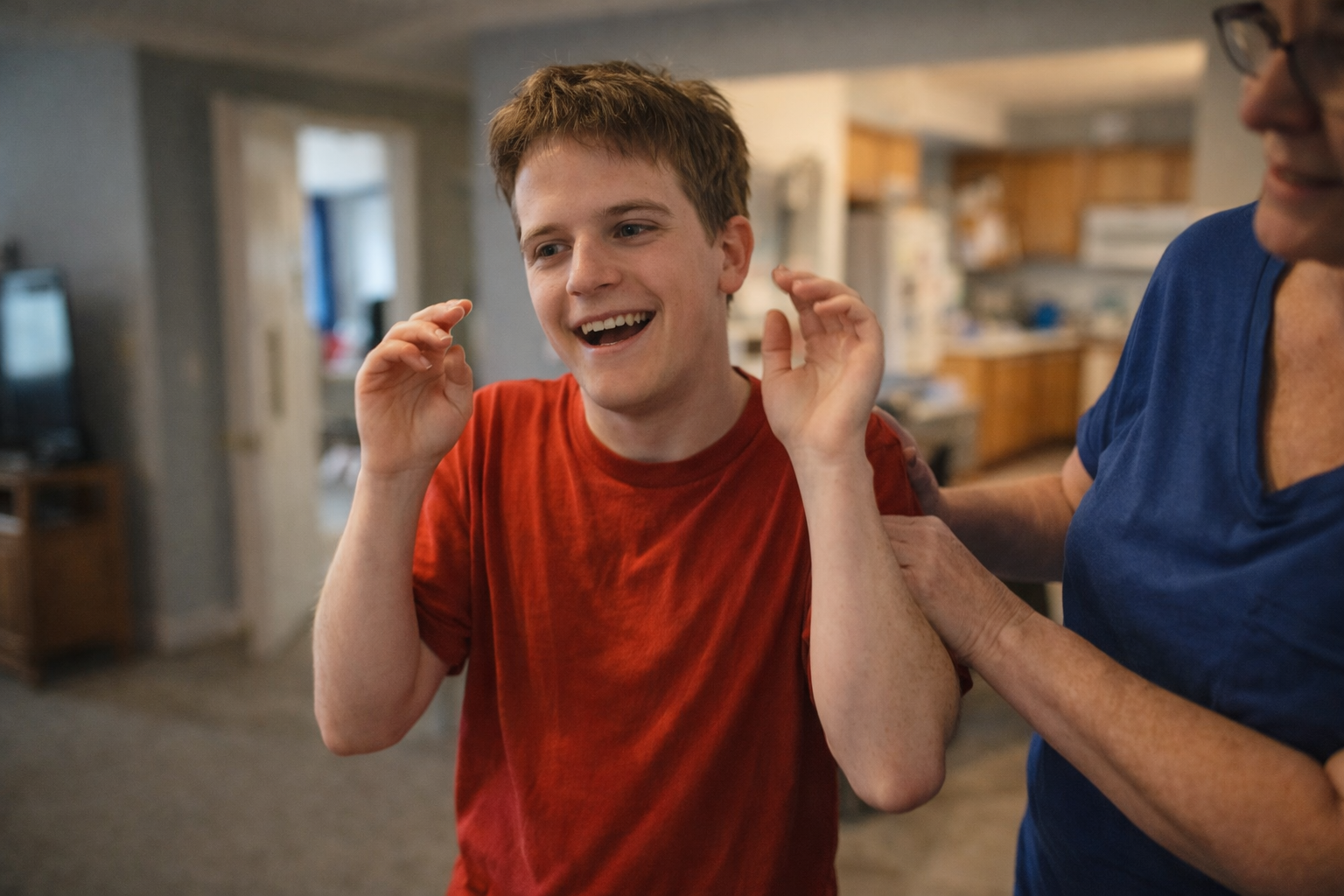
Staff are concerned about these behaviors. He has not yet had any medication changes since his hospital discharge and introduction to his group home. He has no known drug allergies. He presents as a thin, smiling young man who makes no eye contact, flaps his hands and jumps, and will periodically leave the room to use the bathroom, watch the toilet flush, and then return to the office with staff assistance. His teeth look clean and straight, and he can say “No!” when asked if he is in any pain.
Medications:
Chlorpromazine (Thorazine) 200mg PO TID
Topiramate (Topamax) 200mg PO BID
Clonazepam (Klonopin) 1mg PO PRN agitation
insulin glargine (Lantus) 40 units SC qHS
insulin lispro (Humalog) sliding scale qAC
MiraLAX 17g PO daily
Medical Perspective:
When someone’s behavior suddenly changes, a good rule of thumb is to consider it related to pain until proven otherwise. Looking at the pattern of his aggression, which seems to come on rather abruptly, we should think about conditions which might cause pain very suddenly, a kidney stone? A gallbladder attack? A muscle spasm? A stomach cramp? Discomfort from intermittent gastroesophageal reflux? These are some of the first things that come to mind. Fluctuating blood glucose levels can become rapidly symptomatic and cause changes in behavior, and with his history of diabetes, could this be a factor?
Rumination is sometimes a sign of gastroesophageal reflux but can also be a learned behavior where the person may be receiving some benefit for that action. It could take the form of receiving more attention or avoiding a situation they do not want to be in.
Psychiatric/Neurologic Perspective:
It sounds a lot like something may be hurting. I would defer any psychiatric evaluation to the medical specialist on Randy’s support team—sudden, unexplained aggressions are still pain or discomfort until proven otherwise.
I also would very much appreciate more history—why was topiramate chosen as a treatment for him? Does he have epilepsy? Is there any possible way we can reach his family or his care team from his hospitalization?
Initial thoughts are that topiramate, in addition to being an excellent antiepileptic drug, can help prevent migraines and is also used off label for appetite suppression and mood stabilization. Was this added to help manage food-seeking compulsions?
Does his jumping and hand-flapping behavior represent self-stimulatory behaviors related to his autism, or is this communicating something else?
Is he having side effects from the chlorpromazine (an antipsychotic often used off-label to manage autism-related compulsions and aggressions) called akathisia, which is an internal sense of restlessness and terrible discomfort, preventing someone from sitting still? Is he having side effects from topiramate?
With significant collaboration between our behavioral and medical colleagues, once we have ruled EVERYTHING else out, it is tough to know in this case whether to reduce medication, increase medication, or switch to something else.
In this case, if no collateral ever becomes available, the safest thing would be to rely on careful and close coordination with his staff and with his other providers, and to pull back on his antipsychotic, following up frequently, in order to decide what to do going forward.
In this case, however, we would again rely on our medical and dental colleagues first.
Behavioral Perspective:
It is not uncommon for a person to present with one behavioral concern, but after assessment, it becomes apparent that multiple behavioral concerns and needs are present. Randy seems to fall into this category! As a behavior analyst, there are times when we need to determine the greatest need and address that concern first, especially if it jeopardizes the health and safety of the person and/or others.
After addressing the more immediate and “dangerous” behaviors, behavior analysts should continue to provide support. At times, there is a sense from interdisciplinary teams that we need to find the one thing that is causing the problem (behavior). The reality is that there are often multiple concerns, each with its own needs, which require multifaceted approaches across a multidisciplinary team to manage and/or resolve the behavioral problems. From a behavioral standpoint, working to clearly identify what these behaviors look like, when they present, and what they could mean would be advantageous to all team members.
For Randy, there are multiple behavioral issues, but which ones are acute vs. chronic? Which ones lead to crisis management needs? Are some medical symptoms? Do chronic behaviors predict acute crisis? These are questions behavior analysts can help answer for interdisciplinary teams.
Rapid onset high-intensity physical aggression without warning
If he has seizures, what do they look like for him?
Throwing up vs. rumination (how much is he actually ingesting?)
Jumping up and down all day, hyper-motor activity impacting ADLs
Obsessive toilet flushing
Outcome:
Randy didn’t yet have good records of his finger stick glucose monitoring due to his short time in his new home. It was checked before meals, but he would sometimes end up inadvertently throwing up an entire meal when intending to merely bring up some of his last meal to continue chewing on it. By checking FSG (finger stick glucose) before every meal in addition to after every time he threw up, AND every time he became suddenly aggressive, it was seen that his aggressions had a 1:1 correlation with hypoglycemia, where his blood glucose readings would go below 40. He was given glucose packs or orange juice to manage these episodes of hypoglycemia. This eliminated one part of the puzzle of his behaviors, but didn’t address the rumination, the jumping, or the erratic sleep.
At the very least, the staff were physically safe to work with him, and his level of monitoring could be reduced from constant one-on-one monitoring. As an aside, no family contact ever became available, and his hospital records never materialized as he was unable to sign a HIPAA consent. The agency and his care coordination team initiated a guardianship application to address these and other administrative concerns on his behalf, and we continued to work on addressing his complex behaviors. As one staff member put it, commenting on his updated behavior plan, “If you let Randy’s glucose go low, you better duck!”
About the Authors

Ley Linder is a Board-Certified Behavior Analyst with an academic and professional background in gerontology and applied behavior analysis. Ley’s specialties include behavioral gerontology and the behavioral presentations of neurocognitive disorders, in addition to working with high-management behavioral needs for dually diagnosed persons with intellectual disabilities and mental illness. He works closely with national organizations, such as the National Down Syndrome Society and the National Task Group on Intellectual Disabilities and Dementia Practices. He is the founder and CEO of Crescent Behavioral Health Services, based in Columbia, SC.

Dr. Craig Escudé is a board-certified Fellow of the American Academy of Family Physicians and the American Academy of Developmental Medicine and President of IntellectAbility. He has more than 20 years of clinical experience providing medical care for people with IDD and complex medical and mental health conditions. He is the author of “Clinical Pearls in IDD Healthcare” and developer of the “Curriculum in IDD Healthcare,” an e-learning course used to train clinicians on the fundamentals of healthcare for people with IDD.

Benjamin Margolis, M.D., is board-certified in neurology and psychiatry, trained under the combined residency program at Brown University. He specializes in neuropsychiatric care of adults with I/DD in the New York Hudson Valley and is an attending inpatient psychiatrist at Bronx Psychiatric Center. He completed medical school at the Albert Einstein College of Medicine after the postbaccalaureate premedical program at Columbia University, and holds a BFA from the School of Visual Arts in New York City. He is a former treasurer of the American Academy of Developmental Medicine and Dentistry, current co-chair of the AADMD Behavioral Health Task Group, and is working to improve behavioral and mental health care for individuals with I/DD at local, state, and national levels. As part of this mission, he serves on the Health Advisory Board for Special Olympics New York, specifically for the Strong Minds Program, and on the Medical Advisory Task Force for the Developmental Disabilities Advisory Committee of the New York State Office for People with Developmental Disabilities.