
President’s Message
“Keepers”
Steve Perlman, DDS, MScD, DHL (hon) President, People Advocating for Optimal Health (PAOH) Special Projects Sr., Editor Helen: The Journal of Human Exceptionality
Over the course of my 50 year professional career, countless articles, letters, emails, text messages, and memos have come to me that I read, store, file, archive, catalog, and discard. But every once in a while, I come across something that resonates with me, either touching my heart or somewhere in my head that I instantly say to myself, “this is a keeper.” I am sure everyone has gone through this same situation.
The letter below I printed out and kept in my desk drawer for 25 years. It was sent to me and others that attended Surgeon General David Satcher’s “Health Disparities and Mental Retardation” Conference December 5 and 6, 2001 in Washington DC.
“From the desk of the Executive Director of the Daniels Family
(No sarcasm intended just proud of who I am)
Date: December 10, 2001Twenty-one years ago, this past November my son was born with Downs Syndrome and 4 large holes in his heart. For the next 4 years of his life his family tried to convince his doctor that something was wrong and that we should see a specialist about his problems. Repeatedly we were told that all of his systems were because he has Downs’s syndrome and all was “as good as could be expected.”
We finally stopped listening to the lies and took him to another doctor who immediately diagnosed his heart condition. We spent the next year with cardiac specialist and enduring open-heart surgeries. We were finally told that nothing could be done to save our son, that we had waited too long and the damage was too great.
For years I have been bitter and even though I have given countless hours and worked hard to ensure that this never happen to another family in our area, I never let go of my anger. Last week, because of your support and belief, I sat in a room filled with people who cared as much as I did. I looked into the eyes of people who cared and people who are committed to changing the way things have been. I listen to the word of our Surgeon General and I dared to hope.
I felt the anger and pain slipping away and I begin to believe that I could trust that we were going to make things better. I wanted you to know what it meant to me to be invited, and what an honor it was to be part of such a dream come true for myself, my family and for all people with mental retardation.
I thank you from the very bottom of my soul and I offer my time, my passion, and energy in any way that you may need me. I beg you to carry on with the spirit which you showed during our time together and that you already given to your work.
Kim Daniels
Vermont Self Determination Project”
Few people know the history that led to this monumental event. In 1993, I was asked by Eunice Kennedy Shriver, the founder of The Special Olympics, to create a global health program for its athletes. I started with oral health and within a few years expanded it to 7 health disciplines, and the Special Olympics Healthy Athlete’s Program became the largest Public Health Program in the world serving people with Intellectual and Developmental Disabilities.
Our Special Olympics Interdisciplinary health screenings from 1994 clearly demonstrated that significant health disparities existed for individuals with IDD, but the literature was sparse, poorly documented and lacked credibility. In 1999, Special Olympics contracted the Department of Epidemiology and Public Health at the Yale School of Medicine, Department of Psychology to do the “Health status of individuals with Mental Retardation.” Shockingly, when the report was published on September 15, 2000, it was only 111 pages, signifying that we really knew and understood little about the situation and were in desperate need of good data.
In collaboration with the Centers for Disease Control and Prevention (CDC) we continued to collect data on a population that was virtually invisible to Public Health Programs. This data clearly demonstrated that “significant health care disparities existed for both children and adults with IDD, that they lacked access to care, and were the most invisible, medically underserved minority population.”
Mrs. Shriver presented this data to influential Congressional Leaders who were able to succeed in having an official Senate Special Hearing on March 5, 2001, at the Special Olympics Winter Games in Anchorage, Alaska, “Health Disparities for People with Mental Retardation.” At that hearing, Surgeon General David Satcher gave testimony as well as representatives from other prominent government agencies related to health and disability. After his testimony, Dr. Satcher met with several of us and promised he would hold the first ever Surgeon General’s Conference in response to the Senate hearing before the end of the year.
True to his word, on December 5 & 6, 2001 in Washington DC under the Department of Health and Human Services, the conference was a major component of Dr. Satcher’s national initiative to address the health disparities of people with “mental retardation.” This meeting brought together government agencies, universities, leading experts in the social and medical models, and was a true “who’s who” in the scope and the village who treat and care for this population. Problems and issues were identified, and shortly thereafter “Closing the Gap: A National Blueprint to Improve the Health of Persons with Mental Retardation” was published, giving the meeting legs.
Let history show that the Special Olympics Healthy Athletes Program led to the Yale Report, which led to the Senate Hearing, which led to the Surgeon General’s Conference, which led to the Closing the Gap Report.
And while the Yale Report is often referenced as one of the earliest published research papers on how society viewed Mental Retardation (use of the MR term is used here for historical reference, as it was the accepted terminology) another report was published almost forty years before. It has largely gone unnoticed, but it has a rich and significant place in the history of the disability rights movement.
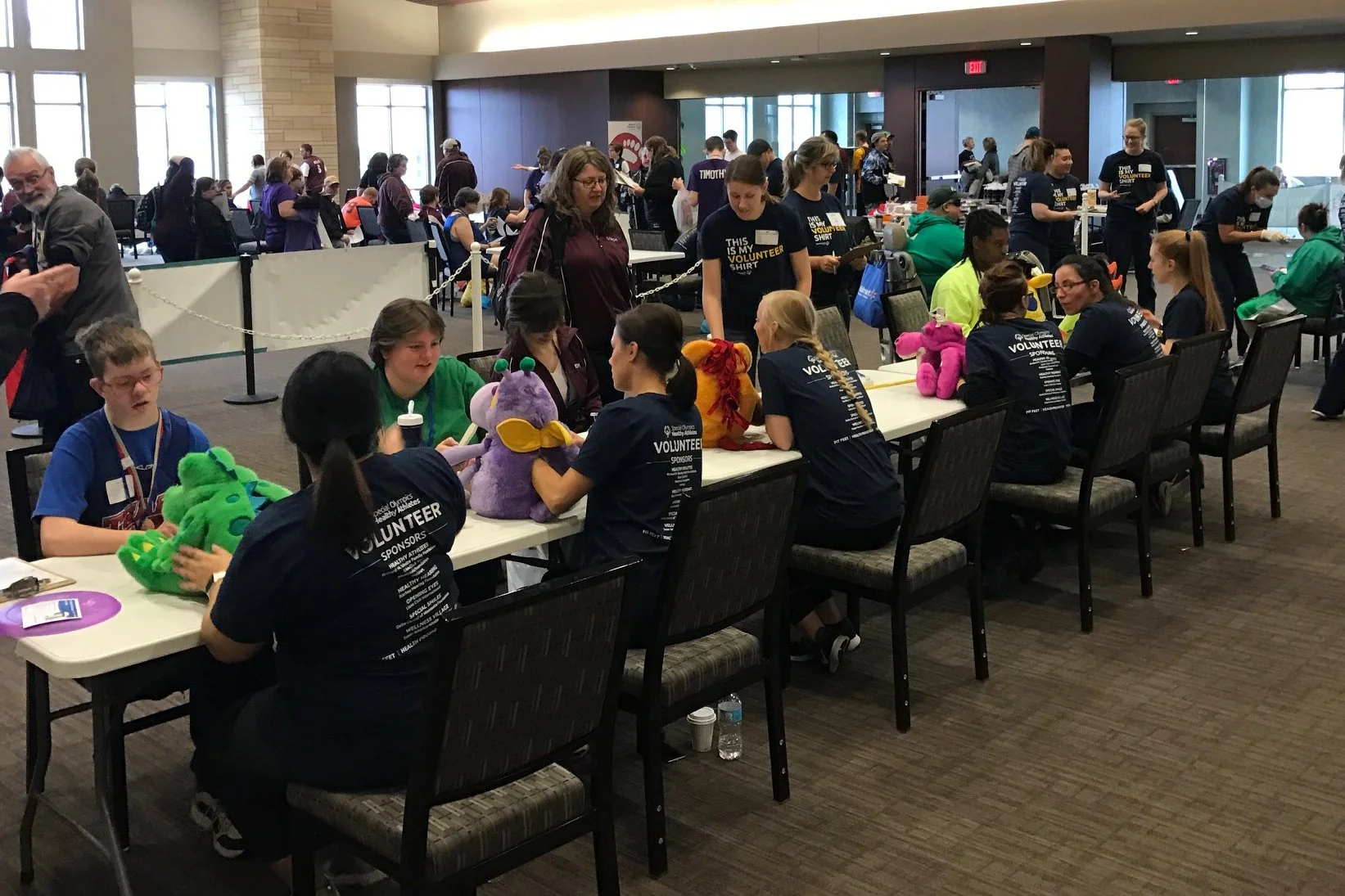
Athletes receive oral health education and screenings at a Special Olympics Healthy Athletes event.
On August 11, 1961, President John F. Kennedy appointed a panel of experts to prepare a national plan for ''combating mental retardation.'' The Presidents Panel on Mental Retardation offered 97 recommendations for improving research, training, income maintenance, and service programs.
I invite you to read his own words, “I sent to the Congress today a series of proposals to help fight mental illness and mental retardation. These two afflictions have been long neglected. They occur more frequently, affect more people, require more prolonged treatment, cause more individual and family suffering than other condition in American life. It has been tolerated for too long. It has troubled our national conscience, but only as a problem unpleasant to mention, easy to postpone and despairing of solution. The time has come for a great national effort.' President Kennedy
I also sat in that room with Kim Daniels, who wrote the above letter. I too, looked into the eyes of those in attendance and saw people who cared as much as I did, and who were as committed as I was.
I keep Kim’s letter to remind me why we created the American Academy of Developmental Medicine and Dentistry (AADMD), People Advocating for Optimal Health (PAOH), HELEN Journal, and all of our allied organizations.
We must work together so no family will ever have to endure what the Daniels went through. We need to continue to advocate for better training and education for all health professionals that treat people with disabilities, to improve healthcare delivery systems, to do more research, to collect more data, and to improve access to and to quality of care.
Thank you, Kim, for sharing your story with us. It was a keeper for me.