
No one’s disposable
Gideon Lieberman
Summary: Gideon Lieberman reflects on the documentary Disposable Humanity, which examines the persecution and murder of disabled people under Nazi Germany’s Aktion T4 program and the eugenics ideas that helped make it possible. Writing from his perspective as a young Jewish man with autism, Lieberman connects this history with questions of accessibility, representation, remembrance, and the responsibility to preserve stories that were long overlooked.
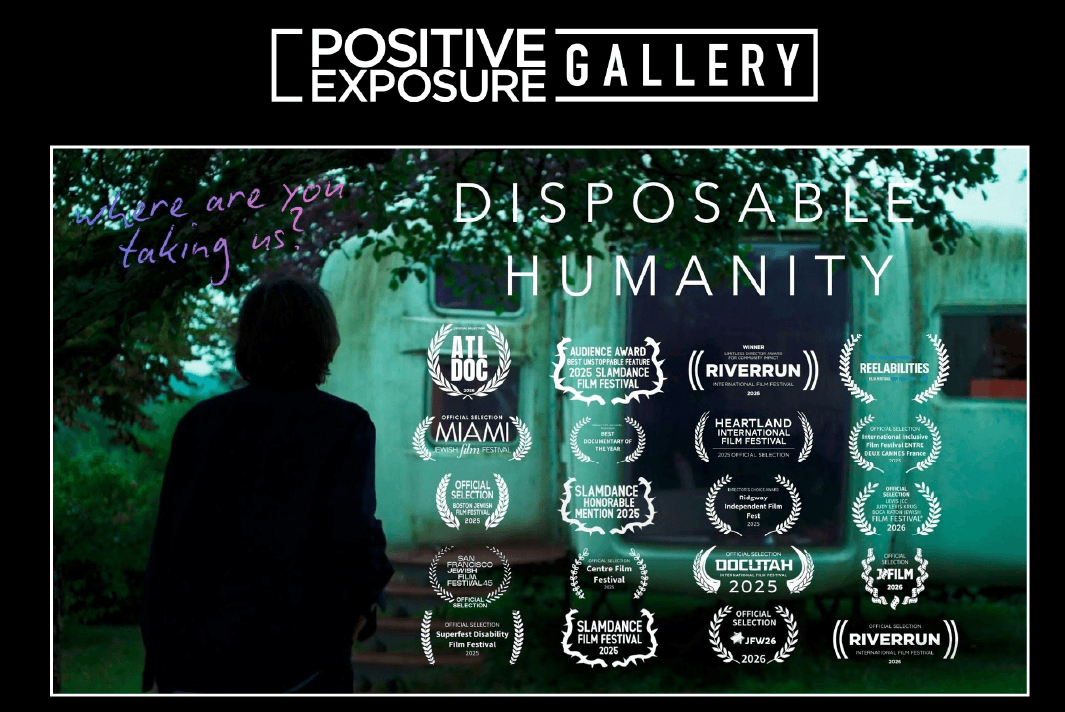
As a young Jewish man with autism, the movie “Disposable Humanity” had a powerful impact on me. The film is created by the father-son duo David T. Mitchell and Cameron S. Mitchell. The film covers how disabled people in Germany during the Holocaust weren’t accepted and how there even was a whole program to get rid of them. The program was Aktion T4, and even America was partially involved at points. The film is a historical documentary and took about twenty-five years due to some of the filming having started back in the mid-late 1990's when Cameron was only a child. At some point during or after his college schooling, the younger Mitchell realized that maybe there COULD be a film and a story there that continued off of a few videos taken back when he was just a kid. Interestingly or not surprisingly, he read Anne Frank’s diary as a kid.
Although Cameron Mitchell himself and his mother are not disabled, his father David and sibling are as such. When the Mitchell family, who are filmmakers and scholars within the field of Disability Studies, came to Germany in the mid-late 1990s, they found out that a lot of the museums there weren’t actually accessible to disabled people. Nevertheless, the family of four were determined and found ways to enter the building(s)! Even then, the train rides TO the destination(s) explored in the film were inaccessible to disabled people as well. Videos taken then were a big part of how and when it became a bigger film a few years, even maybe a decade and a half, later.
The Mitchell family always envisioned traveling to Germany and doing some filming here and there. It wasn’t until a certain point during their trip during the 1990s, did some specific curiosity appear. Even then, it wasn’t actually until at some point after the early 2000s did the younger Michell family member, Cameron realize that there truly COULD be an overarching story with the initial videos taken when he was younger, and that a much longer film could be produced. That eventually came true, in the form of a now-confirmed 90-minute historical documentary. Cameron Mitchell majored in Film just like his parents and graduated in 2013. It was by the 1920’s when Germany’s society took a turn for the worst, which was the environmental groundwork that led to the Holocaust.
In 1920, at the height of the Eugenics movement and the end of WW I, the book “The Release of the Destruction of Life Unworthy of Life" by Karl Binding and Alfred Hoche – attorney and psychiatrist respectively, both German – was published. The book argued that disabled people were too costly medically speaking, which led to mentally and/or physically disabled Germans not being able to get the help they needed. The book was a big – unfortunate — help with the beginnings of the Aktion program as well. It’s horrifying how much one singular book could change a whole society’s point of view.
A big part of the documentary is the concept of sterilization and how the truth being revealed about the past can be quite complicated. In 1933, a sterilization law was passed in Germany by the Nazi Regime. It was called, “The Law for the Prevention of Hereditarily Diseased Offspring” and wasn’t removed until 1945, when the end of WWII came around. This helped with and/or lead to the T4 Aktion program that started in 1939, which resulted in the deaths of thousands of disabled people. It was actually in the United States during the 1920’s when the concept of Sterilization was first started, which eventually traveled TO Germany by the 1930’s.
One thing is that many families were lied to about why their disabled members suddenly disappeared and/or were now dead for various reasons. On the other hand, there were a lot of people who were bystanders to the whole T4 program, which was practiced on those who seemed likely to not recover anytime soon, essentially severely medically or mentally impaired to the point of not having much long to survive well on their own. Sterilization of disabled people was essentially a part of the program. Although the sterilization concept of disabled people was being talked about at the same time in both Germany AND the United States of America, there was a big difference then: Germans were unable to, couldn’t, or just didn’t speak up while Americans very much DID speak up.
When it boils down to coming to terms with and/or finding out complicated parts of the past it’s partially a double edged sword. In order for some stories to be told and documented, OTHER people have to be actually willing and/or willing TO hear these stories out too. For example, generally speaking, disabled people were the first to be killed and the last to be remembered in the Holocaust. Or that once someone goes into a psychological institute, they rarely even come out of it. On a slightly related note, there was at least one prisoner who was freed and gave info about what they had seen about the gas chamber and related sickening ways of how disabled people were being treated. By sharing that experience, he was hoping that no more people who were part of the disability community would be harmed anymore! At least, not to that extent.
In order to hold people accountable after the Holocaust, the Nuremberg Trials occurred. The trials were a way to hold the Nazis accountable and put them into prison themselves. There were at least twenty-three Nazi creators of the 4T Aktion program and they were all found guilty within the Nuremberg trials. Another name for these trials is the “Doctors’ Trials”, which were held in the United States of America, where at least one notion of eugenics originated in the first place. Thankfully, there have been recent actions to try and NOT forget the complicated history of disabled people in the Holocaust.
Presently, there are now museums and/or memorials that either do put focus on disabled people who died and/or are also ACTUALLY accessible for those presently who are disabled. For instance, there is braille for those who are blind. Things are beginning to change. History and memories of the past should not be forgotten. Some ways of doing that is by removing the sticky notes off of some documents on the killed disabled people that have photos OF the victims. That way, the eyes that are/were initially covered by the sticky notes are NO LONGER covered, bringing humanity BACK to the deceased. As explained in the film, the reason why sticky notes covered the eyes of the Holocaust victims is because it helped their oppressors not view them as human. If you can’t see one’s eyes, then you might be less hurt about killing them. Victims deserve to be treated like just and fair human beings; not be dehumanized.
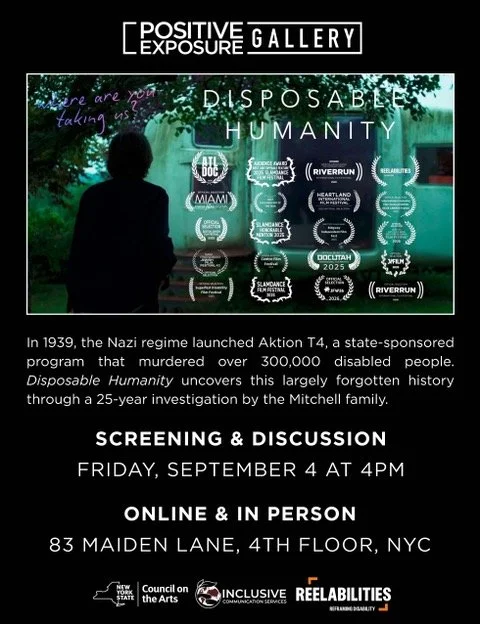
The film was initially released in February 2025 at the Slamdance Film Festival and won the Audience Award. According to Cameron Mitchell, who was at the Positive Exposure screening about six months later in September, it was quite amazing when “Disposable Humanity” won. Once the audience finished their standing ovation, the documentary’s executive director Steve Way was on the stage and announced, “Welcome to the revolution,” which is definitely a way to get people ready for more acceptance to occur! When the film was finished playing in September at Positive Exposure, it too was very well received then. Mostly quiet, but sometimes that can prove HOW MUCH the audience was engaged in the film, which I could definitely tell. There were one or two ASL speakers, which allowed the deaf people who attended be included.
When it came to the Q & A portion of the screening night at Positive Exposure, it went very well. At the forefront, Cameron and one other were the mediators, receiving questions both from those on Zoom and from the live audience. One of the many questions asked was about why T4 is still considered a mercy killing and not a mass suicide. The response is that it’s mostly due do euthanisia simply being a softened word for what happened. It’s also that due to the T4 program pre-dating WWII or beginning just around the time that the second war starts, it was very much a predecessor to Hitler’s “Final Solution” plan that occurred towards the end of the war.
At the end of the day, there were no survivors of the T4 program, which is quite disheartening, but not surprising. One more question that was asked was, “How is the movie impactful?” and I believe it was Cameron who answered it. It was impactful, at least for him, because of the fact that Mr. Mitchell considers himself to be an anthropology filmmaker, meaning that history is forever a living thing. It’s also the fact that when it comes to documentary filmmaking, a camera doesn't have to be used in a certain way; can be ever-moving if needed. Related to this, the younger Mitchell stated more clearly during the Q & A, “Film is an empathy making machine” [...] “Power of cinema”. Diversity and representation in media is important and great stories can help with that, whether that's revealing some hard historical truths of the past, OR seeing oneself FINALLY on screen. One example that comes to mind for me is the character of TJ Kippen on the Disney Channel TV show Andi Mack from 2017, who learns that he has dyscalculia and eventually accepts that part of himself.
Overall, this historical documentary film touches multiple parts of the intersectionality between being disabled and German and living during the Holocaust, whether these Germans were Jewish or not. As much as I myself am grateful to be alive as a Jew and feel lucky to be well supported as an autistic person, my heart does grieve in sorrow for all that happened. Not just the Holocaust itself, but the whole Aktion T4 program as well. The best way to never let something like this happen again or be forgotten is keep telling stories, reminding people of their past(s). If you’re able to see the film, I highly recommend it. Humanity is not disposable.
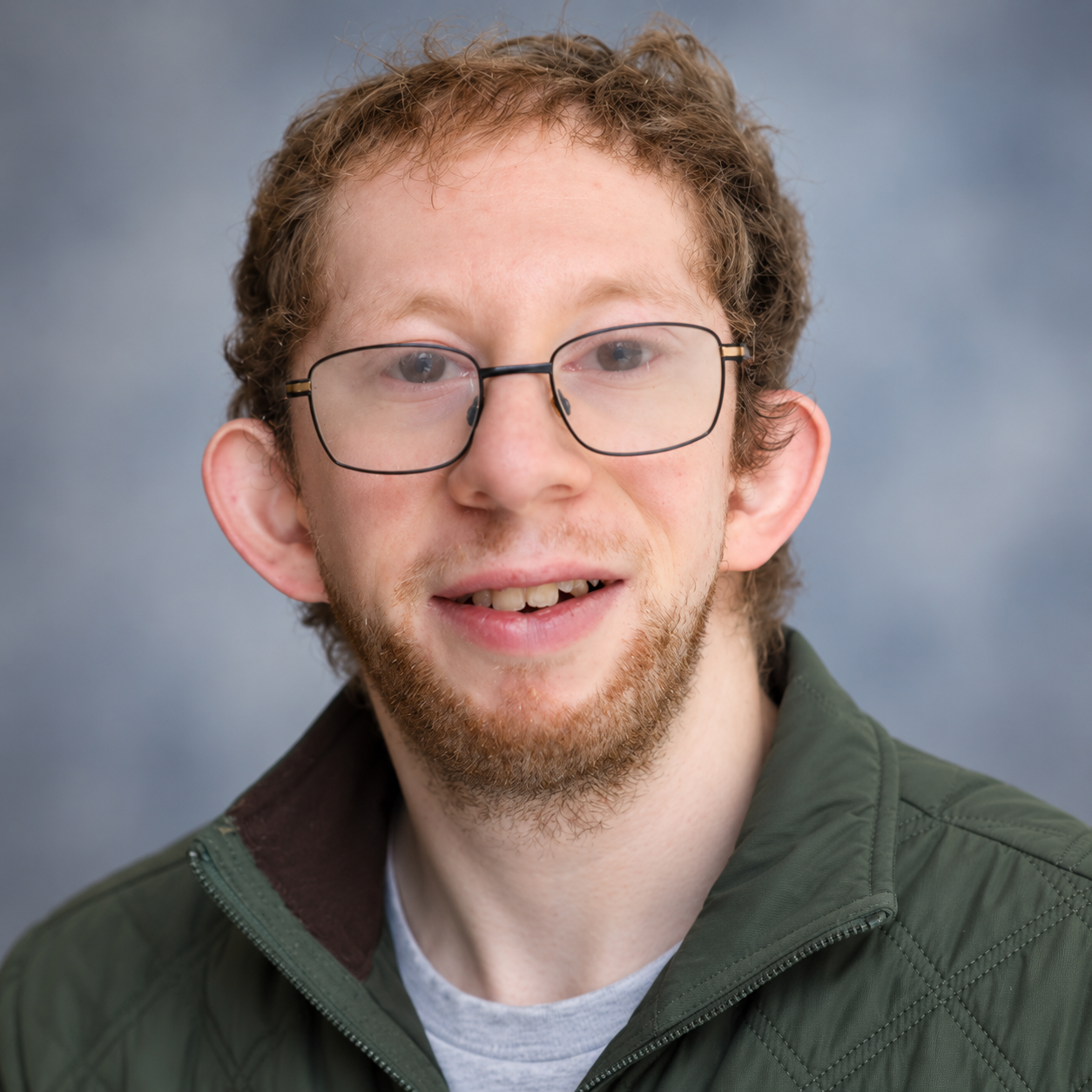
Gideon Lieberman is a Jewish writer with autism who is interested in disability representation, history, film, and the ways media can shape empathy and understanding.