
Exploring Virtual Reality as Assistive Technology
Elena Salgado
Summary: Virtual reality is moving beyond entertainment and into healthcare, rehabilitation, caregiver training, and disability support. This article explores how VR can create safe practice environments, reduce stress, support therapy, and expand access to home-based care and skills training.
Introduction
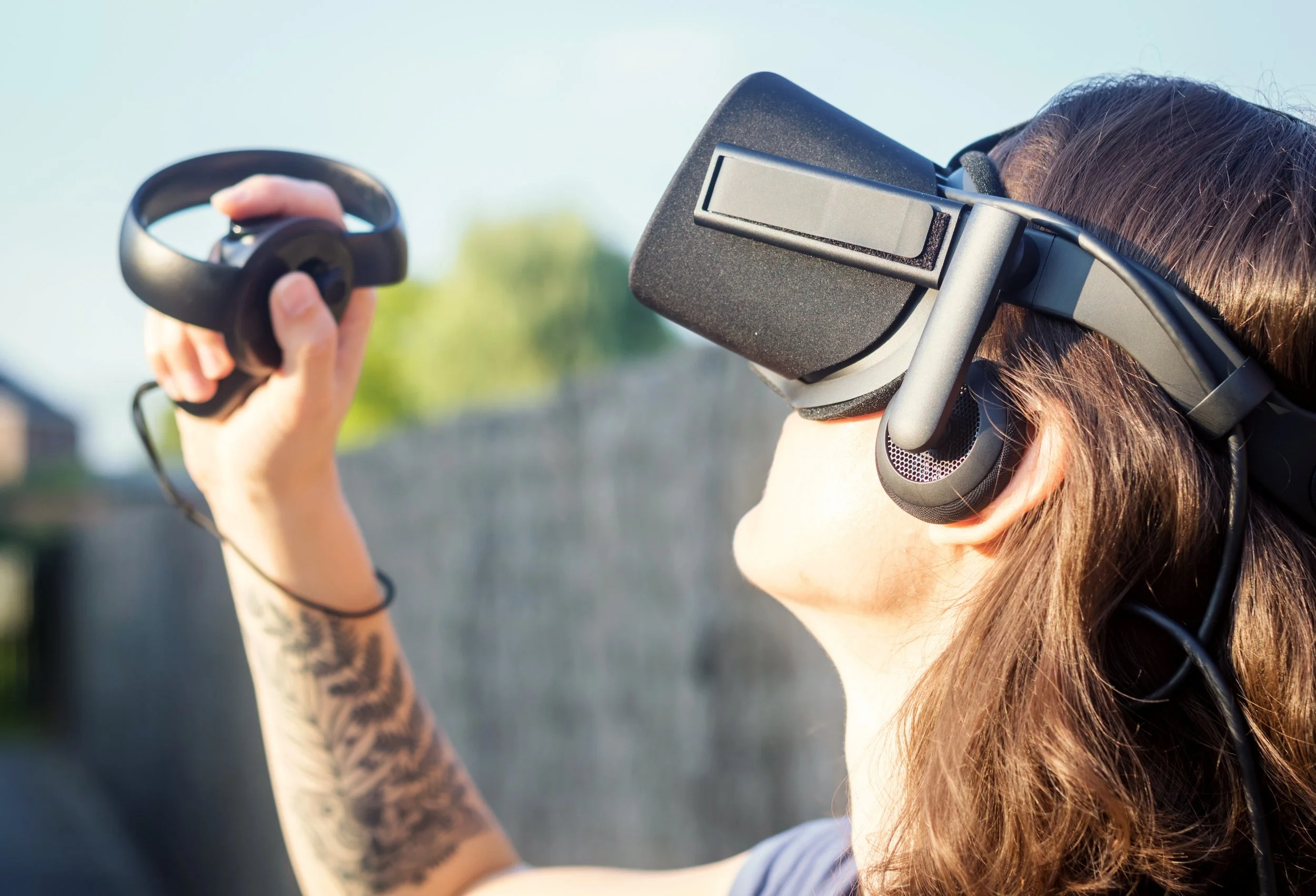
The current American healthcare system has evolved over decades of research and the implementation and evaluation of innovative programs. Specifically, therapeutic frameworks have progressed as federal regulations have been created, medical research has been published, and academics, professionals, and individuals have fought for and prioritized inclusive, equitable, and accessible care. Changes in the psychological field, along with technological development, have inspired the creation of innovative assistive technology (IAT). According to the World Health Organization (2024) IAT helps maintain and improve an individual’s function related to their mobility, cognition, physical senses, and communication skills to support health, well-being, inclusion, and participation in everyday life. IAT can range from wheelchairs, glasses, prosthetic limbs, and hearing aids to artificial intelligence, virtual reality, haptic devices, tactile feedback, speech recognition, eye-tracking, and much more. Virtual reality (VR), specifically, has become a cornerstone in therapeutic practices because of its effectiveness on caregiver competence and empathy, and its promising future in the field. Its success in clinical applications has garnered enough recognition that can, hopefully, allow it to become an accessible alternative in healthcare for those who can physically and cognitively use technology.
VR: Caregivers and Healthcare Providers
To ensure quality care, the field needs literate and knowledgeable professionals who understand the intricacies of mental health and can empathize with their patients. Caregivers, doctors, nurses, and first responders who lack the necessary skills and competencies need further education, which technology-based simulations like VR can provide through practical training essential for caregiving. A systematic review and meta-analysis by Wang et al (2023) found that VR-based interventions effectively improve caregiver competencies. Specially because VR is uniquely suited to help users, as it provides a standardized, low-risk, “safe-to-fail” environment and easily repeatable scenarios. Therefore, VR learning can decrease caregiver and healthcare providers’ anxieties and increase comfort, confidence, and skills.
This article is not advocating for the sole use of VR for learning; instead, it is highlighting how VR can be a useful tool to foster great caregivers and providers, in turn, creating good care. There is a limited number of studies on VR and caregiving, so the results should be acknowledged with caution. Current literature does show VR learning possibly becoming an encouraging alternative for caregivers and healthcare providers, specifically if it is presented through a thorough, innovative, and targeted approach.
Though VR needs more research to solidify it as a good learning tool for all healthcare providers and caregivers, there is extensive research on how it can help with everyday coping. Burnout, anxiety, and a range of maladaptive coping mechanisms are quite common in healthcare, so researchers have created VR interventions to gauge if it can effectively aid in such instances. A 2024 study by Fonseca and colleagues created a controlled study whose results indicate that their VR- intervention had a significant effect on reducing caregiver anxiety. Though their study was conducted at a single academic institution and had a heterogeneous caregiver population, their results still demonstrate that their meditation-focused VR program was regarded as a safe, reliable, and effective tool that should be considered for caregivers seeking to reduce their anxiety.
Chronic stress, anxiety, and fatigue lead to maladaptive coping mechanisms, which are an unhealthy and unhelpful way to deal with problems. A study by Maggio et al. (2025) goes into the responsibilities that healthcare providers and caregivers are assigned, which typically include providing emotional, logistical, and organizational support. The most common cases involve tasks such as mobility support, medication management, financial oversight, and more. In more extreme cases, such as neurodegenerative conditions, responsibilities intensify over time, eventually encompassing feeding, bathing, toileting, lifting, and other complex and physically intensive activities. Such cases lead caregivers and healthcare providers to feel more intense negativity. Studies prove VR interventions have been proven to be a helpful tool to reduce stress and promote resilience. Though the serenity and peace of mind achieved from VR interventions are usually immediate, simple, and brief, it is still a worthwhile alternative that can promote positive changes, improve coping mechanisms, and reduce destructive behaviors. A further advantage is that technologies like VR are rapidly developing, increasingly being used in the medical and therapeutic fields, and are becoming more accessible to the public.
VR: Therapeutic Practices
IATs are emerging tools, changing the healthcare system by providing training and interventions for caregivers and healthcare providers. However, it also shows promising results in therapeutical practices. There is sufficient evidence to support the benefits of VR for a variety of assessment purposes in mental health (Bell et al., 2020). Methodological and individualized programs can be created to capture real-time behavioral, emotional, and psychological signals from VR experiences to reveal important insights. These unique capabilities VR presents could significantly advance the field of mental health by improving clinical methods.
An extraordinary article by Emmelkamp and Meyerbröker (2021) examine various studies that addressed how assessments and treatments relevant to psychiatric symptoms and VR worlds. Just to name a few, they expand on various phobias, post-traumatic stress disorder, attention deficit disorder, anxiety disorders, obsessive-compulsive disorders, addiction disorders, psychosis, autism, and much more. Their article goes into further detail on the treatments, VR programs, VR exposure therapy (VRET), and VR-based avatar interventions, and their successes. Some disorders that have hardly any research published on VR therapy effectiveness, but there is evidence that VR is a viable treatment for other disorders, such as specific phobias, social anxiety disorder, panic disorder, and agoraphobia.
Research on VR interventions is steadily improving as technology and programs evolve. Despite studies’ limitations on sample sizes, there have been positive outcomes that indicate VR can be used for management of motor symptoms in stroke patients, as an add-on treatment for patients with long-standing eating disorders, and much more (Vinas-Diz & Sobrido-Prieto, 2016); (Hansen et al., 2026). VR and its innovative approaches to therapy have been especially helpful in evolving the field. Not only are there new therapeutic frameworks to help, empower, and encourage patients, but it has also become accessible. With VR, patients can now receive treatments at home through VR, and clinicians can still monitor progress, physical symptoms, and emotional signals (Medaris, 2025). The accessibility of VR is one of the biggest advantages this innovative tool has.
Amongst its many advantages, increasing independence and helping with daily-life skills are some of the most essential ones. Growing research shows how VR has become a support that teaches socialization, communication, daily living skills, and improves behavioral reactions to stressful situations. Floreo, a company using VR as IAT, has spearheaded research on how technology can be used to teach social, behavioral, communication, and life skills to neurodiverse individuals and others who can benefit (Floreo, n.d.). Their findings show how immersive VR interventions, developed by leaders in neurodiverse learning, clinicians, therapists, and engineers, can improve social skills in children with autism (Shapiro et al., 2025). The use of such interventions, like that of Floreo’s, has been proven to improve facial recognition, emotional regulation and recognition, social interactions, and body language responses. Floreo’s success was so impactful for social skills that they started creating more VR modules to help with all kinds of skills. There are interventions teaching digital boundaries, interview etiquette, water safety, and much more. Their team is always very conscious and receptive about what their community needs and creates intervention programs as needed.
When Innovation Meets Advocacy
The expansion of VR use has inspired and continues to inspire individuals, programs, academics, organizations, healthcare professionals, and much more. Exciting and promising research on utilizing VR has been seen in Floreo, making them a leader in a movement for neurodiverse communities with their incredible intervention programs designed to be person-centered and inclusive. Due to their exemplary work, the Tennessee Department of Disability and Aging created a grant that allowed six organizations to use Floreo’s immersive intervention programs for various goals. A non-profit organization in Chattanooga, Tennessee, Orange Grove Center, was one of the chosen organizations and will use immersive VR and Floreo to expand access to employment and improve community independence skills. The project is designed around person-centered outcomes and measurable improvements in skill development, focusing on work, community, and self-sufficiency.
The goal is for participants to develop skills related to workplace communication, emotional regulation in stressful situations, and confident decision-making. Furthermore, participants will gain experience by navigating common community interactions, such as public safety, transportation, and online safety scenarios. The expected outcomes for Orange Grove Center and Floreo are measured improvement in confidence in community settings, improved employment readiness, and increased independence in daily activities. Though the project is still in its early stage, Orange Grove Center reports a good and exciting start and has high expectations for its success.
The other five organizations that received the grant had projects akin to Orange Grove’s. Though different in their own way, they mainly focus on community, life transitions, and independence. Therefore, Tennessee’s DDA and Floreo’s use of VR is an important step forward that lays the foundation for enabling technology, like VR, to be an everyday tool for improvement. Floreo’s promising research has led to serious, continuous initiatives to become FDA-approved, to allow families and individuals with financial insecurity a chance to access VR systems through insurance. Additionally, there are multiple alternatives that can help cover such expenses, such as Tennessee’s DDA’s Enabling Technology Program that has approved Medicaid reimbursement for services by Floreo, and services can be accessed through the 1915(c) HCBS Waiver, ECF CHOICES, CHOICES Long-Term Services and Supports Program, among many others.
Conclusion
Innovative assistive technology (IAT) has evolved to be person-centered, equitable, and accessible. Specifically, virtual reality (VR) has become an incredibly useful tool for healthcare and therapeutic practices. VR can provide training through interactive and immersive simulations, providing the practical training essential for caregiving. It can also provide interventions to reduce stress and promote resilience in healthcare providers, caregivers, and others. It can promote positive changes, improve coping mechanisms, and reduce destructive behaviors, making it a great tool for therapeutic practice. VR’s individualized and methodological programs can capture real-time behavioral, emotional, and psychological signals to reveal important insights. The promising research on its capabilities shows incredible potential to advance the mental health field by improving clinical methodology and care. It is exciting to see the embracing of such technology by organizations, institutes, clinicians, government workers, and many others. VR’s use to assist with skills development, mental health, independence, and life transitions only guarantees success and recognition to become accessible as an alternative in healthcare.
About the Author

Mayra Elena Salgado immigrated from Honduras to the United States at age nine. She graduated with highest honors from the University of Tennessee at Chattanooga, where she was inducted into Phi Theta Kappa and the Alpha Society for her academic and research achievements. She currently works as a coordinator for the Family Support Program at a nonprofit organization. Salgado plans to pursue a master’s degree and doctorate in psychology and hopes to become a neuropsychologist contributing to research and advocacy.