
How Down Syndrome International Is Changing the Conversation, Worldwide
Down Syndrome International
Summary: Down Syndrome International (DSi) is a global network of people with Down syndrome, families, and member organizations working to advance human rights, health equity, inclusion, and self-advocacy. This article highlights major achievements from the past three years, including stronger leadership roles for people with Down syndrome within DSi, the publication of the global Our Say in Our Health report, collaboration with the World Health Organization, expansion of the Listen Include Respect guidelines, self-advocacy training across multiple countries, and continued growth of World Down Syndrome Day and the World Down Syndrome Congress. Throughout, one message is clear: lasting change happens when people with Down syndrome are included in decisions and empowered to lead.
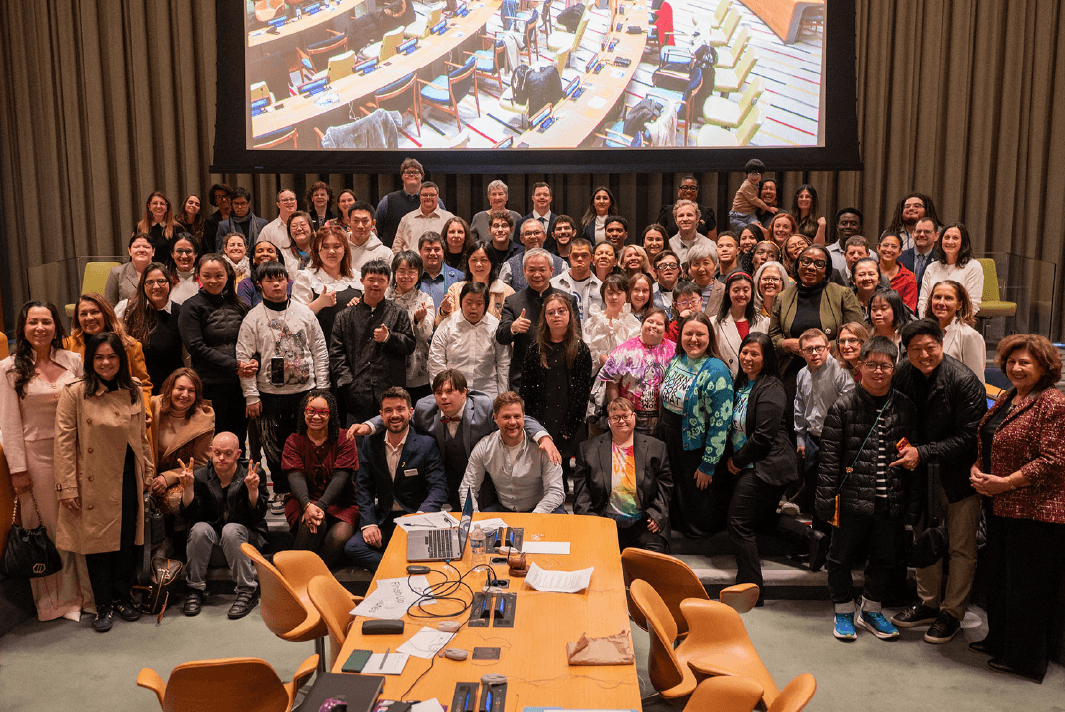
The UN Celebration of International Down syndrome awareness day 3.21.26 (Photo credit: Alison Graham for Positive Exposure)
There are about seven million people with Down syndrome in the world. They live in every country, speak every language, and have every kind of hope and ambition you can think of. But in too many places, they still face the same barriers. Doctors don't listen to them. Schools and workplaces leave them out. Decisions about their lives are made without them.
At Down Syndrome International (DSi), we are working to change that. We are a global network of people with Down syndrome and their families, with member organizations in more than 115 countries. Our purpose is simple: together, we speak up for the human rights of all people with Down syndrome around the world.
This October, for Down Syndrome Awareness Month, we want to share some of what our community has achieved over the past three years. Above all, we want to show what happens when people with Down syndrome lead the way.
Leading from the inside
We believe an organization is strongest when its leaders are the people it exists to serve. So, we have worked to make sure people with Down syndrome have real influence at every level of DSi.
In 2023, Emma Bishop joined our staff as Inclusion and Advocacy Officer. She is the first person with Down syndrome to hold a permanent job at DSi. Emma works across everything we do, from health research to easy-to-read communications. She has spoken at the United Nations in New York and at the Global Disability Summit in Berlin. She was also interviewed by the UN for the International Day of Care and Support.
The same year, Janet Charchuk became the first person with Down syndrome to join our board of trustees. In 2025, Janet co-chaired the Civil Society Forum at the Global Disability Summit, one of the biggest disability events in the world. She also spoke on the main health panel alongside leaders from the World Health Organization (WHO) and government ministers.
Our Ambassadors are self-advocates who represent our member organizations around the world. They help shape our work. This year we welcomed eight new Ambassadors, each mentored by someone who has done the job before them. Experience is passed on, and new voices keep coming through.
Our Say in Our Health
People with Down syndrome often have more health needs than other people. Yet they often get worse care. Many of our members tell us the same story: doctors speak to parents instead of patients, information is hard to understand, and people are turned away from treatment they need. One of our members in Ethiopia told us that people with Down syndrome have been refused life-saving heart treatment because of discrimination by doctors.
We wanted to understand the problem properly, and to hear it from people with lived experience. So in partnership with Humanity & Inclusion, we ran a global consultation. More than 750 people and 118 organizations took part, and the London School of Economics helped us analyze what they told us.
The result is Our Say in Our Health, published in July 2025. It is the first global report on health equity for people with intellectual disabilities. Health equity means everyone gets fair access to good healthcare. The report sets out the barriers people face and what needs to change. We have shared it with governments, the World Bank and the WHO, and it has been translated into Spanish, Arabic, and Chinese.
The report has opened doors. DSi helped the WHO shape its new global guide on health equity for people with disabilities. We were asked to help set up the WHO Disability Health Equity Network, which launched in September 2025. And we now co-chair one of its workstreams, focused on building leadership among people with disabilities and their organizations.
As the WHO said about DSi: "Their leadership, technical expertise and global reach makes them an indispensable partner in our collective effort to advance health and well-being for all."
Evidence only matters if it leads to change on the ground. That is why we started a health equity training programme with five of our member organizations in Kenya, Nigeria, Uganda, South Africa and Tanzania. Each one is now carrying out its own plan to push for better healthcare in its country. We are turning the training into materials that any member organization, anywhere, will be able to use.
We have also set up a health equity network group. The health group has 55 members from around the world.
Listen, Include, Respect
Many organizations say they want to include people with intellectual disabilities, but they don't know how. Our Listen Include Respect guidelines, developed with Inclusion International, give them a practical way to do it.
The guidelines are now available in seven languages: English, Spanish, Arabic, Chinese, Finnish, Indonesian and Portuguese.
The guidelines are no longer just words on a page. Major international organizations are using them. We have helped the Global Disability Fund write guidance on meaningful participation, reviewed a UNICEF resource on gender-based violence, and made a large international website more accessible.
One result stands out. The International Disability Alliance ran a global survey of disability organizations, and almost no one with an intellectual disability took part. Just 1.4% of responses came from this group. After we helped make the survey accessible, that figure rose to 11.9%. The people in the room had changed.
In the UK, we trained two people with Down syndrome as inclusion consultants. They helped build a tool that shows organizations how inclusive they are and what to do next. They presented their work at the World Down Syndrome Congress in Brisbane, and they have trained staff in the National Health Service. The UK Department of Health and Social Care now lists the guidelines as a resource for health, social care, education and housing authorities.
We have also started a "Train the Trainer" programme, first delivered in Toronto, Canada. It means more people can teach the guidelines in their own communities, without DSi having to be in the room.
Self-advocates, speaking for themselves
Self-advocacy means people with Down syndrome speaking up for their own rights. It is at the heart of everything we do.
In July 2025, our team travelled to Hangzhou, China, to deliver the first training of its kind there. Twenty self-advocates, family members and support staff took part over four days. Since then, they have set up their own WeChat group to keep learning together. Some of the self-advocates we trained are now running their own sessions on the UN Convention on the Rights of Persons with Disabilities. They have gone from learning about their rights to teaching others about them.
China is the latest country in a long line. We have run similar training in the UAE, Turkey, Kosovo, Nigeria, Kenya, Uganda and Bangladesh. We have also published a Self-Advocacy Group Guide, a practical resource to help anyone start and run a self-advocacy group.
To help our members learn from each other, we set up a self-advocacy network group. The group is mapping where self-advocacy is happening across our network, so we can see where support is needed most.
A global community
Every year on 21 March, we bring the world together for World Down Syndrome Day. The date, 21/3, stands for the third copy of chromosome 21 that people with Down syndrome have. Each year has a theme that tackles a real barrier. In 2026, it was Together Against Loneliness, focused on one of the biggest and least talked-about challenges people with Down syndrome face.
People with Down syndrome plan and speak at our World Down Syndrome Day conferences at the United Nations in New York and Geneva. Around the world, thousands of people join in with Lots of Socks, wearing bright, odd or unusual socks to get people talking. Around 15,000 pairs of official socks are sold each year.
Every three years, the World Down Syndrome Congress brings our whole community together in person. The 2024 Congress in Brisbane, Australia, drew more than 1,000 people. One young advocate said afterwards: "Coming out of Congress, I felt inspired… like everyone, I want to be included. I want to feel like I am achieving something – like I matter."
Next year, from 22 to 25 September 2027, the Congress travels to Argentina, the first time it will be held in Latin America since 1983.
What our members tell us
The best measure of our work is what our members say. From Bangladesh, the Down Syndrome Society told us DSi helps people there "be connected to the global network – as one voice." In Georgia, our member said the messages we produce each year for World Down Syndrome Day are ones they "use all year." And from Rwanda came the words that stay with us most: "Without DSi we would not be existing."
Looking ahead
There is much more to do. Over the next few years, we will keep pushing for better healthcare, growing inclusion work across our network, and supporting more self-advocacy groups to start and thrive.
This Down Syndrome Awareness Month, we invite you to be part of it. Visit ds-int.org to read Our Say in Our Health, explore the Listen Include Respect guidelines, or find a Down syndrome organization in your own country. Share the stories of people with Down syndrome in your life. And whenever decisions are being made, ask one simple question: who is missing from the room?
Nothing about us without us. That is how change happens.