
Closing The Disability Data Gap
By Daniella Donshik
Summary: Without consistent disability-status and accommodation data in electronic health records, healthcare systems cannot reliably identify disparities, monitor access to services, or measure whether care is meeting the needs of people with disabilities. This article calls for standardized data collection and stronger disability-inclusive quality measures to support health equity, informed policy, and more responsive care.
The Problem
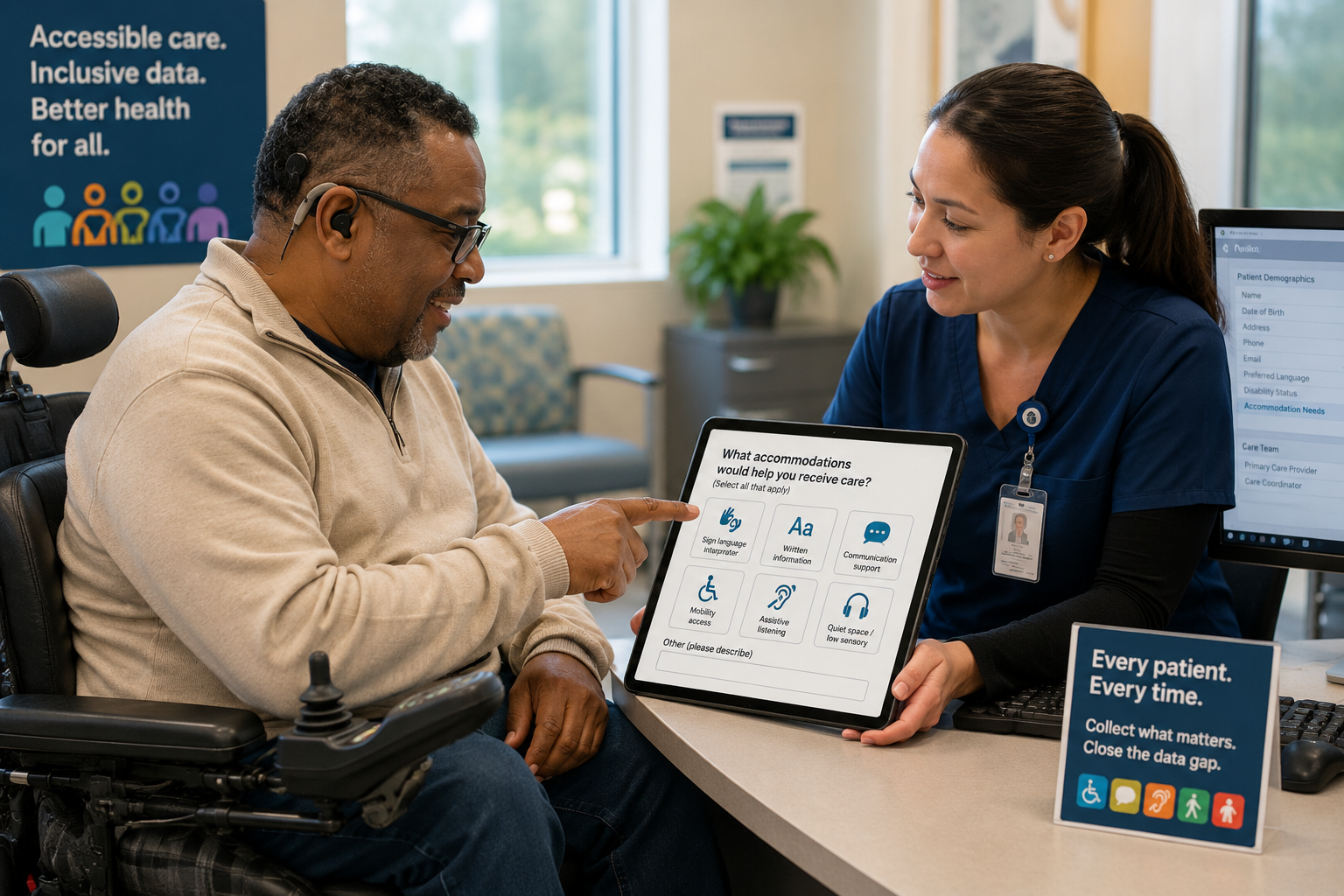
There is currently no federal mandate requiring healthcare systems to collect and record disability status and accommodation needs in Electronic Health Records (EHRs).1
Mandating the collection of disability status would not require new laws or infrastructure, as the tools already exist. ONC- and USCDI-certified EHR systems are capable of collecting standardized demographic information, and existing federal interoperability frameworks support the exchange of standardized data across healthcare systems and providers.2,3 However, disability status and accommodation needs are not consistently required demographic data elements.
As a result, there is a lack of standardized data needed to identify and monitor health disparities experienced by people with disabilities.4 This data gap limits the ability to:
Identify disparities in healthcare access and outcomes.
Monitor inequities in access to home- and community-based services (HCBS).
Understand factors contributing to unnecessary institutionalization.
Support evidence-based policy development and quality improvement initiatives.
Current disability data collection methods, including the ACS-6, primarily measure functional limitations.5 While valuable, these tools may not fully capture the diversity of experiences across the broader disability community, leaving some individuals underrepresented in existing datasets.
Standardized collection of disability status and accommodation needs would improve understanding of quality of care and patient experiences. Improved data collection would strengthen health equity efforts to identify disparities, support more informed policymaking, and help ensure healthcare systems are responsive to the needs of the disability community.
Recommendations
Standardize the collection of disability status and accommodation data across healthcare settings.
Advance disability inclusion within federal health equity initiatives and reporting programs.
Encourage the development and adoption of disability-related quality measures and reporting standards that
extend beyond existing functional limitation surveys.
About the Author

Daniella Donshik is currently an intern with People Advocating for Optimal Health (PAOH). She is a Master of Public Health candidate in Health Policy and Management at the New York University School of Global Public Health. Daniella earned her Bachelor of Science in Psychology with an emphasis in Behavior Analysis from the University of Florida in 2024 and has contributed to public health and clinical research as a research assistant. She is a member the Fundraising and Development Committee and serves as Head of Fundraising for the Emerging Leader Board for Project Lyme. Her interests include disability rights and healthcare access, with a particular focus on advancing equitable healthcare outcomes for individuals with disabilities and chronic illnesses.
People Advocating for Optimal Health (PAOH) is dedicated to advancing equitable healthcare access for people with disabilities and improving quality of life across the disability community. Learn more at paoh.org.
References:
National Council on Disability. Framework to End Health Disparities for People with Disabilities. 2025.
Office of the National Coordinator for Health Information Technology (ONC). United States Core Data for Interoperability (USCDI). U.S. Department of Health and Human Services.
Office of the National Coordinator for Health Information Technology (ONC). 21st Century Cures Act: Interoperability, Information Blocking, and the ONC Health IT Certification Program Final Rule. U.S. Department of Health and Human Services, 2020.
National Council on Disability. Framework to End Health Disparities for People with Disabilities. 2025.
Office of the National Coordinator for Health Information Technology. USCDI Data Element: Disability Status. U.S. Department of Health and Human Services, 2026.