
From Our Friends
We are happy to share news from our partner organizations because, as Helen Keller once said, “Alone we can do so little; Together we can do so much.”
Study Finds ADHD Drugs May Work Differently Than Scientists Once Thought
January 7, 2026 (HealthDay News) — For decades, doctors assumed ADHD medications like Ritalin and Adderall work by fixing problems in the brain’s attention system.
A new study suggests that assumption may be wrong.
Instead of acting on attention centers, these stimulant drugs appear to target the brain’s reward and wakefulness centers, according to new research published in the journal Cell.
“When I first saw the results, I thought I had just made a mistake because none of the attention systems are changing here,” study author Dr. Benjamin Kay, a professor of neurology at Washington University School of Medicine in St. Louis, told The Washington Post.
The researchers analyzed brain scans from nearly 5,800 8- to 11-year-olds who took part in the long-running Adolescent Brain Cognitive Development study.
Some had taken prescription stimulants on the day of their scan. Others had not.
When scientists compared the two groups, they found clear differences — but not where they expected. The drugs increased activity in brain regions tied to reward and wakefulness, not attention.
That doesn’t mean the medications don’t help.
“The paper clearly shows that they help,” study co-author Dr. Nico Dosenbach told The Post. “They help kids who have a diagnosis of ADHD do better in school and do better on tests, and they help kids who don’t sleep enough ― and a lot of Americans don’t sleep enough.”
Dosenbach, who is also a professor of neurology at Washington University, explained that the drugs may help by making boring tasks feel more rewarding.
They “pre-reward our brains and allow us to keep working at things that wouldn’t normally hold our interest,” he added.
ADHD affects an estimated 7 million U.S. children ages 3 to 17, and about 15.5 million adults. Rates among children rose from 6.1% in the late 1990s to more than 10% by 2016, one study found.
The new study also highlighted the role of sleep.
The stimulants not only helped kids with ADHD, but also children without an ADHD diagnosis who slept less than the recommended nine hours a night.
But the medications didn’t improve school performance in children who slept well and did not have ADHD.
In short, sleep matters a lot, experts said.
“Despite the name ‘Attention Deficit,’ ADHD is a multifaceted disorder in which difficulty focusing attention is just one component,” said Maggie Sweitzer, a psychiatry professor at Duke University School of Medicine in Durham, North Carolina, who reviewed the findings.
“It’s important to remember that ADHD is not a benign condition — individuals with ADHD are not only at risk for school problems in childhood, but also for occupational, social, and physical, and mental health problems across the lifespan. For many people these medications are transformative,” Sweitzer added.
Jessica Lunsford-Avery, a child development and behavioral health specialist at Duke, also reacted to the findings.
“Sleep disturbances are incredibly common in ADHD, impacting about 3 out of 4 children and adolescents with the disorder,” she told The Post in an email.
“It is increasingly clear that clinicians and families should view ADHD as a 24-hour disorder,” Lunsford-Avery added. “Unfortunately, sleep problems are rarely recognized or adequately treated in children and adolescents with ADHD.”
Doctors emphasize that prescription stimulants are not the same as energy drinks or caffeine.
Dr. Sinan Omer Turnacioglu of Children’s National Hospital in Washington, D.C., noted that prescription stimulants “don’t work in the exact same way in the nervous system.”
He added that healthy sleep habits such as limiting screen time before bed and having a calming routine are important.
SOURCE: The Washington Post, Jan. 6, 2026. Copyright © 2026 HealthDay. All rights reserved.
Alzheimer’s Disease & Down Syndrome: What a New Study Means for Families
Written by Seth M. Keller, MD, FAAN, Past President AADMD, Co-President NTG
Based on research published in JAMA Neurology, January 2026
Why This Study Matters
Adults with Down syndrome are at higher risk for Alzheimer’s disease because of genetic differences. This new research helps explain how changes in the brain relate to changes in memory and thinking—and what that means for care, planning, and hope for the future.
What Did Researchers Study?
Researchers studied adults with Down syndrome using brain scans that detect Alzheimer’s disease changes, memory and thinking tests designed for people with Down syndrome, and clinical evaluations. They asked whether brain changes usually match how someone is functioning day to day.
Key Findings in Plain Language
• In most adults with Down syndrome, Alzheimer’s disease brain changes matched memory and thinking abilities.
• This match was much stronger than what is usually seen in the general population.
Why this matters: Doctors and families can have more confidence that testing reflects what is really happening.
Some People Show Resilience
Some adults had Alzheimer’s disease changes in their brain but were doing better cognitively than expected. These individuals were generally younger and had less severe brain changes but did not differ in baseline intellectual disability.
Why this matters: Some people may have protective factors that delay symptoms. Understanding this resilience could help guide future treatments.
Why Memory Testing Is Important
A specialized memory test designed for adults with Down syndrome helped improve accuracy in identifying changes and matching symptoms with brain findings. This supports the importance of routine, appropriate cognitive screening.
Why Down Syndrome Is Important for Alzheimer’s Research
Alzheimer’s disease in Down syndrome follows a more predictable pattern and is less affected by other brain diseases. This makes adults with Down syndrome especially important for early detection studies, prevention research, and clinical trials.
What This Does Not Mean
• It does not mean everyone with Down syndrome will develop dementia at the same age.
• It does not mean symptoms cannot be delayed.
• It does not replace the need for individualized care and monitoring.
Bottom Line
This study shows a clearer connection between Alzheimer’s disease brain changes and symptoms in adults with Down syndrome. It also highlights hopeful signs of resilience and reinforces the importance of ongoing research, early monitoring, and supportive care.
Russell, J. K., Schlachetzki, Z., Ances, B. M., et al. Concordance of Biological and Clinical Staging of Alzheimer Disease Pathology in Down Syndrome. JAMA Neurology. Advance online publication. January 12, 2026.
Supporting People as They Age: A Guide for Using Charting the LifeCourse
Direct support professionals (DSPs) are the backbone of support for people with disabilities across the lifespan but DSPs’ role becomes especially powerful as people age. With time, support needs can become more complex. Health concerns may grow. Family dynamics may shift. Individuals may begin to ask: “What does my next stage look like?” This is where DSPs step in—not just as caregivers, but as trusted partners who listen, reflect, and support people in shaping what aging with dignity and intention can look like.
Charting the LifeCourse (CtLC) is a framework that professionals use every day to support people in thinking about their lives in a way that is personal, flexible, and rooted in what matters most to them. For DSPs, CtLC offers tools that help guide real conversations, not just about services, but about what brings meaning to someone’s day, what they want more of, and what concerns them about growing older.
For DSPs, Charting the Lifecourse offers tools that help guide real conversations, not just about services, but about what brings meaning to someone’s day, what they want more of, and what concerns them about growing older.
The CtLC Aging Life Stage guide is one of our go-to resources when supporting people through transitions. The guide helps identify the common questions and experiences that come with aging: things like changes in health, housing, retirement, relationships, and end-of-life planning. More importantly, it gives DSPs ways to start these conversations without overwhelming the person. It’s not about checking boxes. It’s about noticing what’s shifting and asking: What does a good life look like now? What does this person need to feel secure, included, and in control?
The Charting the LifeCourse Integrated Star
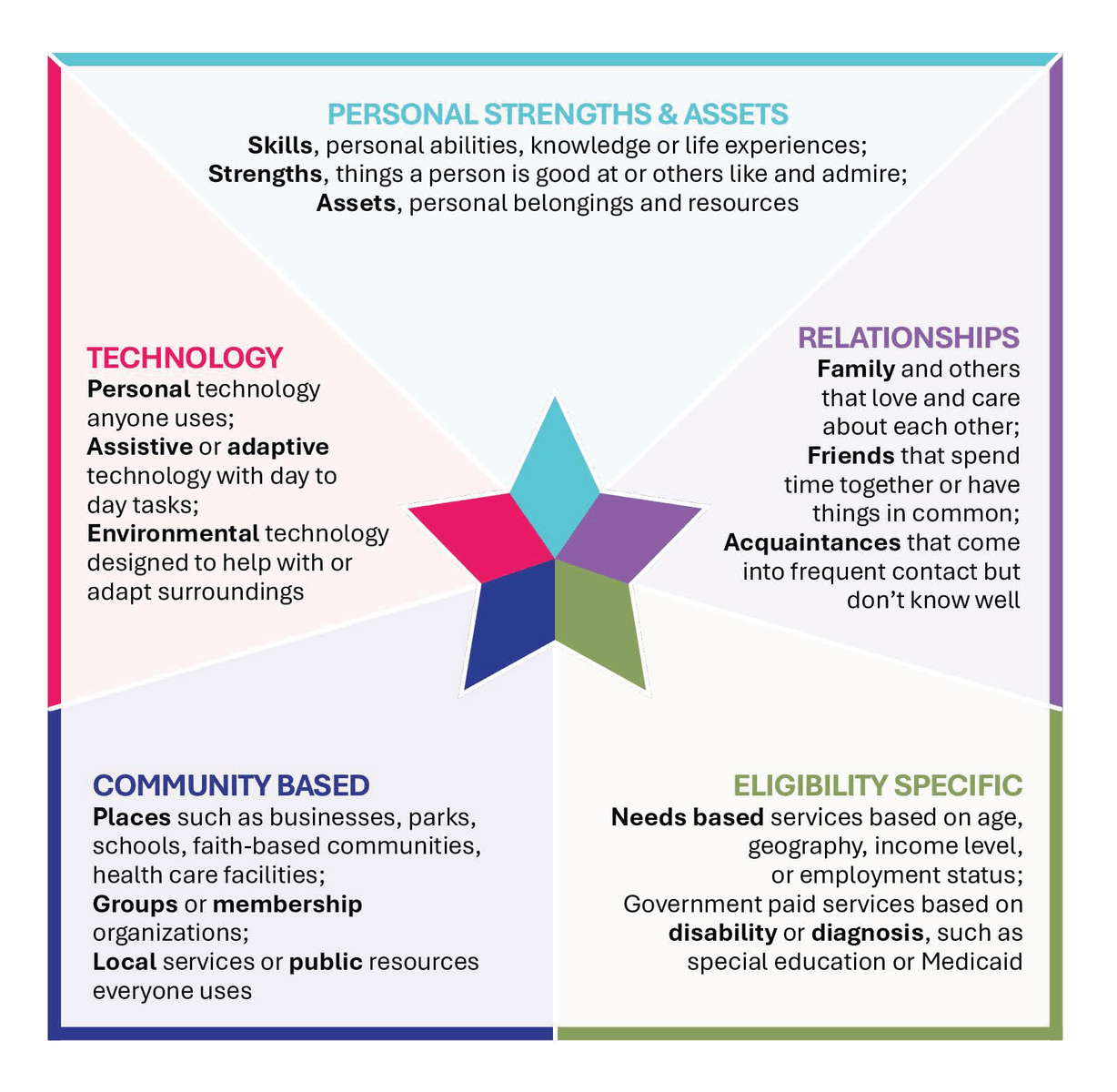
At the center is a 5-point star, each ray is a different color and has a description. The star ray pointing up is teal blue. It represents personal strengths and assets. Skills, personal abilities, knowledge or life experiences; strengths, things a person is good at or other like and admire; assets, personal belongings and resources. Purple represents relationships. Family and others that love and care about each other; friends that spend time together or have things in common; acquaintances that come into frequent contact but don’t know well. Olive green represents eligibility specific. Needs bases services based on age, geography, income level, or employment status; government paid services based on disability or diagnosis, such as special education or Medicaid. Navy blue represents community based. Places such as businesses, parks, schools, faith-based communities, health care facilities, groups or membership organizations, local services or public resources everyone uses. Red represents technology. Personal technology anyone uses; assistive or adaptive technology with day to day tasks environmental technology design to help with or adapt surroundings.
We often use the Life Trajectory to help people think about what they want next, even if they’re not sure where to start. Some people may be thinking about retiring or spending more time with family. Others might want to volunteer, reconnect with friends, or stay active in their community. Mapping out what they want more of and what they want to avoid can bring clarity and direction. Then we use the Integrated Star to explore how to make that vision possible by looking at all types of supports, from technology and relationships to local resources and formal services.
As people age, health conversations become more common. CtLC’s health and decision-making tools are especially helpful for DSPs who are supporting someone through medical changes. The Exploring Decision-Making Supports tool, for example, helps individuals communicate where they want support and where they want to stay in charge. We’ve seen how this tool helps DSPs feel more confident and aligned with the person they support, especially when appointments, medications, or big decisions come up.
DSPs are often the first to hear comments like, “I’ve been feeling more tired lately,” or “I wonder what it would be like to slow down.” These moments are invitations.
You don’t need to wait for a planning meeting to use these tools. Some of the most powerful conversations happen during the in-between moments on a walk, at lunch, or driving to an appointment. DSPs are often the first to hear comments like, “I’ve been feeling more tired lately,” or “I wonder what it would be like to slow down.” These moments are invitations. Charting the LifeCourse helps turn them into opportunities for deeper understanding and gentle planning. At Nexus, we say that CtLC is not a program; it’s a way of thinking. For DSPs, it’s a mindset that recognizes the depth of your relationship with the person you support. You notice the shifts, you listen to and experience the stories, and you are often the one who walks through change with them. CtLC doesn't replace that; it helps bring even more meaning and direction to what you're already doing.
If you’re new to CtLC, just try one tool. Print a Life Trajectory and explore it together. Ask someone what they hope for as they grow older. Then listen. The tools don’t lead the conversation—the person does. And that’s exactly the point.
You don’t need a new title or more credentials to support someone through aging. You’re already doing this work with so much care. Charting the LifeCourse is here to support you with tools, connection, and a community that values what you do.
Learn more and explore free resources:
Stay connected: Join the LifeCourse Nexus email list or follow us on social media. Learn more about upcoming resources and opportunities. Subscribe to Frontline Initiative.
Authors:
Michelle C. Reynolds is Senior Associate Director of the University of Missouri Kansas City - Institute for Human Development and Director of the LifeCourse Nexus Training and Technical Assistance Center. Michelle can be reached at reynoldsmc@umkc.edu.
Colette Canchola is Director of Missouri Family to Family. Collette can be reached at colette.canchola@umkc.edu.
Empowering People In Making Their Own Choices
January 20, 2026 | by John Raffaele
The following article is part of an ongoing series about the NADSP Competency Areas. The NADSP Competency Areas offer DSPs the opportunity to address challenges, work on issues identified by the person they support, or assist a person in pursuing a particular goal. Each Competency Area has corresponding skill statements that describe the knowledge and skills DSPs must have to demonstrate competency in each area.
This blog is about the skill statement “The competent DSP assists and supports the participant to develop strategies, make informed choices, follow through on responsibilities, and take risks,” within the NADSP Competency Area: “Participant Empowerment.”
Inside The Competency Area
Participant Empowerment
As we start off the new year, 2026 is the perfect time to cover Participant Empowerment. It means so much to people who have disabilities. Feeling empowered can have a positive impact on mental health, self-esteem, and ultimately, being independent in life. Understanding and embracing the competency of Participant Empowerment is essential because it places the person supported at the center of their own life decisions and growth.
When a DSP assists people to develop strategies, make informed choices, and follow through on responsibilities, they are fostering autonomy, confidence, and self-determination. Supporting people to take appropriate risks is something that DSPs do all the time. Rather than shielding them from all challenges, good DSPs will honor the right for people they support to learn from experiences and build resilience. Competent DSPs balance guidance with respect, helping people weigh options, understand consequences, and pursue their goals. This approach leads to more meaningful outcomes, stronger skills for independence, and lives that are directed by the person, not the system.
The competent DSP assists and supports the participant to develop strategies, make informed choices, follow through on responsibilities, and take risks.
Competency Area: Participant Empowerment
Inside The Skill Statement
The competent DSP assists and supports the participant to develop strategies, make informed choices, follow through on responsibilities, and take risks.
At its core, direct support work is about empowering people to live lives that reflect their own values, preferences, and aspirations. By centering people supported in their own informed decision-making, DSPs reinforce the belief that people are capable and knowledgeable regarding their own lives. People deserve to have control over their choices.
Embracing Participant Empowerment also strengthens trust and helps build authentic relationships. When DSPs support informed decision-making, and follow-through, people supported experience respect rather than control. This increases engagement and motivation and allows room for appropriate risk-taking. It is critical in person centered practice. Growth, confidence, and resilience are built through real-world experiences, not through constant protection. DSPs who skillfully balance safety with dignity help people learn from successes and setbacks alike.
Ultimately, this approach aligns with person-centered practices and ethical support. It moves services away from compliance-driven systems toward outcomes that reflect real independence, accountability, and personal growth. This works to ensure that support enhances people’s lives rather than limit them.
The Impact On People Receiving Services
Empowering people with disabilities affirms their right to direct their own lives and make meaningful choices. When DSPs practice Participant Empowerment, people gain greater control over daily decisions and long-term goals. DSPs can foster confidence, self-esteem, and a stronger sense of identity. Being supported to make informed choices and take appropriate risks allows people to learn from experience, develop problem-solving skills, and build resilience.
Rather than being protected from challenges, people are trusted to grow through them. Empowerment also leads to more natural and meaningful community participation, as people pursue activities, relationships, and roles that matter to them. These experiences strengthen independence, self-advocacy, and personal responsibility. Most importantly, if DSPs are intentional about their practice and use this competency area, it shifts services away from compliance and dependence, toward enhanced dignity, purpose, and self-determination. It can help ensure that people with disabilities are not just supported but truly respected as capable decision-makers in their own lives.
Putting It All Into Practice
Participant Empowerment as a competency is practiced daily through actions and interventions that promote choice, voice, and control for people receiving support. DSPs should begin by actively listening and seeking to understand each person’s preferences, goals, and concerns, rather than making assumptions or decisions on their behalf. Offering real choices about routines, activities, relationships, and supports – and honoring those choices whenever possible – reinforces autonomy and self-determination.
DSPs can support empowerment by helping people develop strategies to solve problems, make decisions, and plan next steps. Informed decision making is a highly complex skill. This may include breaking tasks into manageable parts, using visual support, or talking through options and possible outcomes. Encouraging follow-through on responsibilities, while providing appropriate reminders or support, helps people build confidence and accountability as the person supported makes independent decisions.
Practicing participant empowerment also means supporting people to take reasonable and informed risks. DSPs should balance safety with dignity, discussing potential consequences and facilitating opportunities for learning and growth, instead of automatically preventing risk. When mistakes happen, DSPs can frame them as chances for growth rather than failures.
Additionally, DSPs can advocate alongside people they support, encouraging them to speak up for themselves in meetings, in the community, or within service systems. By modeling respect, patience, and belief in each person’s abilities, DSPs create environments where people feel valued and capable. Over time, these daily practices lead to increased independence, stronger self-advocacy skills, and lives that are truly directed by the person.
Quick Tips
How can you help embrace this skill statement and implement it? Here are some quick tips!
Begin by actively listening and seeking to understand each person
Help people develop strategies to solve problems, make decisions, and plan next steps
Be sure to balance safety with dignity of risk
Honor the right for people to learn from experience and help them build resilience
Encourage follow-through on responsibilities, while providing appropriate reminders

Restraint and Seclusion Toolkit
The toolkit below is intended to support advocates who wish to get involved with restraint and seclusion advocacy efforts at the federal level. Resources included in the toolkit are intended to be shared with elected officials and their staff and may include facts and
statistics that are new or upsetting to some community members. If you would like to contact a member of our policy team about the information found in these resources, please email policy@ndss.org.
Overview on Restraint and Seclusion
Restraint is defined as the act of controlling behavior or restricting freedom of movement. There are several kinds of restraints:
Chemical restraint uses drugs or medication that have not been prescribed by a licensed physician or administered by a qualified health professional.
Mechanical restraint is the utilization of devices to restrict a student’s movement.
Physical restraint is the use of physical force to immobilize or reduce the free movement of a student’s arms, legs, torso, or head. Seclusion is the involuntary confinement of a student alone in an area where the student is prevented from leaving.
Restraint and seclusion practices disproportionately impact students with disabilities. Although students with disabilities receiving special education services under IDEA make up only 14% of the total K-12 enrollment, they account for 28% of mechanical restraint, 76% of physical restraint, and 68% of seclusion incidents.
Keeping All Students Safe Act
At the federal level, NDSS supports the Keeping All Students Safe Act (KASSA). This bill would prohibit the use of mechanical restraint, chemical restraint, and seclusion. KASSA will also limit instances in which physical restraint can be used, allowing it only when there is an imminent threat of physical harm to others in the classroom. This bill will direct the Department of Education to give grants to state education agencies to provide training to faculty on alternatives to restraint and seclusion, and to collect more data.
The Keeping All Students Safe Act (S. 3448 / H.R. 6617) was introduced on December 12th, 2025 by Senators Sanders (I-VT), Murray (D-WA), and Murphy (D-CT) and Representatives Beyer (D-VA), Scott (D-VA), and Hamadeh (R-AZ).
We need YOU to reach out to your Members of Congress and ask them to cosponsor this important piece of legislation! End harmful restraint and seclusion practices in schools.